With the holiday travel season quickly approaching, there is expected to be an increased number of travelers at airports across the U.S., and therefore significantly more people attempting to connect to free airport Wi-Fi at the same time.
Stable connections for free Wi-Fi hot spots can be a hassle in any location, but airport travel offers a unique situation, where internet speed options can vary depending on whether they are free or paid, or a perk of another subscription service.
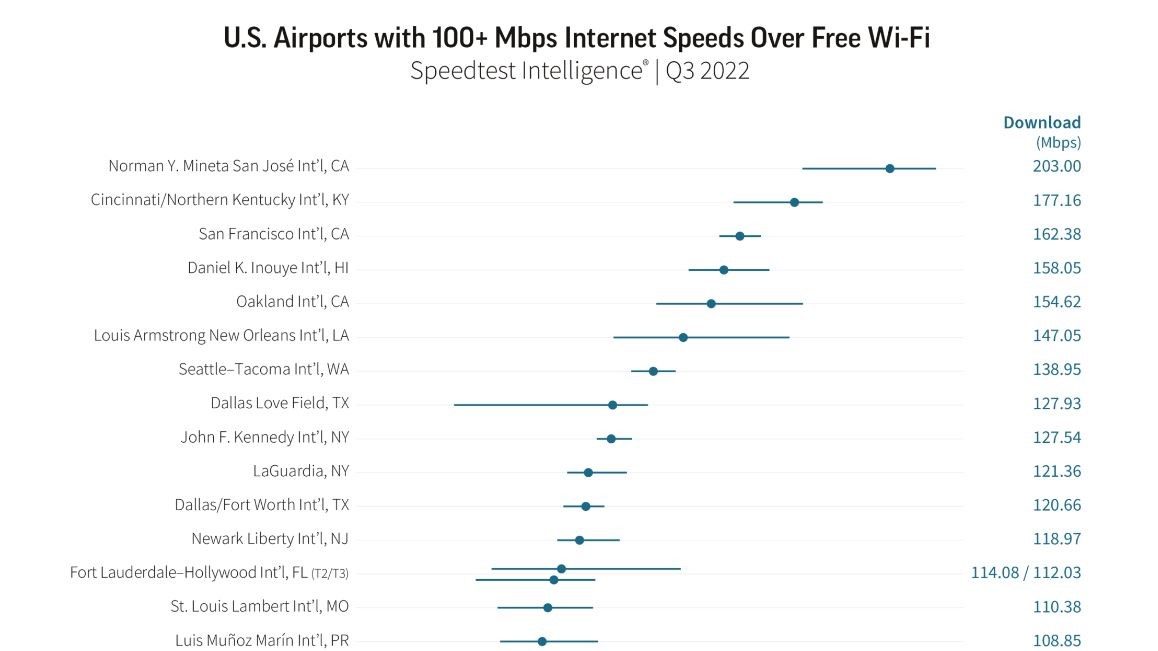
Researcher Isla McKetta at Ookla shared the results of an analysis done primarily on the free Wi-Fi connections at 50 of the busiest airports in the U.S. to determine which has the fastest and most reliable connectivity. The results concluded that 17 airports on the list had fast Wi-Fi connections with speeds over 100 Mbps.
Having conducted tests during the third quarter of 2022, the researcher determined that the top three busiest airports with the fastest free Wi-Fi speeds are Norman Y. Mineta San José International Airport in California with median download speeds of 203.00 Mbps, Cincinnati/Northern Kentucky International Airport with download speeds of 177.16 Mbps, and San Francisco International Airport with download speeds of 162.38 Mbps. McKetta noted that travelers at these airports should have no issue with connectivity as long as their devices hold a consistent charge.
Also shared are the 20 busiest airports with free Wi-Fi download speeds between 50 to 100 Mbps. Topping this list includes John Wayne Airport in California with a median download speed of 97.20 Mbps, Fort Lauderdale-Hollywood in Florida, which hosts two high-speed service connections with download speeds of 96.49 Mbps and 88.71 Mbps, Detroit Metropolitan Airport in Michigan with download speeds of 85.85 Mbps, and Washington Dulles International Airport in Virginia with download speeds of 84.70.
Wi-Fi between 20 to 40 Mbps would still not be bad for the average public Wi-Fi.
The next tier is the 12 busiest airports with free Wi-Fi download speeds below 50 Mbps. Some locations on the top of this list include Raleigh-Durham International in North Carolina with a median download speed of 48.40 Mbps, Charlotte Douglas International in North Carolina with a download speed of 45.2 Mbps, and Denver International, Colorado with a download speed of 42.71 Mbps and 41.61 Mbps between different connection points.
Typically, Wi-Fi connections between 20 to 40 Mbps would still not be bad for the average user of public Wi-Fi to connect and browse. However, the researcher noted that these airports are notorious for their high-traffic travel days as well as travel delays. These instances might keep travelers waiting long hours and put a lot of strain on Wi-Fi connections.
Some of the slowest connections on the list include Pittsburgh International Airport in Pennsylvania with a median download speed of 5.23 Mbps, George Bush Intercontinental Airport in Texas with a download speed of 8.79 Mbps, and William P. Hobby Airport in Texas with a download speed of 8.90 Mbps.
McKetta noted that travelers who are concerned about their Wi-Fi options at airports can use the Speedtest app to get an idea of what connectivity they might encounter as they embark on their trips. The app is available for Android or iOS as well as Windows, Mac, Chrome, and other platforms.