1. Home
  2. Space
  3. News

Hubble and Spitzer spot two far-off watery worlds

Add as a preferred source on Google

While we have discovered over 5,000 exoplanets to date, most of the information we have about these planets is fairly basic. Researchers typically know about a planet’s mass or radius and its distance from its host star, but little more than that, making it hard to predict what these worlds are actually like. However, new tools and techniques are allowing researchers to learn more about details like a planet’s density, allowing a better understanding of what these places are like.

Recently, researchers using data from the Hubble Space Telescope and Spitzer Space Telescope have identified two planets that seem to be water worlds, with oceans that are 500 times deeper than the oceans on Earth.
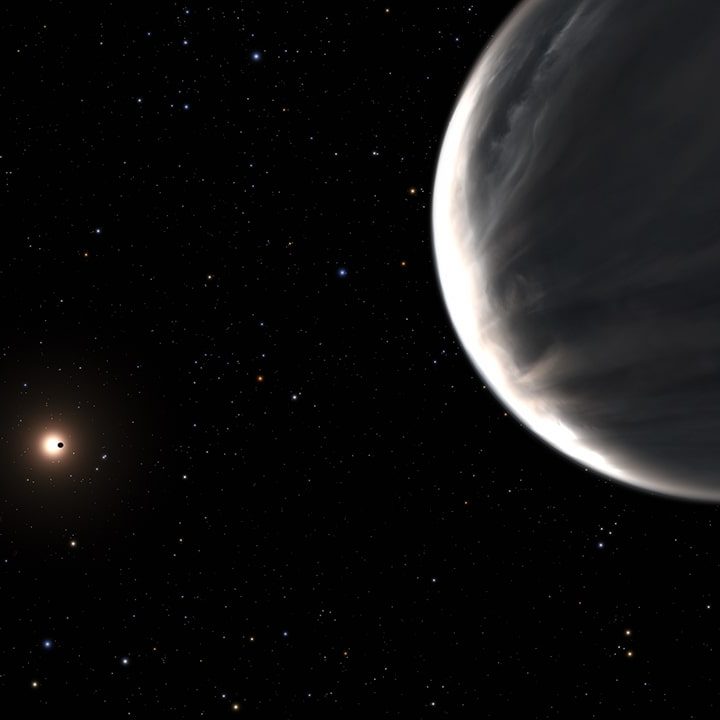
In this illustration super-Earth Kepler-138 d is in the foreground. To the left, the planet Kepler-138 c, and in the background the planet Kepler 138 b, seen in silhouette transiting its central star.
In this illustration super-Earth Kepler-138 d is in the foreground. To the left, the planet Kepler-138 c, and in the background the planet Kepler 138 b, seen in silhouette transiting its central star. Kepler 138 is a red dwarf star located 218 light-years away. The low density of Kepler-138 c and Kepler-138 d — which are nearly identical in size — means that they must be composed largely of water. ILLUSTRATION: NASA, ESA, Leah Hustak (STScI)

The planets Kepler-138 c and Kepler-138 d were first identified by the Kepler Space Telescope in 2014, but it wasn’t until recently that data from Hubble and Spitzer was used to reveal their density. Research shows that up to half of the planets’ volume could be made up of water, raising questions about planets of this size and type.

Recommended Videos

“We previously thought that planets that were a bit larger than Earth were big balls of metal and rock, like scaled-up versions of Earth, and that’s why we called them super-Earths,” said one of the researchers, Björn Benneke of the University of Montreal, in a statement. “However, we have now shown that these two planets, Kepler-138 c and d, are quite different in nature and that a big fraction of their entire volume is likely composed of water. It is the best evidence yet for water worlds, a type of planet that was theorized by astronomers to exist for a long time.”

To picture what these watery worlds are like, experts say we should not be thinking about any of the planets in our solar system but rather some of the moons. “Imagine larger versions of Europa or Enceladus, the water-rich moons orbiting Jupiter and Saturn, but brought much closer to their star,” said lead author Caroline Piaulet of the Trottier Institute for Research on Exoplanets. “Instead of an icy surface, they would harbor large water-vapor envelopes.”

However, these planets wouldn’t be really similar to any place in our solar system as the planets in question have extremely hot atmospheres. Instead, they would likely have a thick atmosphere of steam with liquid water at high pressure beneath.

As unusual as that sounds, we may find more similar worlds in the future. “As our instruments and techniques become sensitive enough to find and study planets that are farther from their stars, we might start finding a lot more of these water worlds,” Benneke said.

Georgina Torbet
Georgina has been the space writer at Digital Trends space writer for six years, covering human space exploration, planetary…
Space is becoming Bezos and Musk’s next data center site, and we have every reason to worry
The AI boom is coming for the night sky
How Vast's space station will look in orbit.

AI data centers already consume vast amounts of electricity and water on Earth, so Silicon Valley has begun looking somewhere considerably more spacious... literally.

Elon Musk's SpaceX and Jeff Bezos' Blue Origin, along with several other companies, have proposed enormous constellations of satellites designed to operate as orbital data centers. However, environmental groups and former space officials are now warning that putting them into orbit at the proposed scale could have severe consequences for Earth's atmosphere and the night sky.

Read more
The first possible exomoon is here, and it makes our Moon look hilariously tiny
Scientists may have found the first exomoon, except this one is the size of Jupiter
This artist’s concept depicts a potential volcanic moon between the exoplanet WASP-49 b, left, and its parent star. New evidence indicating that a massive sodium cloud observed near WASP-49 b is produced by neither the planet nor the star has prompted researchers to ask if its origin could be an exomoon.

We have already discovered more than 6,000 planets outside of our immediate neighborhood. Yet, finding a moon orbiting one of those distant worlds has proved considerably harder. Astronomers may finally have something close to the real deal, but this particular object stretches the word “moon” almost beyond recognition.

Using the European Southern Observatory’s Very Large Telescope in Chile, researchers detected strong evidence for a moon-like object in the CD-35 2722 system. Further observations are still necessary to confirm the discovery, but it could become the first confidently detected natural satellite outside our solar system. There is still one tiny complication though. This moon is apparently massive.

Read more
China’s answer to SpaceX’s reusable rockets literally catches boosters in a net
SpaceX catches boosters on legs. China just used a net.
Ammunition, Missile, Weapon

SpaceX's playbook for recovering a rocket booster generally involves legs, a precisely controlled vertical landing, and either a concrete pad or a drone ship. 

China just managed to pull off something similar, but in a slightly different way, and on July 10, it tested the method as well.

Read more