  1. Home
  2. Space
  3. News

These supermassive black holes are cozying up close together

Add as a preferred source on Google

At the center of most galaxies lies a single monster: a supermassive black hole, with a mass millions or even billions of times that of the sun. These lonely beasts typically sit alone in the heart of galaxies, but recent research found two of these monsters nestled close together in the galaxy UGC4211.

The two supermassive black holes originated in two different galaxies which are now merging into one, located relatively close by at a distance of 500 million light-years from Earth. The pair is among the closest black hole binaries ever observed, sitting just 750 light-years apart, and was observed using the Atacama Large Millimeter/submillimeter Array (ALMA).
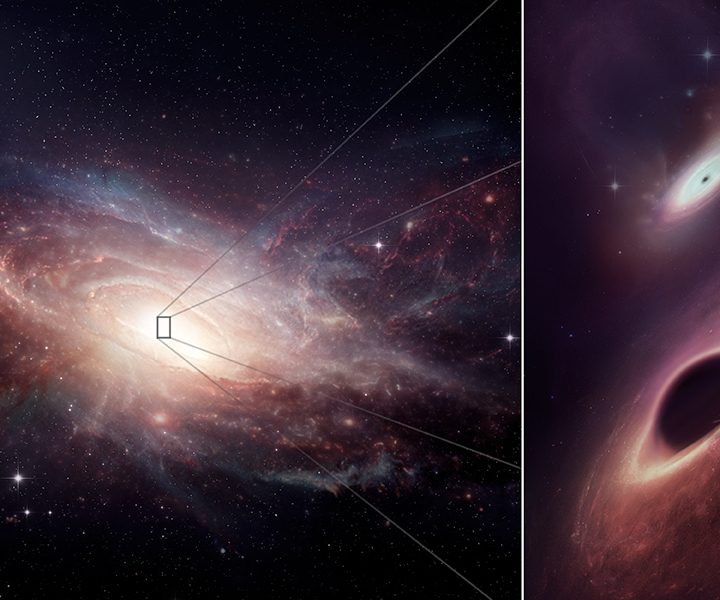
Artist’s conception showing late-stage galaxy merger and its two central black holes.
Scientists using the Atacama Large Millimeter/submillimeter Array (ALMA) to look deep into the heart of the pair of merging galaxies known as UGC 4211 discovered two black holes growing side by side, just 750 light-years apart. This artist’s conception shows the late-stage galaxy merger and its two central black holes. The binary black holes are the closest together ever observed in multiple wavelengths. ALMA (ESO/NAOJ/NRAO); M. Weiss (NRAO/AUI/NSF)

These are hungry black holes as well, as both members of the pair are growing in size. That surprised scientists, as they had expected to find a more sedate pairing. “Simulations suggested that most of the population of black hole binaries in nearby galaxies would be inactive because they are more common, not two growing black holes like we found,” explained lead author Michael Koss in a statement.

Recommended Videos

It could be that close black hole binaries like this one are actually quite common in the universe. The research is also relevant to our own galaxy, the Milky Way, as we are set to crash into the Andromeda galaxy in around 4.5 billion years’ time, and the merging galaxies of UGC4211 give an idea of what that process could look like.

As well as the data from ALMA, which is a ground-based array of many telescopes looking in the radio wavelength, the researchers used data from other sources like the space-based Hubble telescope which observes in the visible light wavelength, and X-ray instruments which provided another view.

“Each wavelength tells a different part of the story,” said co-author Ezequiel Treister. “While ground-based optical imaging showed us the whole merging galaxy, Hubble showed us the nuclear regions at high resolutions. X-ray observations revealed that there was at least one active galactic nucleus in the system. And ALMA showed us the exact location of these two growing, hungry supermassive black holes. All of these data together have given us a clearer picture of how galaxies such as our own turned out to be the way they are, and what they will become in the future.”

Georgina Torbet
Georgina has been the space writer at Digital Trends space writer for six years, covering human space exploration, planetary…
You can now walk through space and gaze into a black hole at this VR exhibit
Smithsonian Starstruck lets you drift past dying stars and see the origin point of the universe for as little as $18 a person.
Smithsonian Starstruck featured

Most planetarium shows ask you to sit still and look up. The Smithsonian's new VR exhibit takes a different approach, letting visitors walk through the vast expanse of the universe, drifting past stars, planets, and a black hole to get a physical sense of its true scale.

A $29 ticket to the edge of the galaxy

Read more
Scientists warn Elon Musk’s orbital data centers could blind Earth’s biggest telescopes
A new ESO study suggests millions of satellites could make parts of the night sky effectively unusable for astronomy.
One hour of satellites over the northern Atacama Desert in Chile (October 2025)

The race to blanket Earth with satellite internet has unlocked faster connectivity for millions. But according to the European Southern Observatory (ESO), it could also make one of humanity's oldest hobbies, and one of its most important sciences, a whole lot harder. The organization warns that the rapid growth of satellite mega-constellations could severely disrupt observations made by some of the world's most powerful telescopes.

Astronomers say the night sky is reaching its limit

Read more
Amazon’s Starlink rival just crossed a major milestone, but don’t expect perfect internet just yet
Amazon finally showed up to the space internet party
Amazon Leo satellite layout across all launch vehicles

Amazon has taken a significant step toward launching its long-awaited satellite internet service. Following its latest rocket launch, the company now has 396 Project Kuiper satellites in low-Earth orbit, enough to begin offering continuous service across select regions. The milestone keeps Amazon on track for its previously announced goal of launching commercial service by mid-2026.

https://twitter.com/Weber44Chris/status/2072575499461963938?ref_src=twsrc%5Etfw%7Ctwcamp%5Etweetembed%7Ctwterm%5E2072575499461963938%7Ctwgr%5Ed727a1b853cbf519585e7bf2655943afb2f91bb8%7Ctwcon%5Es1_&ref_url=https%3A%2F%2Fwww.theverge.com%2Fscience%2F960563%2Famazon-leo-service-tipping-point

Read more