Look, I get it. When you buy an entry-level laptop, you’re not getting the same components as with more expensive models. But usually, that covers things like the size of the SSD, the amount of RAM, or the specific CPU. These are obvious choices that you know you’re making when you’re putting down your cash.
But Apple’s been taking things a step further. It all started with the MacBook Air M2 and MacBook Pro M2, where the entry-level models with 256GB of storage use slower single-NAND SSDs compared to faster dual-NAND SSDs. Without going into unnecessary technical detail, I’ll just say that the smaller drives are slower than the larger drives — around half as fast, in fact. And then, to make matters worse, Apple has done the same with the performance-oriented M2 MacBook Pro, with the smallest 512GB SSD being single-NAND as well and considerably slower.

What’s it mean?
According to 9to5Mac, the 512GB SSD reads at 2973MB/s and writes at 3,145.5 MB/s, while the 1TB and larger SSDs read at 4,900 MB/s and write at 3,950 MB/s. Particularly in read performance, that’s a meaningful deficit, and it will impact booting the laptop, opening and saving files, and swapping to and from RAM when physical memory runs out. It’s just one performance metric, and so as Apple has pointed out, the entry-level MacBook Pro M2 Pro is still faster overall than the entry-level MacBook Pro M1 Pro. This difference is mostly going to affect the most demanding users. But that’s not the point.
The point is that there’s no way to know when you’re buying the laptop that by saving a few dollars, you’re reducing storage capacity and compromising performance. That may not matter as much to MacBook Air users who are likely running mainstream productivity apps on their machines, but for people who are buying the MacBook Pro, which starts at $2,000 for the entry-level MacBook Pro 14, it can matter a lot more.
Editing photos and video benefits from fast storage speeds, and performance reductions mean it takes longer to perform the same tasks. Added up over time, that can make a difference in productivity and money earned.
I ended up with a 1TB MacBook Pro 14 with the M1 Pro when I bought my machine, but that was only because the model I bought offered a $450 discount compared to the $350 discount on the entry-level model. I’d be pretty unhappy right now if I’d opted for the overall less expensive machine, but got lesser performance in return. In fact, if given the conscious choice, I would have happily spent more money for the faster configuration. And I’m not even a power user.
What’s the solution?
Plenty of people have already complained in op-eds and on Twitter, Reddit, and many more venues, and I don’t want to just add to the noise. But there’s an easy solution, and one that Apple should consider if it wants to be transparent to its customers.
This doesn’t apply to every manufacturer, many of which likely use less expensive components like this in lesser configurations and also say nothing. But some companies, such as Dell, HP, and Lenovo, tell you exactly what you’re getting when you’re configuring your laptop. For example, here’s Lenovo’s SSD configuration section for the ThinkPad X1 Carbon Gen 10.
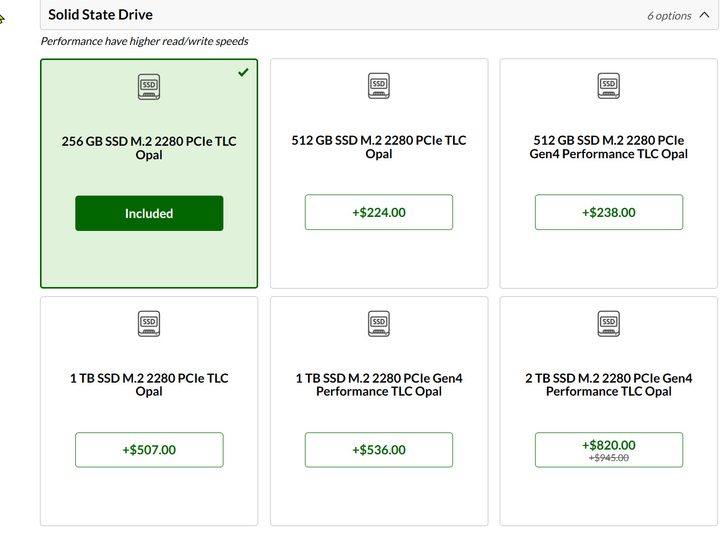
As you can see, it’s obvious which drive you’re getting when you make your choice. And notice the 512GB and 1TB options. Yes, that’s right, there’s a PCIe Gen3 (presumably) and a PCIe Gen4 option. You can opt to spend a little more money and get a more expensive drive. I’m not suggesting that Apple make the same kind of offering, but it’s the communication that’s important here. It’s clear to the buyer that if they opt for the smaller drive, they’re giving up the option of faster storage.
HP does something similar in the HP Envy x360 13 configurator. Again, it’s not exactly the same situation as with the MacBooks, but HP clarifies that there’s a higher-performance option.
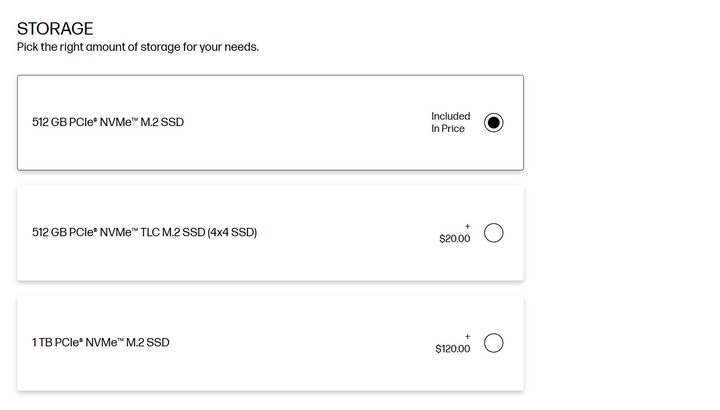
I couldn’t find a specific example of where any of these vendors offered an entry-level drive that was slower than the next version up, but I suspect that the same information would be made available. And that’s what Apple should be doing.
Here’s its storage configuration section for the MacBook Pro 14.
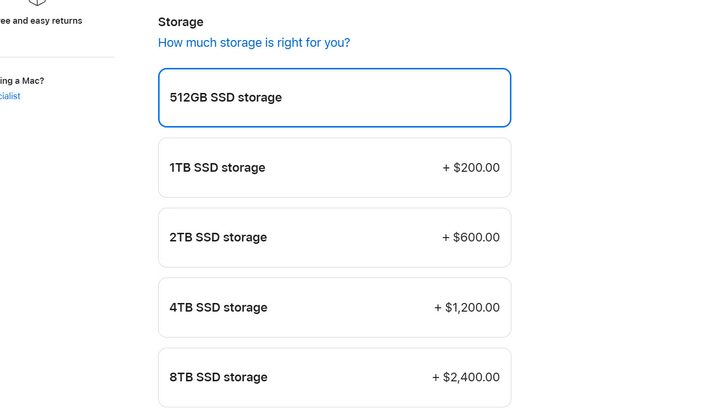
See that? There’s no indication that you’re getting a slower drive if you opt for the 512GB SSD. All Apple needs to do here (and with their configurations for other affected products) is to add some kind of disclaimer. They could be technical and put “(single-NAND)” next to the 512GB listing and “(double-NAND)” next to the larger SSDs. Or, they could simply indicate that the larger SSDs provide faster performance. And ironically, they’d not only avoid upsetting people who aren’t getting what they expected, but they’d also likely upsell more people to larger drives and increase their sales.
Just do the right thing
Again, I’m sure it’s not just Apple that’s playing this game. But Apple’s marketing efforts are heavily skewed toward promising the highest performance in a laptop if you buy its very costly MacBook Pro. And make no mistake about it, at a starting price of $2,000, MacBook Pros are expensive machines. Most people who buy them likely want the most performance they can get, while spending the right amount of money.
Does saving $200 justify what might be only a slight real-world reduction in performance? Perhaps. But that should be for the buyer, not Apple, to decide.