Samsung has announced updates to its flagship Galaxy Book laptops for 2023, including a new addition called the Galaxy Book 3 Ultra. This one is Samsung’s answer to the 16-inch MacBook Pro — a maxed-out beast of a laptop with up to an Nvidia RTX 4070 and an Intel 13th-gen Core i9 processor.
Samsung has shied away from tackling a larger, more powerful laptop, making the Galaxy Book 3 Ultra particularly noteworthy. It’s not small though. The 16-inch laptop is 0.65 inches thick and weighs 3.9 pounds. That’s large for a Samsung laptop, but it’s actually over a pound lighter than the 16-inch MacBook Pro — to put things in perspective.
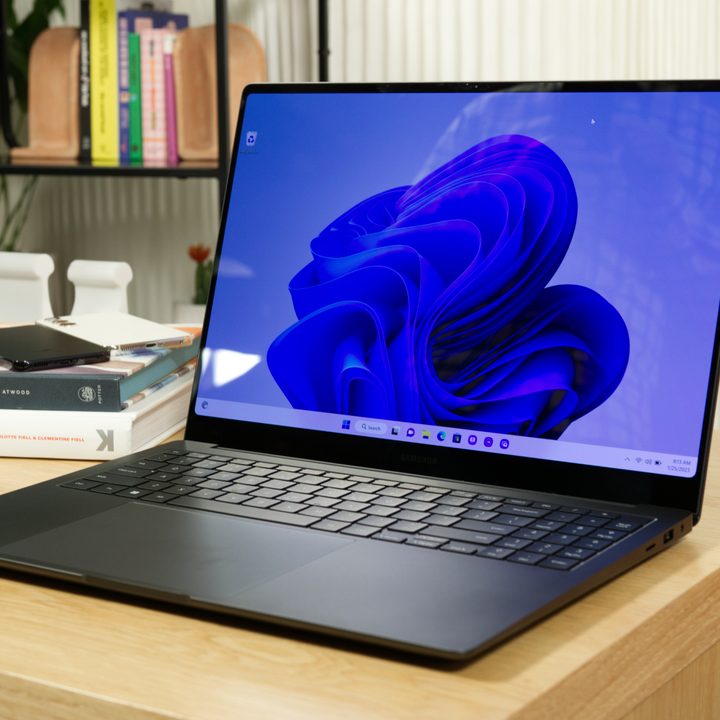
There’s lots more of interest here than just the size, though. These are the first Samsung laptops to embrace the 16:10 aspect ratio, which allows companies to reduce the size of the bottom and top bezels. Samsung is among the last companies to do this, having stuck with 16:9 in the Galaxy Book 2 Pro.
It’s nice to see, and the top bezel here looks particularly trim. Even still, the Galaxy Book 3 Ultra manages to squeeze in a 1080p webcam.
As you can probably see, the Book 3 Ultra also has arounded screen, which is something we’ve only seen on a handful of laptops, such as the MacBook Pro and the Surface Laptop Studio. Speaking of the screen, the Galaxy Book 3 Ultra has an AMOLED panel with a 120Hz refresh rate and a 2880 x 1800 resolution. It’s rated for 400 nits of brightness, or 500 nits for HDR content.


There’s a decent selection of ports, too. You get two Thunderbolt 4 ports, one USB-A, an HDMI 2.0, a microSD card slot, and a headphone jack.
The keyboard also includes a number pad over to the right and a massive, off-center touchpad below.
But it’s the performance that really stands out here. Your graphics option are either an RTX 4050 or 4070, with the choice of either a Core i7 or Core i9 processor, and either 16GB or 32GB of RAM. Storage options, meanwhile, are either 512GB or 1TB, though there is one expansion slot available.
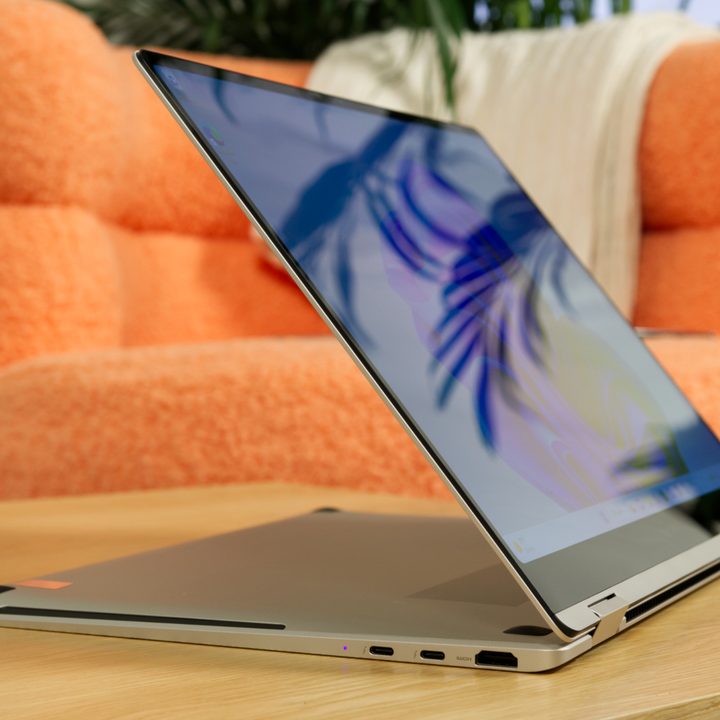
The Galaxy Book 3 Pro and Pro 360 also benefit from a lot of those advancements. They have the same AMOLED displays, which include the rounded corners and tiny bezels. They also have the same 1080p webcam. The 16-inch version of the Galaxy Book 3 Pro and Pro 360 even include the number pad off to the side. The port selection is almost identical too, except that the Galaxy Book Ultra is HDMI 2.0 instead of 1.4 on the Pro laptops.
The main difference between the Pro laptops and the Ultra is performance. The Ultra gets you that discrete GPU, while the Galaxy Book 3 Pro and Galaxy Book 3 Pro 360 both have just integrated graphics. That reduced performance allows these laptops to be significantly slimmer. In fact, the 14-inch Galaxy Book 3 Pro is one of the thinnest laptops you’ll be able to buy at 0.44 inches thick, matching the M2 MacBook Air. The 16-inch version isn’t too far behind at 0.49 inches thick.


The Galaxy Book 3 Pro 360, meanwhile, is slightly thicker and heavier than the clamshell version, but the main difference is that it has a 360-degree hinge and optional 5G support.
The Galaxy Book 3 Pro will start at $1,450, available both in 14-inch and 16-inch sizes, and with Graphite and Beige color options. The Galaxy Book 3 Pro 360, meanwhile, starts at $1,900 in only the 16-inch size with the same color options.
Lastly, the Galaxy Book 3 Ultra starts at $2,400. The entire series will be available starting on February 17, though it’s not clear exactly when the Ultra model will launch.