  1. Home
  2. Space
  3. News

Venus’ volcanic activity has left it with a squishy outer shell

Add as a preferred source on Google

Venus might be our neighbor in the solar system, but there’s a lot we still don’t know about the planet. That’s partly because of its high temperatures and atmospheric pressure which make it difficult to send probes there, and also because its thick atmosphere makes it difficult to observe from orbit. But researchers have recently dug through data from a decades-old NASA mission to learn about the strange geological processes which renew its surface.

One of the open questions about Venus is how it loses its heat, as, unlike Earth, Venus doesn’t have tectonic plates. By looking at data from the Magellan mission, researchers discovered that the outer layer of Venus’ surface, called the lithosphere, may be considerably thinner than previously thought and could let heat escape from the planet’s hot core.
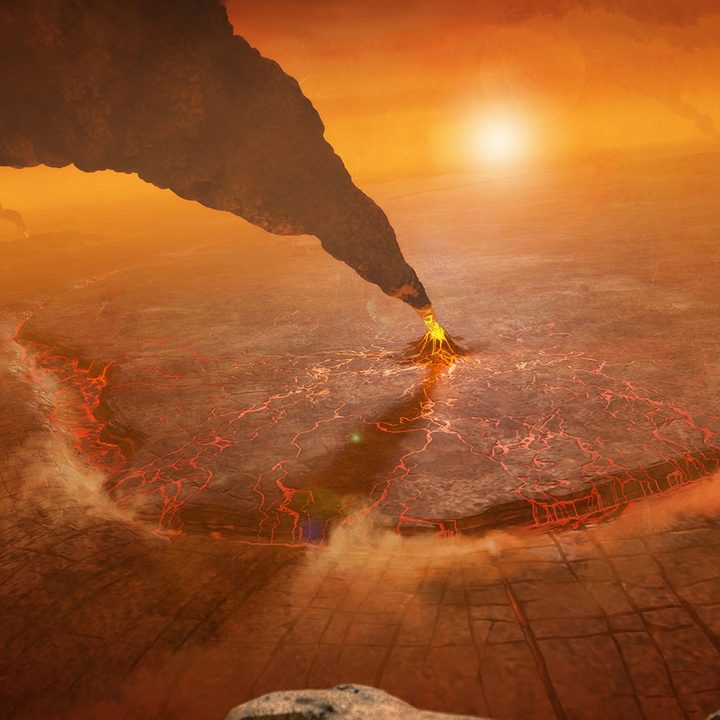
The large Quetzalpetlatl Corona located in Venus’ southern hemisphere depicts active volcanism and a subduction zone.
This illustration of the large Quetzalpetlatl Corona located in Venus’ southern hemisphere depicts active volcanism and a subduction zone, where the foreground crust plunges into the planet’s interior. A new study suggests coronae reveal locations where active geology is shaping Venus’ surface. NASA/JPL-Caltech/Peter Rubin

“For so long we’ve been locked into this idea that Venus’ lithosphere is stagnant and thick, but our view is now evolving,” said lead researcher Suzanne Smrekar of NASA’s Jet Propulsion Laboratory in a statement. “While Venus doesn’t have Earth-style tectonics, these regions of thin lithosphere appear to be allowing significant amounts of heat to escape, similar to areas where new tectonic plates form on Earth’s seafloor.”

Recommended Videos

The researchers looked at images of round features called coronae which Magellan saw on the planet’s surface, and by looking at the depths of ridges around them they could estimate the thickness of the lithosphere in these regions. They found that the lithosphere around these features was as thin as 7 miles deep.

This can help to explain a strange feature of Venus: Its surface looks young, as it lacks the many old impact craters you would expect to see on a planet of its age. There has a lot of volcanic activity in Venus’s past and there could still be volcanic activity there today, so one theory is that every few hundred million years the entire surface of the planet is melted and reformed in epic events called resurfacings — which is why it appears to be young. The thinness of the lithosphere allowing heat to flow through it supports that idea.

“What’s interesting is that Venus provides a window into the past to help us better understand how Earth may have looked over 2.5 billion years ago. It’s in a state that is predicted to occur before a planet forms tectonic plates,” said Smrekar.

An upcoming NASA mission called VERITAS will investigate the issue further and is set to launch in the 2030s. “VERITAS will be an orbiting geologist, able to pinpoint where these active areas are, and better resolve local variations in lithospheric thickness. We’ll even be able to catch the lithosphere in the act of deforming,” said Smrekar. “We’ll determine if volcanism really is making the lithosphere ‘squishy’ enough to lose as much heat as Earth, or if Venus has more mysteries in store.”

The research is published in the journal Nature Geoscience.

Georgina Torbet
Georgina has been the space writer at Digital Trends space writer for six years, covering human space exploration, planetary…
Space is becoming Bezos and Musk’s next data center site, and we have every reason to worry
The AI boom is coming for the night sky
How Vast's space station will look in orbit.

AI data centers already consume vast amounts of electricity and water on Earth, so Silicon Valley has begun looking somewhere considerably more spacious... literally.

Elon Musk's SpaceX and Jeff Bezos' Blue Origin, along with several other companies, have proposed enormous constellations of satellites designed to operate as orbital data centers. However, environmental groups and former space officials are now warning that putting them into orbit at the proposed scale could have severe consequences for Earth's atmosphere and the night sky.

Read more
The first possible exomoon is here, and it makes our Moon look hilariously tiny
Scientists may have found the first exomoon, except this one is the size of Jupiter
This artist’s concept depicts a potential volcanic moon between the exoplanet WASP-49 b, left, and its parent star. New evidence indicating that a massive sodium cloud observed near WASP-49 b is produced by neither the planet nor the star has prompted researchers to ask if its origin could be an exomoon.

We have already discovered more than 6,000 planets outside of our immediate neighborhood. Yet, finding a moon orbiting one of those distant worlds has proved considerably harder. Astronomers may finally have something close to the real deal, but this particular object stretches the word “moon” almost beyond recognition.

Using the European Southern Observatory’s Very Large Telescope in Chile, researchers detected strong evidence for a moon-like object in the CD-35 2722 system. Further observations are still necessary to confirm the discovery, but it could become the first confidently detected natural satellite outside our solar system. There is still one tiny complication though. This moon is apparently massive.

Read more
China’s answer to SpaceX’s reusable rockets literally catches boosters in a net
SpaceX catches boosters on legs. China just used a net.
Ammunition, Missile, Weapon

SpaceX's playbook for recovering a rocket booster generally involves legs, a precisely controlled vertical landing, and either a concrete pad or a drone ship. 

China just managed to pull off something similar, but in a slightly different way, and on July 10, it tested the method as well.

Read more

