1. Home
  2. Space
  3. News

Hubble image of the week shows an unusual jellyfish galaxy

Add as a preferred source on Google

This week’s image from the Hubble Space Telescope shows an unusual type of galaxy named for its aquatic look-alike: a jellyfish.

The jellyfish galaxy JO206 is shown below in an image taken using Hubble’s Wide Field Camera 3 instrument. Located 700 million light-years away, in the constellation of Aquarius, this image of the galaxy shows both the bright center of the galaxy and its long tendrils reaching out toward the bottom right. It is these tendrils that give jellyfish galaxies their names, and they are formed through a process called ram pressure stripping.
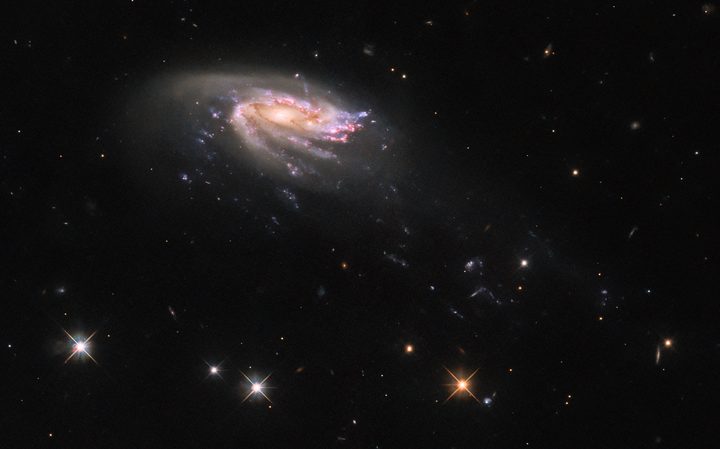
The jellyfish galaxy JO206 trails across this image from the NASA/ESA Hubble Space Telescope, showcasing a colorful star-forming disk surrounded by a pale, luminous cloud of dust. A handful of foreground bright stars with crisscross diffraction spikes stands out against an inky black backdrop at the bottom of the image. JO206 lies over 700 million light-years from Earth in the constellation Aquarius.
The jellyfish galaxy JO206 trails across this image from the NASA/European Space Agency Hubble Space Telescope, showcasing a colorful star-forming disk surrounded by a pale, luminous cloud of dust. A handful of foreground bright stars with crisscross diffraction spikes stands out against an inky black backdrop at the bottom of the image. JO206 is located over 700 million light-years from Earth in the constellation Aquarius. ESA/Hubble & NASA, M. Gullieuszik and the GASP team

When a galaxy moves through a galaxy cluster, it isn’t just moving through empty space. It moves through diffuse clouds of plasma gas called the intracluster medium, which is hotter than the surrounding space outside the cluster. As the galaxy moves through this medium, it creates drag, which pushes gas out of the galaxy and causes it to form a long tail that trails behind the galaxy’s main body. These tails are the tendrils of the jellyfish galaxy.

Recommended Videos

Hubble has previously captured a number of other jellyfish galaxies, like JO201 and JW100. Hubble is often used to study these galaxies because of the high rates of star formation in their tails, as astronomers want to understand how star formation might differ when it occurs far away from a galaxy’s center. But it turns out that the process appears to be very similar, whether it occurs in the center of a jellyfish galaxy or at the edges of its tails.

“The tentacles of jellyfish galaxies give astronomers a unique opportunity to study star formation under extreme conditions, far from the influence of the galaxy’s main disk,” Hubble scientists write. “Surprisingly, Hubble revealed that there are no striking differences between star formation in the disks of jellyfish galaxies and star formation in their tentacles, which suggests the environment of newly formed stars has only a minor influence on their formation.”

Georgina Torbet
Georgina has been the space writer at Digital Trends space writer for six years, covering human space exploration, planetary…
Space is becoming Bezos and Musk’s next data center site, and we have every reason to worry
The AI boom is coming for the night sky
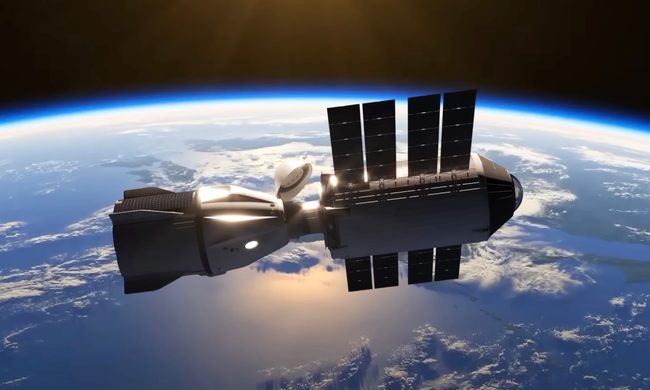
How Vast's space station will look in orbit.

AI data centers already consume vast amounts of electricity and water on Earth, so Silicon Valley has begun looking somewhere considerably more spacious... literally.

Elon Musk's SpaceX and Jeff Bezos' Blue Origin, along with several other companies, have proposed enormous constellations of satellites designed to operate as orbital data centers. However, environmental groups and former space officials are now warning that putting them into orbit at the proposed scale could have severe consequences for Earth's atmosphere and the night sky.

Read more
The first possible exomoon is here, and it makes our Moon look hilariously tiny
Scientists may have found the first exomoon, except this one is the size of Jupiter
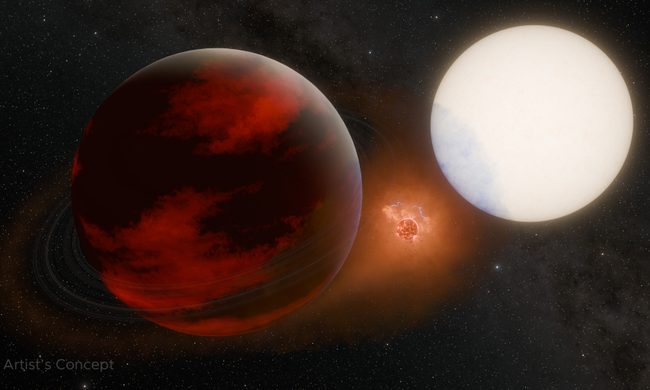
This artist’s concept depicts a potential volcanic moon between the exoplanet WASP-49 b, left, and its parent star. New evidence indicating that a massive sodium cloud observed near WASP-49 b is produced by neither the planet nor the star has prompted researchers to ask if its origin could be an exomoon.

We have already discovered more than 6,000 planets outside of our immediate neighborhood. Yet, finding a moon orbiting one of those distant worlds has proved considerably harder. Astronomers may finally have something close to the real deal, but this particular object stretches the word “moon” almost beyond recognition.

Using the European Southern Observatory’s Very Large Telescope in Chile, researchers detected strong evidence for a moon-like object in the CD-35 2722 system. Further observations are still necessary to confirm the discovery, but it could become the first confidently detected natural satellite outside our solar system. There is still one tiny complication though. This moon is apparently massive.

Read more
China’s answer to SpaceX’s reusable rockets literally catches boosters in a net
SpaceX catches boosters on legs. China just used a net.
Ammunition, Missile, Weapon

SpaceX's playbook for recovering a rocket booster generally involves legs, a precisely controlled vertical landing, and either a concrete pad or a drone ship. 

China just managed to pull off something similar, but in a slightly different way, and on July 10, it tested the method as well.

Read more