1. Home
  2. Space
  3. News

How to watch the Euclid dark matter telescope launch this Saturday

Add as a preferred source on Google

The astronomy community is about to get a new instrument to probe the mysteries of dark matter, with the launch of the European Space Agency (ESA)’s Euclid telescope this Saturday. Euclid is a highly sophisticated space-based telescope that will observe huge swaths of the sky to create a 3D model of the universe to help elucidate some of the biggest questions in cosmology.

Euclid | Journey to darkness

The launch of the telescope will be live-streamed, and we have the details on how to watch online below.

Recommended Videos

What to expect from the launch

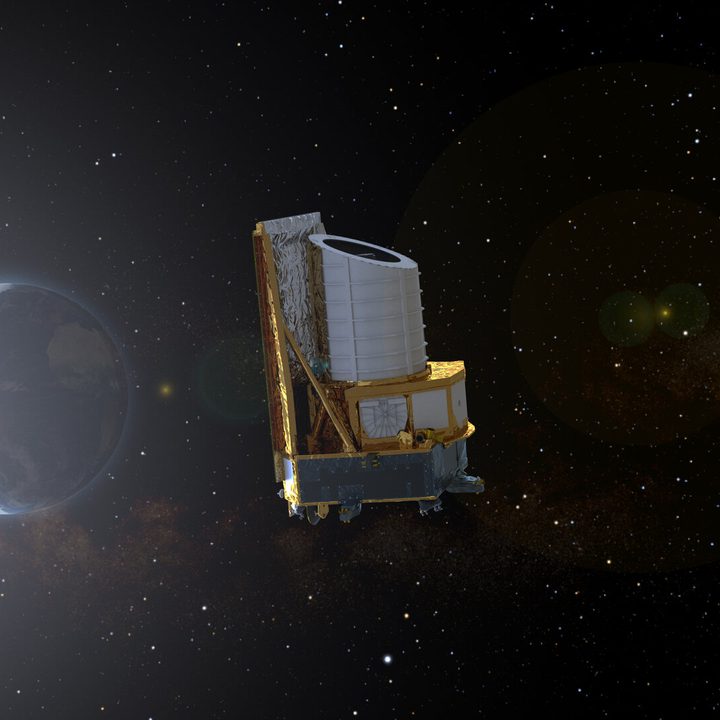
Artist impression showing Euclid leaving Earth and on its way to Sun-Earth Lagrange point L2.
This artist impression shows Euclid leaving Earth and on its way to Sun-Earth Lagrange point L2. This equilibrium point of the Sun-Earth system is located 1.5 million kilometers from Earth in the opposite direction of the Sun. L2 revolves around the Sun along with Earth. During Euclid’s orbit at L2, Euclid’s sunshield always blocks the light from the Sun, Earth, and moon while pointing its telescope toward deep space, ensuring a high level of stability for its instruments. ESA. Acknowledgement: Work performed by ATG under contract for ESA., CC BY-SA 3.0 IGO

The launch will take place from Cape Canaveral in Florida and will use a SpaceX Falcon 9 rocket. The launch is taking place from the U.S. rather than from Europe’s spaceport in French Guiana due to an issue with the originally planned launch vehicle. The original intention had been to launch Euclid using a Russian Soyuz rocket. However, ESA suspended its cooperation with Russia following the invasion of Ukraine, so it was not possible to use a Soyuz.

Instead, ESA made an agreement to launch Euclid using a SpaceX rocket. The mission also has ties with the U.S. as NASA is contributing hardware for one of the telescope’s instruments and will also be contributing to processing the data collected by the mission.

Once Euclid is in space it will begin its journey to the Lagrange point L2. It will take around four weeks to reach this orbit around the sun, at which point it will begin a several-month process of preparing its instruments before beginning science operations around three months after launch.

How to watch the launch

The launch of the Euclid spacecraft will be livestreamed by both ESA and NASA. You can watch the ESA stream using the video embedded at the top of this page or by heading to the ESA live stream YouTube page. Alternatively, you can also watch using the NASA app or by watching the NASA live channel online.

Coverage of the launch begins at 10:30 a.m. ET (7:30 a.m. PT) on Saturday, July 1, and will run for several hours until just after midday ET (9 a.m. PT). If you’d prefer to tune into just the key moments, ESA has provided an expected schedule as follows:

11:11 a.m. ET: Euclid launch on SpaceX Falcon 9
11:53 a.m. ET: Separation of Euclid from Falcon 9
1:57 a.m. ET: Earliest expected time to acquire Euclid’s signal

The first signal from Euclid should be acquired around 2 p.m. ET, which will mark the successful launch of the mission and confirm that the spacecraft is on its way to L2 as planned.

Georgina Torbet
Georgina has been the space writer at Digital Trends space writer for six years, covering human space exploration, planetary…
China’s answer to SpaceX’s reusable rockets literally catches boosters in a net
SpaceX catches boosters on legs. China just used a net.
Ammunition, Missile, Weapon

SpaceX's playbook for recovering a rocket booster generally involves legs, a precisely controlled vertical landing, and either a concrete pad or a drone ship. 

China just managed to pull off something similar, but in a slightly different way, and on July 10, it tested the method as well.

Read more
Dimming the sun sounds unhinged, but this new study on El Niño makes a surprisingly good case for it
A natural test case, Australia's worst-ever wildfire season, suggests the idea deserves serious consideration.
Nature, Outdoors, Sky

When I first saw "scientists propose dimming the sun," I rolled my eyes. It sounds like a science fiction movie cooked up after watching many climate documentaries. But a new study, published on July 8, 2026, in the journal Science Advances, seems to have a genuinely compelling argument.

A Super El Niño is currently forming in the Pacific, feared to be the most intense in decades. It could escalate floods, wildfires, and extreme heat events worldwide. However, Researchers at UC San Diego's Scripps Institution of Oceanography, led by climate scientists Kate Ricke and Jessica Wan, are now proposing one of the most interesting solutions I’ve come across.

Read more
You can now walk through space and gaze into a black hole at this VR exhibit
Smithsonian Starstruck lets you drift past dying stars and see the origin point of the universe for as little as $18 a person.
Smithsonian Starstruck featured

Most planetarium shows ask you to sit still and look up. The Smithsonian's new VR exhibit takes a different approach, letting visitors walk through the vast expanse of the universe, drifting past stars, planets, and a black hole to get a physical sense of its true scale.

A $29 ticket to the edge of the galaxy

Read more