  1. Home
  2. Space
  3. News

Euclid mission launches to probe the mysteries of dark matter

Add as a preferred source on Google

The European Space Agency (ESA) has successfully launched its Euclid space telescope to study the mysteries of dark matter and dark energy. The spacecraft launched from Cape Canaveral in Florida using a SpaceX Falcon 9 rocket, with liftoff at 11:12 a.m. ET (8:12 a.m. PT).
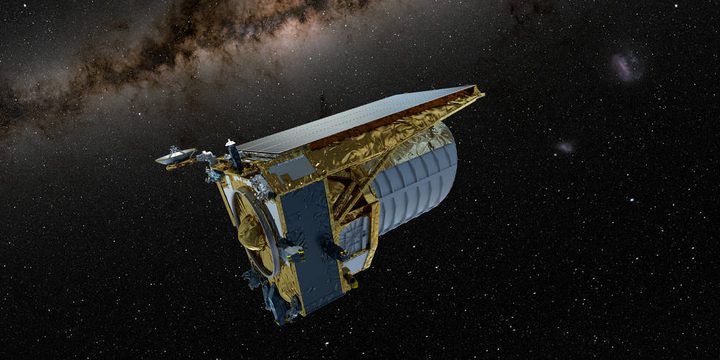
This artist’s concept shows the ESA (European Space Agency) Euclid mission in space.
This artist’s concept shows the ESA (European Space Agency) Euclid mission in space. ESA, CC BY-SA 3.0 IGO

The space telescope separated from the Falcon 9 rocket and is now on its way to its orbit around the sun. It will orbit at the second Lagrange point, called L2, which is the same orbit used by the James Webb Space Telescope as well as other space telescopes. This orbit has the advantage of requiring minimal power to maintain and being extremely stable. That stability is important because the telescope will take very detailed images of large portions of the sky, and these need to be highly accurate to measure the subtle effects of dark matter and dark energy.

Recommended Videos

Unlike some telescopes like James Webb, which are folded up for launch and must unfold once they arrive in space, Euclid will only deploy a single high gain antenna as it travels to L2. That’s also due to the need for stability for the very sensitive readings it must take.

The idea of the Euclid mission is to examine some of the biggest questions in cosmology about the nature of dark matter and dark energy. To understand these phenomena, the mission will take images of over one-third of the sky, looking beyond the Milky Way at distant background galaxies. By looking at how galaxies cluster in space, researchers can see the effects of dark energy which affects the expansion of the universe. And by making use of a phenomenon called gravitational lensing, they can see the differences between the perceived and actual mass of galaxies — with the difference being due to dark matter.

“Today we celebrate the successful launch of a ground-breaking mission that places Europe at the forefront of cosmological studies,” said Carole Mundell, ESA’s Director of Science. “If we want to understand the Universe we live in, we need to uncover the nature of dark matter and dark energy and understand the role they played in shaping our cosmos. To address these fundamental questions, Euclid will deliver the most detailed map of the extra-galactic sky. This inestimable wealth of data will also enable the scientific community to investigate many other aspects of astronomy, for many years to come.”

Euclid is scheduled to arrive at its orbit at L2 in around four weeks’ time, where it will spend around two months preparing its instruments before beginning science operations.

Georgina Torbet
Georgina has been the space writer at Digital Trends space writer for six years, covering human space exploration, planetary…
Dimming the sun sounds unhinged, but this new study on El Niño makes a surprisingly good case for it
A natural test case, Australia's worst-ever wildfire season, suggests the idea deserves serious consideration.
Nature, Outdoors, Sky

When I first saw "scientists propose dimming the sun," I rolled my eyes. It sounds like a science fiction movie cooked up after watching many climate documentaries. But a new study, published on July 8, 2026, in the journal Science Advances, seems to have a genuinely compelling argument.

A Super El Niño is currently forming in the Pacific, feared to be the most intense in decades. It could escalate floods, wildfires, and extreme heat events worldwide. However, Researchers at UC San Diego's Scripps Institution of Oceanography, led by climate scientists Kate Ricke and Jessica Wan, are now proposing one of the most interesting solutions I’ve come across.

Read more
You can now walk through space and gaze into a black hole at this VR exhibit
Smithsonian Starstruck lets you drift past dying stars and see the origin point of the universe for as little as $18 a person.
Smithsonian Starstruck featured

Most planetarium shows ask you to sit still and look up. The Smithsonian's new VR exhibit takes a different approach, letting visitors walk through the vast expanse of the universe, drifting past stars, planets, and a black hole to get a physical sense of its true scale.

A $29 ticket to the edge of the galaxy

Read more
Scientists warn Elon Musk’s orbital data centers could blind Earth’s biggest telescopes
A new ESO study suggests millions of satellites could make parts of the night sky effectively unusable for astronomy.
One hour of satellites over the northern Atacama Desert in Chile (October 2025)

The race to blanket Earth with satellite internet has unlocked faster connectivity for millions. But according to the European Southern Observatory (ESO), it could also make one of humanity's oldest hobbies, and one of its most important sciences, a whole lot harder. The organization warns that the rapid growth of satellite mega-constellations could severely disrupt observations made by some of the world's most powerful telescopes.

Astronomers say the night sky is reaching its limit

Read more