1. Home
  2. Space
  3. News

James Webb spots the most distant active supermassive black hole ever discovered

Add as a preferred source on Google

As well as observing specific objects like distant galaxies and planets here in our solar system, the James Webb Space Telescope is also being used to perform wide-scale surveys of parts of the sky. These surveys observe large chunks of the sky to identify important targets like very distant, very early galaxies, as well as observe intriguing objects like black holes. And one such survey has recently identified the most distant active supermassive black hole seen so far.

While a typical black hole might have a mass up to around 10 times that of the sun, supermassive black holes are much more massive, with a mass that can be millions or even billions of times the mass of the sun. These monsters are found at the heart of galaxies and are thought to play important roles in the formation and merging of galaxies.
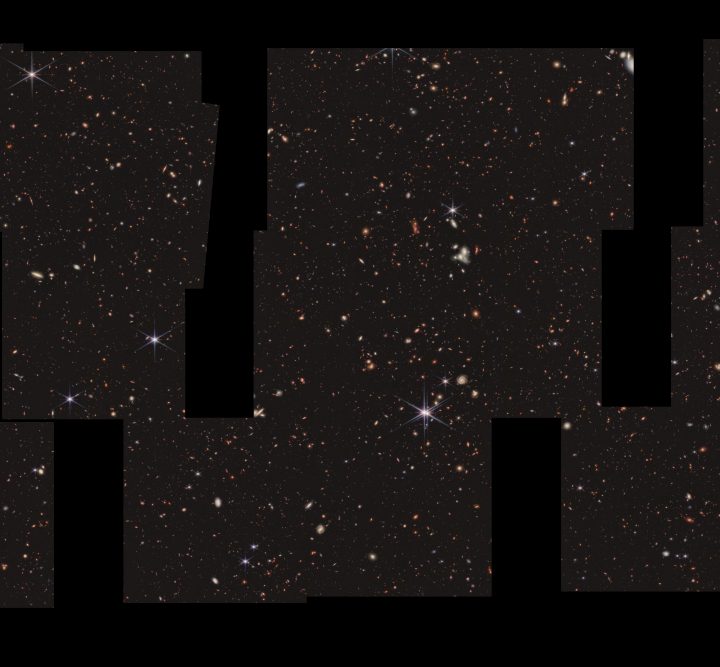
A panoramic vista, known as the Cosmic Evolution Early Release Science (CEERS) Survey.
There is so much detail to explore in this panoramic vista, known as the Cosmic Evolution Early Release Science (CEERS) Survey. The galaxies that first caught the eyes of the researchers are those that haven’t appeared in any other images – Webb was the first to reveal their presence. To find them, seek the tiniest, reddest dots speckled throughout this survey. The light from some of them has traveled for over 13 billion years to reach the telescope. The team followed up to obtain spectra with Webb, which led to the discovery of the most distant active supermassive black hole currently known, along with two more extremely distant active supermassive black holes that existed when the universe was only 1 billion years old. Image NASA, ESA, CSA, Steve Finkelstein (UT Austin), Micaela Bagley (UT Austin), Rebecca Larson (UT Austin); Image Processing Alyssa Pagan (STScI)

A very early example of these supermassive black holes was recently discovered, dating back to just 570 million years after the big bang. Located in a galaxy named CEERS 1019, it was identified as part of a survey called Cosmic Evolution Early Release Science (CEERS) which uses Webb to take huge images of parts of the sky. By looking at regions away from the bright center of the Milky Way and which don’t have bright nearby galaxies obscuring the view, the survey can identify very dim and distant objects.

Recommended Videos

“Looking at this distant object with this telescope is a lot like looking at data from black holes that exist in galaxies near our own,” said lead researcher Rebecca Larson of the University of Texas at Austin in a statement.
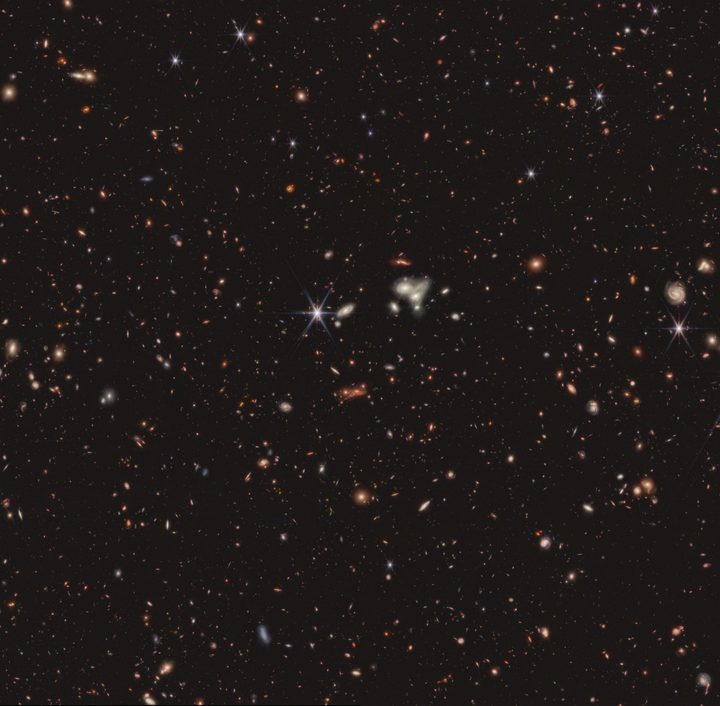
Crop of Webb's CEERS Survey image.
Crop of Webb’s CEERS Survey image. Image NASA, ESA, CSA, Steve Finkelstein (UT Austin), Micaela Bagley (UT Austin), Rebecca Larson (UT Austin); Image Processing Alyssa Pagan (STScI)

The galaxy in which the supermassive black hole resides is interesting too. In the data, it looks like three blobs in a line rather than the single disk which would be expected. That could give clues to how the galaxy came to be, as the result of colliding with other nearby galaxies.

“We’re not used to seeing so much structure in images at these distances,” said CEERS team member Jeyhan Kartaltepe of the Rochester Institute of Technology. “A galaxy merger could be partly responsible for fueling the activity in this galaxy’s black hole, and that could also lead to increased star formation.”

As well as this black hole, CEERS also identified 11 extremely old galaxies, ranging from the time when the universe was between 470 million and 675 million years old. By studying these very early galaxies, researchers hope to learn about the way that galaxies formed and grew throughout the history of the universe.

“Webb was the first to detect some of these galaxies,” said Seiji Fujimoto of the University of Texas at Austin. “This set, along with other distant galaxies we may identify in the future, might change our understanding of star formation and galaxy evolution throughout cosmic history.”

Georgina Torbet
Georgina has been the space writer at Digital Trends space writer for six years, covering human space exploration, planetary…
China’s answer to SpaceX’s reusable rockets literally catches boosters in a net
SpaceX catches boosters on legs. China just used a net.
Ammunition, Missile, Weapon

SpaceX's playbook for recovering a rocket booster generally involves legs, a precisely controlled vertical landing, and either a concrete pad or a drone ship. 

China just managed to pull off something similar, but in a slightly different way, and on July 10, it tested the method as well.

Read more
Dimming the sun sounds unhinged, but this new study on El Niño makes a surprisingly good case for it
A natural test case, Australia's worst-ever wildfire season, suggests the idea deserves serious consideration.
Nature, Outdoors, Sky

When I first saw "scientists propose dimming the sun," I rolled my eyes. It sounds like a science fiction movie cooked up after watching many climate documentaries. But a new study, published on July 8, 2026, in the journal Science Advances, seems to have a genuinely compelling argument.

A Super El Niño is currently forming in the Pacific, feared to be the most intense in decades. It could escalate floods, wildfires, and extreme heat events worldwide. However, Researchers at UC San Diego's Scripps Institution of Oceanography, led by climate scientists Kate Ricke and Jessica Wan, are now proposing one of the most interesting solutions I’ve come across.

Read more
You can now walk through space and gaze into a black hole at this VR exhibit
Smithsonian Starstruck lets you drift past dying stars and see the origin point of the universe for as little as $18 a person.
Smithsonian Starstruck featured

Most planetarium shows ask you to sit still and look up. The Smithsonian's new VR exhibit takes a different approach, letting visitors walk through the vast expanse of the universe, drifting past stars, planets, and a black hole to get a physical sense of its true scale.

A $29 ticket to the edge of the galaxy

Read more