One of the biggest aims of Mars research right now is trying to figure out if life ever existed on Mars. Given how dry and inhospitable Mars is today, scientists are pretty certain that there’s nothing living there currently. But millions of years ago, Mars could have looked a lot more like Earth, with plentiful surface water in rivers and lakes. Now, research focuses on using the instruments on rovers like the Perseverance and Curiosity rovers to try and look for evidence of ancient life on the planet.
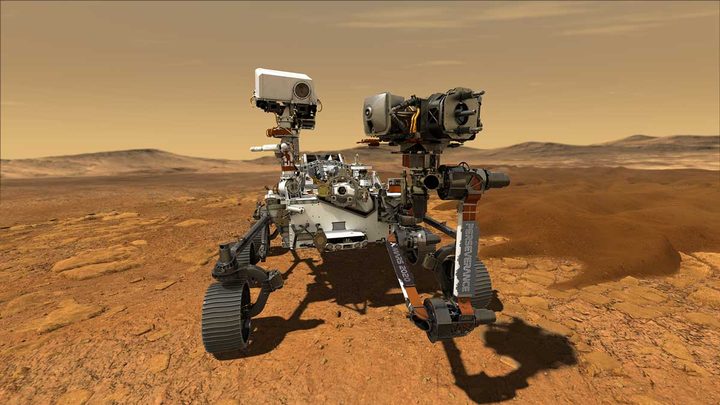
Recently, researchers used data from Perseverance’s SHERLOC instrument, a camera and spectrometer used to detect minerals and organic molecules, to confirm the discovery of a variety of organic molecules in Mars’ Jezero Crater. Similar findings have been made by the Curiosity Rover in the Gale Crater, but these are some of the first indications of the finding in this other location.
Organic molecules are rich in carbon and are typically associated with living things, being either created by or used by them. However, they aren’t only produced by life — they can also be produced by other natural processes such as geology. So finding these molecules on Mars suggests that there could have once been microbial life there, but the source could also be from something else.
“Not all organics are biological in origin,” one of the researchers, Ashley Murphy of the Planetary Science Institute explained in a statement. To know whether a molecule came from something living or not, researchers need to look at the context of the finding, such as other types of rocks nearby and the depth at which the sample was found. “Observing spatial relationships between minerals and organics is necessary when evaluating organic origins and potential biosignatures.”
This is tricky because we’re working from the only example of a habitable planet we know of: Earth. And indicators of past life can depend strongly on the types of rocks in the environment. “Everything we know of life on Earth is limited to what is preserved in the rock-mineral record,” Murphy said.
“On Earth, biosignatures are found in certain minerals and some minerals are better at preserving organics than others. Mars may have had a similar early geologic history to Earth so we use our knowledge of life as we know it on Earth for where to look for potential evidence of past life on Mars. Mapping organics allows for a better understanding of if the Martian carbon cycle is similar to or different from Earth, and the potential of Mars to host life.”
The organic molecules were found in areas of the Jezero Crater named Máaz and Séítah, and are of a similar type to those Curiosity found in the Gale Crater, suggesting that both sites — which are the dried-up beds of ancient lakes — could have had similar processes occurring in their history.
The research is published in the journal Nature.