1. Home
  2. Space
  3. News

Spiral galaxy caught in the act as it’s about to eat its dwarf galaxy neighbor

Add as a preferred source on Google

A recent image from the Dark Energy Camera shows an act of galactic cannibalism, with a spiral galaxy similar to our Milky Way about to devour a nearby dwarf galaxy that has wandered into its path.

The dramatic interaction is occurring between a large spiral galaxy known as Haley’s Coronet and a smaller dwarf galaxy called NGC 1531. The dwarf galaxy is in the process of merging with the larger galaxy, which is being pulled into an irregular shape by the gravitational forces.
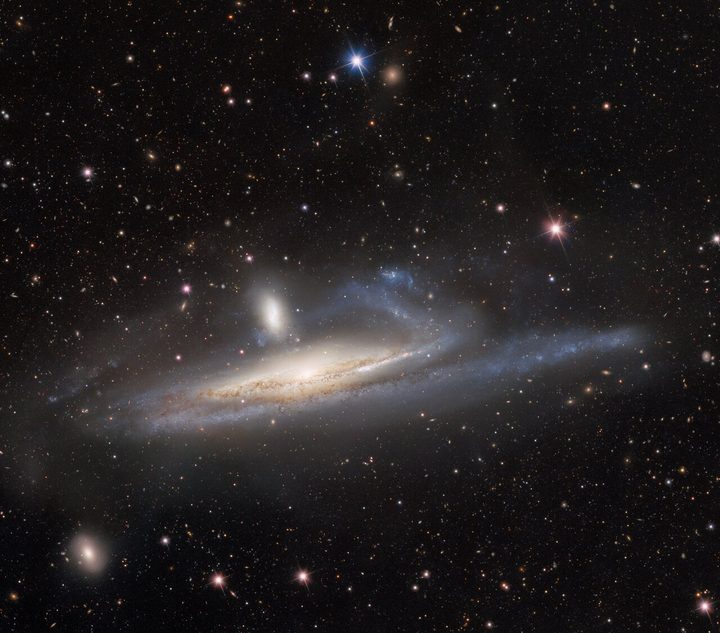
The spiral galaxy NGC 1532, also known as Haley’s Coronet, is caught in a lopsided tug of war with its smaller neighbor, the dwarf galaxy NGC 1531. The image — taken by the US Department of Energy’s (DOE) Dark Energy Camera mounted on the National Science Foundation’s (NSF) Víctor M. Blanco 4-meter Telescope at Cerro Tololo Inter-American Observatory in Chile, a Program of NSF’s NOIRLab — captures the mutual gravitational influences of a massive- and dwarf-galaxy merger.
The spiral galaxy NGC 1532, also known as Haley’s Coronet, is caught in a lopsided tug-of-war with its smaller neighbor, the dwarf galaxy NGC 1531. The image — taken by the US Department of Energy’s (DOE) Dark Energy Camera — captures the mutual gravitational influences of a massive galaxy and dwarf galaxy merger. CTIO/NOIRLab/DOE/NSF/AURA; R. Colombari, M. Zamani & D. de Martin (NSF’s NOIRLab)

“This lopsided cosmic tug-of-war is a snapshot of how large galaxies grow and evolve by devouring smaller galaxies, absorbing their stars and star-forming material,” NOIRLab explains. “A similar process has happened in the Milky Way, possibly six times in the past, leaving vast streams of stars and other signs in the halo of the Milky Way.”

Recommended Videos

The two galaxies shown in the image will eventually merge into one, as the small dwarf galaxy is absorbed by the larger one. But before that happens, you can see how the larger galaxy’s spiral arms are being distorted by gravity, with one spiral arm twisted up toward the top of the image.

How to predict what will happen when two galaxies meet is a complex issue thought to relate to the galaxies’ supermassive black holes, but we do know that the outcome depends on the size of the galaxies involved. In cases like this, one large galaxy can easily absorb a smaller dwarf galaxy. However, when two similarly sized galaxies collide, they may merge to create an unusual structure, or the meeting may result in one of the galaxies being annihilated.

As dramatic as the process of galaxy merging is, however, it isn’t only destructive. Mergers also often trigger waves of star formation, with material like dust and gas forming bridges between the two galaxies and providing the basis for the birth of new stars.

Georgina Torbet
Georgina has been the space writer at Digital Trends space writer for six years, covering human space exploration, planetary…
China’s answer to SpaceX’s reusable rockets literally catches boosters in a net
SpaceX catches boosters on legs. China just used a net.
Ammunition, Missile, Weapon

SpaceX's playbook for recovering a rocket booster generally involves legs, a precisely controlled vertical landing, and either a concrete pad or a drone ship. 

China just managed to pull off something similar, but in a slightly different way, and on July 10, it tested the method as well.

Read more
Dimming the sun sounds unhinged, but this new study on El Niño makes a surprisingly good case for it
A natural test case, Australia's worst-ever wildfire season, suggests the idea deserves serious consideration.
Nature, Outdoors, Sky

When I first saw "scientists propose dimming the sun," I rolled my eyes. It sounds like a science fiction movie cooked up after watching many climate documentaries. But a new study, published on July 8, 2026, in the journal Science Advances, seems to have a genuinely compelling argument.

A Super El Niño is currently forming in the Pacific, feared to be the most intense in decades. It could escalate floods, wildfires, and extreme heat events worldwide. However, Researchers at UC San Diego's Scripps Institution of Oceanography, led by climate scientists Kate Ricke and Jessica Wan, are now proposing one of the most interesting solutions I’ve come across.

Read more
You can now walk through space and gaze into a black hole at this VR exhibit
Smithsonian Starstruck lets you drift past dying stars and see the origin point of the universe for as little as $18 a person.
Smithsonian Starstruck featured

Most planetarium shows ask you to sit still and look up. The Smithsonian's new VR exhibit takes a different approach, letting visitors walk through the vast expanse of the universe, drifting past stars, planets, and a black hole to get a physical sense of its true scale.

A $29 ticket to the edge of the galaxy

Read more