I had the chance to try out Tidal’s new Max audio quality setting — which integrates hi-res audio FLAC files into the streaming service’s HiFi Plus subscription tier — while it was still in beta. It seemed ham-fisted and poorly executed at best, but betas often can be tweaked before seeing their final release. That’s the point of beta testing. So I held out hope that Tidal would fix the problems before rolling Max out to the world.
Now that Tidal has opened the FLAC floodgates — the feature is live for all — that doesn’t appear to be the case.
The heart of the problem is that Tidal is running hi-res FLAC in parallel with its existing catalog tracks that use the MQA format, but without giving its users the ability to select the format they want to hear.
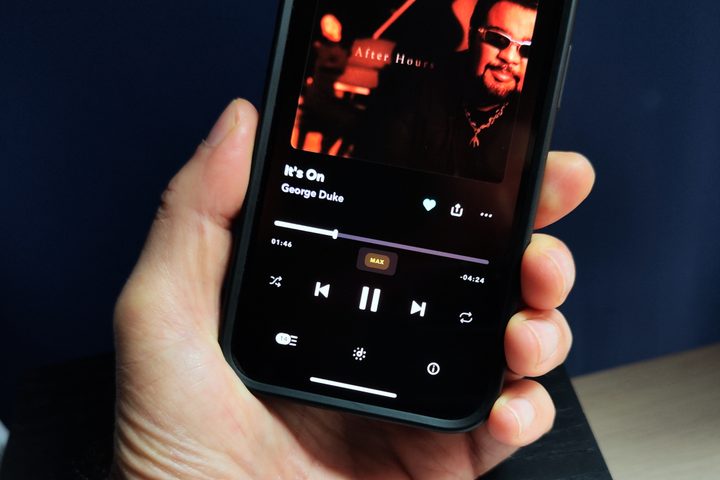
In fact, unless you connect your phone to an external DAC, there’s no way to know whether you’re getting FLAC or MQA, and no way to know the track’s bit-depth or sampling rate. All you have to go on is Tidal’s vague policy: If a Max track exists as 24-bit FLAC, that’s what you’ll get, regardless of its sampling rate, and regardless of whether or not you may want the MQA version instead.
When Tidal CEO Jesse Dorogusker initially took to Reddit to announce the addition of hi-res FLAC, the news was greeted with a lot of optimism, especially from those in the audiophile community that take issue with MQA — they believe MQA to be inferior to hi-res FLAC.
Unfortunately, Tidal’s implementation of the FLAC addition is guaranteed to satisfy neither the FLAC boosters, nor the MQA faithful, because there’s no way for either group to enforce their preferences within the Tidal app.
For those who can’t tell the difference between lossless CD-quality audio and hi-res audio, this probably sounds like a serious first-world problem, which it is. However, if you’re paying the pricey $20 per month subscription fee to access Tidal HiFi Plus, this is the kind of thing that is bound to make you question that decision.
Posting in the r/TIdaL/ subreddit, user zoomtome summed up the obvious aggravation that many are no doubt feeling by saying, “unless things change very soon and I’m given the choice to select MQA as my preferred stream, then I will be moving over to one of the cheaper streaming services which provide better than CD quality at half the price of Tidal.”
Another redditor has pointed out that Tidal’s FLAC-based Max tracks are still only available on iOS, Android, and PC platforms, which means that those who prefer streaming Tidal on Sonos, or on other devices using Tidal Connect, won’t be getting access to any hi-res tracks — at least for now. Tidal says the option is coming later this year.
Eventually, we can expect that Tidal’s approach will see all MQA tracks replaced with FLAC versions (as soon as a hi-res FLAC track exists, the MQA version is effectively unavailable). That’s going to please FLAC fans, and it’s fair to say it will help Tidal’s bottom line. MQA is a proprietary format and must be licensed by any music label, streaming service, or hardware manufacturer that wants to use it.
Block, the Jack Dorsey-led company, which acquired Tidal in 2021 for $306 million, doesn’t break out the streaming service’s numbers in its quarterly reports. However, it’s unlikely that Tidal has been able to reverse its losses — in 2019 (the last year we have reliable data), the company lost $53 million. FLAC, as an open-source and royalty-free format, has no associated licensing fees.