  1. Home
  2. Space
  3. News

How to watch the 2023 Perseid meteor shower this weekend

Add as a preferred source on Google

This weekend sees the opportunity to catch the best meteor shower of the year, the Perseids, as the Earth passes through a cloud of debris from a comet called Swift–Tuttle. If you fancy doing a bit of stargazing then the evening of Saturday, August 12 is the perfect time to catch the meteor shower. Though if you don’t fancy heading out or if you live somewhere with limited visibility of the sky then there will also be the chance to observe the shower from the comfort of your home thanks to an online livestream of the event.

Meteor showers are the result of tiny particles passing through Earth’s atmosphere and creating streaks across the sky. These showers of many meteors happen at set times each year as they occur when the Earth passes through a particular point in its orbit of the sun. In the case of the Perseids, named as they appear to come from the direction of the constellation Perseus, they occur when the Earth moves through a patch of debris left by an orbiting comet.

Recommended Videos

What to expect from the Perseid meteor shower
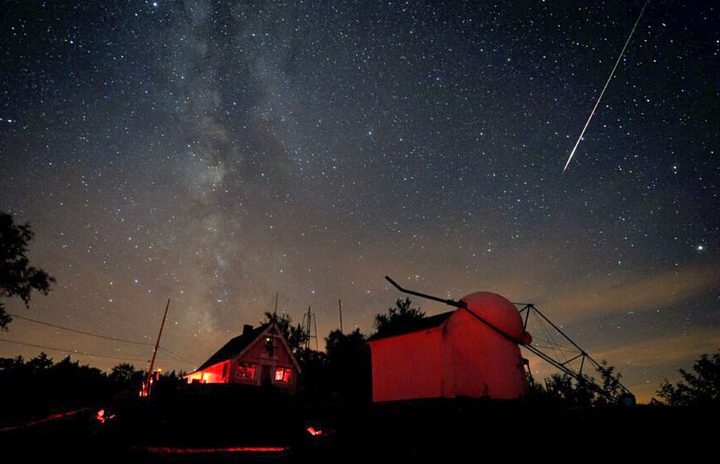
A bright Perseid meteor streaked down on August 7, 2010, over buildings at the Stellafane amateur astronomy convention in Springfield, Vermont.
A bright Perseid meteor streaked down on August 7, 2010, over buildings at the Stellafane amateur astronomy convention in Springfield, Vermont. Sky & Telescope / Dennis di Cicco

This year’s shower promises to be a good one, thanks to the warm summer evening and a waning crescent moon which shouldn’t interfere too much with visibility.

“People in the U.S. can reasonably expect to see around 40 Perseids in the hour just before dawn on the peak nights. That’s about one every couple of minutes, which is not bad,” said Bill Cooke, who leads NASA’s Meteoroid Environment Office, in a statement. “However, we are assuming you are out in the country, well away from cities and suburbs.”

As Cooke mentions, the amount of light pollution in your area will have a significant effect on how many meteors you are able to see. For the best views, you want to find a dark location far away from cities or other sources of light. You also want to avoid looking at anything bright like a phone screen while you wait, as this can affect your night vision which hampers your ability to see meteors.
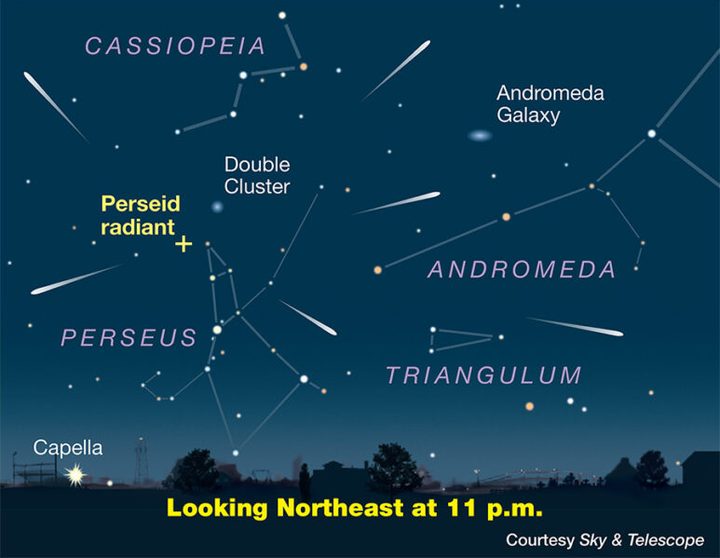
The Perseid meteors appear to stream away from the shower's "radiant" point near the border of Perseus and Cassiopeia.
The Perseid meteors appear to stream away from the shower’s “radiant” point near the border of Perseus and Cassiopeia. Sky & Telescope Illustration

Sky & Telescope magazine has this helpful guide on where in the sky you should look for the best view of the shower.

How to watch the Perseid meteor shower online

If finding a safe, warm, and sufficiently dark place to observe the shower would be difficult for you, then another option is to enjoy the shower via a live stream. The Virtual Telescope Project will show a view of the skies as seen from its facility in Manciano, Italy, which you can watch using the video below:

Perseid meteor shower 2023, online observation – 13 Aug. 2022

Coverage begins at 9:30 p.m. ET (6:30 p.m. PT) on Saturday, August 12.

Georgina Torbet
Georgina has been the space writer at Digital Trends space writer for six years, covering human space exploration, planetary…
Space is becoming Bezos and Musk’s next data center site, and we have every reason to worry
The AI boom is coming for the night sky
How Vast's space station will look in orbit.

AI data centers already consume vast amounts of electricity and water on Earth, so Silicon Valley has begun looking somewhere considerably more spacious... literally.

Elon Musk's SpaceX and Jeff Bezos' Blue Origin, along with several other companies, have proposed enormous constellations of satellites designed to operate as orbital data centers. However, environmental groups and former space officials are now warning that putting them into orbit at the proposed scale could have severe consequences for Earth's atmosphere and the night sky.

Read more
The first possible exomoon is here, and it makes our Moon look hilariously tiny
Scientists may have found the first exomoon, except this one is the size of Jupiter
This artist’s concept depicts a potential volcanic moon between the exoplanet WASP-49 b, left, and its parent star. New evidence indicating that a massive sodium cloud observed near WASP-49 b is produced by neither the planet nor the star has prompted researchers to ask if its origin could be an exomoon.

We have already discovered more than 6,000 planets outside of our immediate neighborhood. Yet, finding a moon orbiting one of those distant worlds has proved considerably harder. Astronomers may finally have something close to the real deal, but this particular object stretches the word “moon” almost beyond recognition.

Using the European Southern Observatory’s Very Large Telescope in Chile, researchers detected strong evidence for a moon-like object in the CD-35 2722 system. Further observations are still necessary to confirm the discovery, but it could become the first confidently detected natural satellite outside our solar system. There is still one tiny complication though. This moon is apparently massive.

Read more
China’s answer to SpaceX’s reusable rockets literally catches boosters in a net
SpaceX catches boosters on legs. China just used a net.
Ammunition, Missile, Weapon

SpaceX's playbook for recovering a rocket booster generally involves legs, a precisely controlled vertical landing, and either a concrete pad or a drone ship. 

China just managed to pull off something similar, but in a slightly different way, and on July 10, it tested the method as well.

Read more

