1. Home
  2. Space
  3. News

Neptune has a dark spot of its own, and it has been imaged from Earth

Add as a preferred source on Google

While the most famous planetary spot in the solar system would have to be Jupiter’s Great Red Spot, an epic storm 10,000 miles wide that has been raging for hundreds of years, other planets are known to host spots of their own as well. That includes Neptune, which had a large dark spot that was first imaged by Voyager 2 when it passed by in the 1980s.

Neptune’s spot was named the Great Dark Spot, but when the Hubble Space Telescope tried to image the spot in 1994, it had disappeared. Now, a Neptune spot has been imaged from the ground for the first time, using the European Southern Observatory’s Very Large Telescope (VLT).
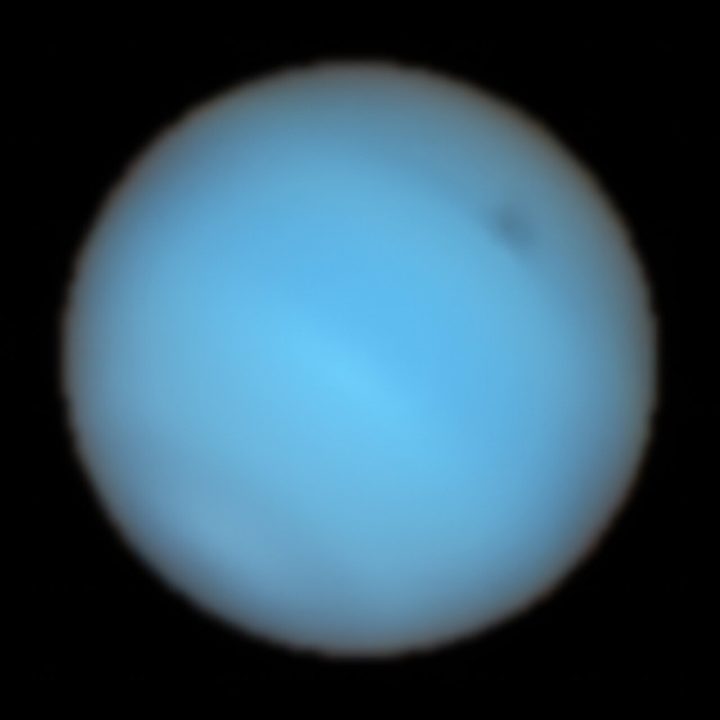
Neptune observed with the MUSE instrument at ESO’s Very Large Telescope.
This image shows Neptune observed with the MUSE instrument at ESO’s Very Large Telescope. At each pixel within Neptune, MUSE splits the incoming light into its constituent colors or wavelengths. This is similar to obtaining images at thousands of different wavelengths all at once, which provides a wealth of valuable information to astronomers. This image combines all colors captured by MUSE into a “natural” view of Neptune, where a dark spot can be seen to the upper right. ESO/P. Irwin et al.

“Since the first discovery of a dark spot, I’ve always wondered what these short-lived and elusive dark features are,” said lead researcher Patrick Irwin of the University of Oxford in a statement.

Recommended Videos

Hubble returned to observe Neptune and observed another spot in the northern hemisphere in 2018, providing the chance for astronomers to study a spot while it was present. They used an instrument on the VLT called MUSE, or the Multi Unit Spectroscopic Explorer, to get spectrographic data which shows a 3D view of the spot by looking at different levels in the atmosphere. The research suggests that the spot is caused by darker air particles, which collect beneath the hazy layer in the planet’s atmosphere.

“I’m absolutely thrilled to have been able to not only make the first detection of a dark spot from the ground but also record for the very first time a reflection spectrum of such a feature,” said Irwin.
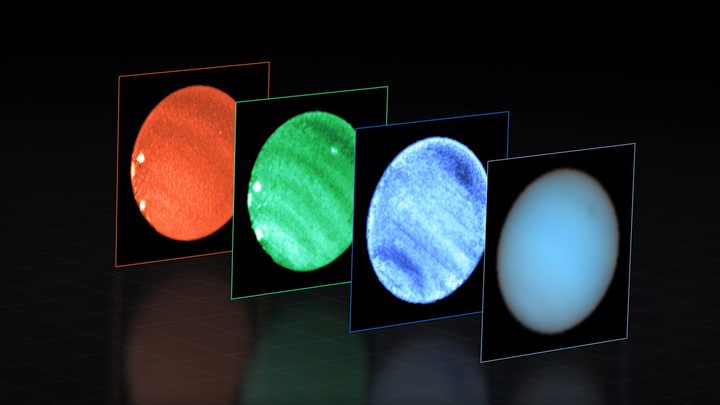
This image shows Neptune observed with the MUSE instrument at ESO’s Very Large Telescope (VLT). At each pixel within Neptune, MUSE splits the incoming light into its constituent colours or wavelengths. This is similar to obtaining images at thousands of different wavelengths all at once, which provides a wealth of valuable information to astronomers.
This image shows Neptune observed with the MUSE instrument at ESO’s Very Large Telescope (VLT). At each pixel within Neptune, MUSE splits the incoming light into its constituent colors or wavelengths. This is similar to obtaining images at thousands of different wavelengths all at once, which provides a wealth of valuable information to astronomers. ESO/P. Irwin et al.

The researchers also found an unexpected bright spot next to the dark spot, thought to be an unusual type of cloud. The research shows how astronomers can learn more about the atmospheres of distant solar system planets from the ground.

“This is an astounding increase in humanity’s ability to observe the cosmos. At first, we could only detect these spots by sending a spacecraft there, like Voyager. Then we gained the ability to make them out remotely with Hubble. Finally, technology has advanced to enable this from the ground,” said co-author Michael Wong.

The research is published in the journal Nature Astronomy.

Georgina Torbet
Georgina has been the space writer at Digital Trends space writer for six years, covering human space exploration, planetary…
China’s answer to SpaceX’s reusable rockets literally catches boosters in a net
SpaceX catches boosters on legs. China just used a net.
Ammunition, Missile, Weapon

SpaceX's playbook for recovering a rocket booster generally involves legs, a precisely controlled vertical landing, and either a concrete pad or a drone ship. 

China just managed to pull off something similar, but in a slightly different way, and on July 10, it tested the method as well.

Read more
Dimming the sun sounds unhinged, but this new study on El Niño makes a surprisingly good case for it
A natural test case, Australia's worst-ever wildfire season, suggests the idea deserves serious consideration.
Nature, Outdoors, Sky

When I first saw "scientists propose dimming the sun," I rolled my eyes. It sounds like a science fiction movie cooked up after watching many climate documentaries. But a new study, published on July 8, 2026, in the journal Science Advances, seems to have a genuinely compelling argument.

A Super El Niño is currently forming in the Pacific, feared to be the most intense in decades. It could escalate floods, wildfires, and extreme heat events worldwide. However, Researchers at UC San Diego's Scripps Institution of Oceanography, led by climate scientists Kate Ricke and Jessica Wan, are now proposing one of the most interesting solutions I’ve come across.

Read more
You can now walk through space and gaze into a black hole at this VR exhibit
Smithsonian Starstruck lets you drift past dying stars and see the origin point of the universe for as little as $18 a person.
Smithsonian Starstruck featured

Most planetarium shows ask you to sit still and look up. The Smithsonian's new VR exhibit takes a different approach, letting visitors walk through the vast expanse of the universe, drifting past stars, planets, and a black hole to get a physical sense of its true scale.

A $29 ticket to the edge of the galaxy

Read more