1. Home
  2. Space
  3. News

Tonight is your chance to observe a rare blue supermoon

Add as a preferred source on Google

Just in time for the end of the month, and the ending of summer in the Northern Hemisphere, tonight will see a rare astronomical phenomenon called a blue supermoon. The moon will be looking particularly spectacular tonight, so if you have the chance to head outside this evening, then make sure to look up and admire our planet’s largest satellite.

The moon will be at its largest and most prominent tonight, and you don’t need any special equipment like telescopes to enjoy the sight. But if you are a keen sky watcher and you do have a telescope or binoculars, then you might want to grab that too as there’s a chance you could also catch a great view of Saturn. You can also check out NASA’s daily moon guide to learn what sights of the moon you’ll be able to see based on what equipment you have and what hemisphere you’re in.
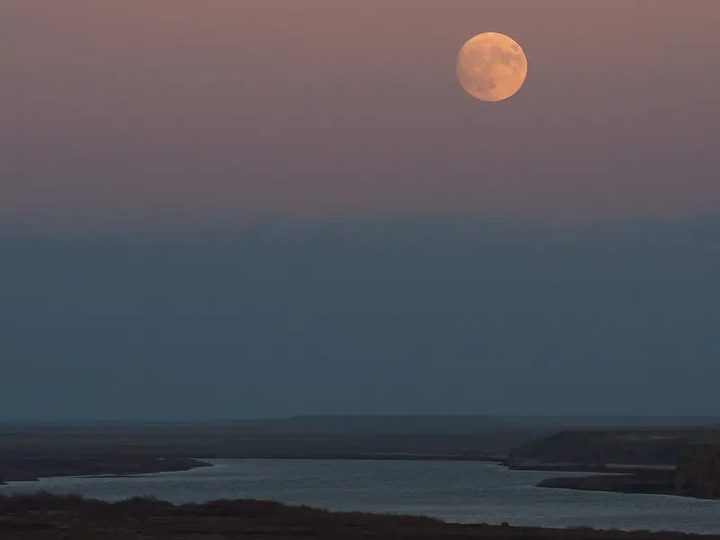
Moonrise over the Syr Darya river in Baikonur, Kazakhstan on Nov. 13, 2016.
Moonrise over the Syr Darya river in Baikonur, Kazakhstan on November 13, 2016. NASA/Bill Ingalls

A supermoon happens when the moon reaches its closest point to Earth. That occurs because the moon doesn’t actually orbit the Earth in a perfect circle — rather, its orbit is slightly elliptical or oval-shaped. So at some points during the month, the moon is further away, and at other times it is closer. When the moon is at its closest point at the same time that it is full, it is called a supermoon and appears around 14% larger than usual.

What Makes a Supermoon Super? (Animation)

A blue moon, made famous by the phrase “once in a blue moon,” doesn’t actually involve the moon changing color. Rather, it is a phrase applied to the rare occasions in which two full moons occur during one calendar month. The second of these full moons is called a blue moon.

Recommended Videos

However, as Sky & Telescope notes, the phrase can have a rather complicated and ambiguous meaning. Sometimes the phrase blue moon can relate to seasonal frequency, not monthly frequency. It can refer to the occasions when four full moons occur within a season, which normally has only three. The third full moon of the four within a season has historically been called a blue moon to help keep the names of other moons in sync.

So tonight’s moon is blue by the calendar meaning, but not by the seasonal meaning. We’ll leave it to you to decide whether that counts or not.

Georgina Torbet
Georgina has been the space writer at Digital Trends space writer for six years, covering human space exploration, planetary…
China’s answer to SpaceX’s reusable rockets literally catches boosters in a net
SpaceX catches boosters on legs. China just used a net.
Ammunition, Missile, Weapon

SpaceX's playbook for recovering a rocket booster generally involves legs, a precisely controlled vertical landing, and either a concrete pad or a drone ship. 

China just managed to pull off something similar, but in a slightly different way, and on July 10, it tested the method as well.

Read more
Dimming the sun sounds unhinged, but this new study on El Niño makes a surprisingly good case for it
A natural test case, Australia's worst-ever wildfire season, suggests the idea deserves serious consideration.
Nature, Outdoors, Sky

When I first saw "scientists propose dimming the sun," I rolled my eyes. It sounds like a science fiction movie cooked up after watching many climate documentaries. But a new study, published on July 8, 2026, in the journal Science Advances, seems to have a genuinely compelling argument.

A Super El Niño is currently forming in the Pacific, feared to be the most intense in decades. It could escalate floods, wildfires, and extreme heat events worldwide. However, Researchers at UC San Diego's Scripps Institution of Oceanography, led by climate scientists Kate Ricke and Jessica Wan, are now proposing one of the most interesting solutions I’ve come across.

Read more
You can now walk through space and gaze into a black hole at this VR exhibit
Smithsonian Starstruck lets you drift past dying stars and see the origin point of the universe for as little as $18 a person.
Smithsonian Starstruck featured

Most planetarium shows ask you to sit still and look up. The Smithsonian's new VR exhibit takes a different approach, letting visitors walk through the vast expanse of the universe, drifting past stars, planets, and a black hole to get a physical sense of its true scale.

A $29 ticket to the edge of the galaxy

Read more