1. Home
  2. Space
  3. News

Swift Observatory spots a black hole snacking on a nearby star

Add as a preferred source on Google

Black holes can be hungry beasts, devouring anything that comes to close to them, including clouds of gas, rogue planets, and even stars. When stars get too close to a black hole, they can be pulled apart by gravity in a process called tidal disruption that breaks up the star into streams of gas. But a recent discovery shows a different phenomenon: a black hole that is “snacking” on a star. It’s not totally destroying the star, but pulling off material and nibbling at it on a regular basis.

Black Hole Snack Attack

The process has been named partial or repeating tidal disruption, as instead of a star being ripped apart in one dramatic event, it is being slowly worn down by repeated encounters with a black hole. It was observed happening to a star called Swift J023017.0+283603 (or Swift J0230 for short) by NASA’s Neil Gehrels Swift Observatory.
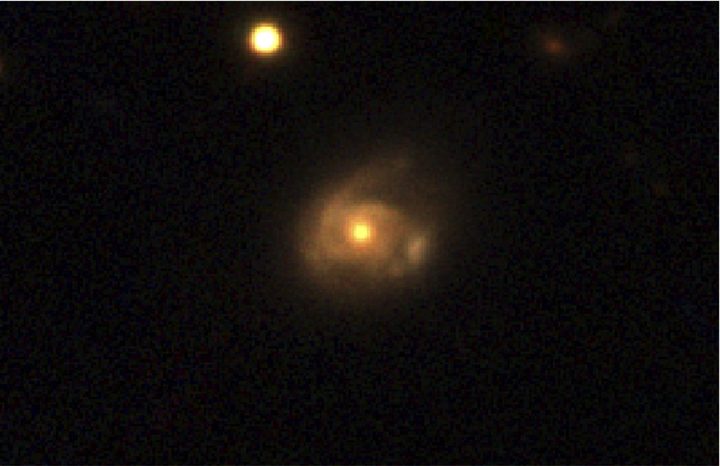
Swift J0230 occurred over 500 million light-years away in a galaxy named 2MASX J02301709+2836050, captured here by the Pan-STARRS telescope in Hawaii.
Swift J0230 occurred over 500 million light-years away in a galaxy named 2MASX J02301709+2836050, and is captured here by the Pan-STARRS telescope in Hawaii. Neils Bohr Institute/Daniele Malesani

Each time the unlucky star passes close to the black hole, the gravitational forces cause it to bulge outward and material is stripped away from it to be eaten by the black hole. But an individual encounter isn’t enough to destroy the star, so it carries on until its orbit brings it close to the black hole once again, when more material is stripped away.

Recommended Videos

In the case of Swift J0230, the sun loses around three Earth masses of material on each encounter, and will continue to lose mass until it runs out of material  and breaks apart.

This event was observed because of a new method of data analysis being used on data from the Swift Observatory, which was launched nearly 20 years ago and was primarily designed to study gamma-ray bursts. Using data from the observatory’s X-ray Telescope instrument, the team turned the instrument into a kind of survey, as it regularly observes portions of the sky, and this data is compared to previous observations. That makes it clear when a change has occurred, indicating a transient event. This flags potentially interesting objects like Swift J0230 for the team to investigate.

“Swift’s hardware, software, and the skills of its international team have enabled it to adapt to new areas of astrophysics over its lifetime,” said Swift team member Phil Evans of the University of Leicester in a statement. “Neil Gehrels, the mission’s namesake, oversaw and encouraged many of those transitions. Now, with this new ability, it’s doing even more cool science.”

Georgina Torbet
Georgina has been the space writer at Digital Trends space writer for six years, covering human space exploration, planetary…
China’s answer to SpaceX’s reusable rockets literally catches boosters in a net
SpaceX catches boosters on legs. China just used a net.
Ammunition, Missile, Weapon

SpaceX's playbook for recovering a rocket booster generally involves legs, a precisely controlled vertical landing, and either a concrete pad or a drone ship. 

China just managed to pull off something similar, but in a slightly different way, and on July 10, it tested the method as well.

Read more
Dimming the sun sounds unhinged, but this new study on El Niño makes a surprisingly good case for it
A natural test case, Australia's worst-ever wildfire season, suggests the idea deserves serious consideration.
Nature, Outdoors, Sky

When I first saw "scientists propose dimming the sun," I rolled my eyes. It sounds like a science fiction movie cooked up after watching many climate documentaries. But a new study, published on July 8, 2026, in the journal Science Advances, seems to have a genuinely compelling argument.

A Super El Niño is currently forming in the Pacific, feared to be the most intense in decades. It could escalate floods, wildfires, and extreme heat events worldwide. However, Researchers at UC San Diego's Scripps Institution of Oceanography, led by climate scientists Kate Ricke and Jessica Wan, are now proposing one of the most interesting solutions I’ve come across.

Read more
You can now walk through space and gaze into a black hole at this VR exhibit
Smithsonian Starstruck lets you drift past dying stars and see the origin point of the universe for as little as $18 a person.
Smithsonian Starstruck featured

Most planetarium shows ask you to sit still and look up. The Smithsonian's new VR exhibit takes a different approach, letting visitors walk through the vast expanse of the universe, drifting past stars, planets, and a black hole to get a physical sense of its true scale.

A $29 ticket to the edge of the galaxy

Read more