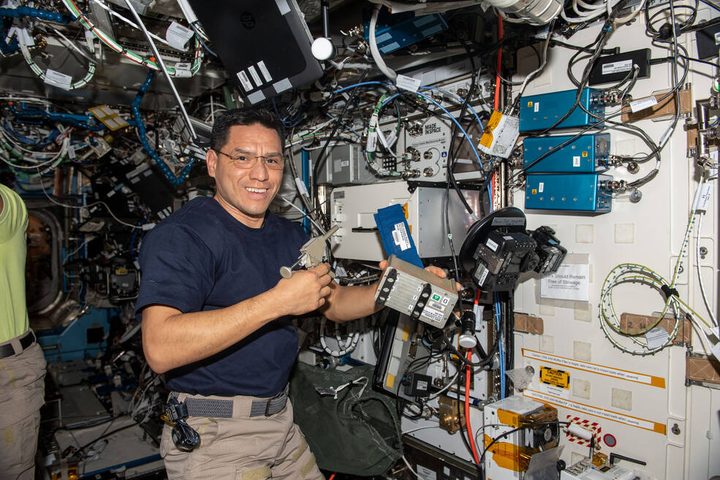
NASA astronaut Frank Rubio marked one whole year in space on Thursday.
It was never meant to be that way, but a coolant leak in December impacting the Soyuz spacecraft that brought him to the International Space Station (ISS) meant he and his two Russian colleagues had their return trip rescheduled, leaving the trio in orbit for an additional six months.
Rubio set a new NASA record for the longest single orbital mission on September 11 when his stay surpassed that of Mark Vande Hei, who spent 355 days in space before returning to Earth in March last year.
NASA shared a short video showing some of the highlights of Rubio’s time aboard the space station over the last 12 months:
Today, Frank Rubio of @NASA_Astronauts marks one full year in space! He holds the record for the longest single spaceflight by a U.S. astronaut.
Rubio returns home to Earth on Sept. 27. About his scientific journey on the @Space_Station: https://t.co/1erJYpWZ1T pic.twitter.com/akE1qa9Jm7
— NASA (@NASA) September 21, 2023
Rubio, who is on his first trip to space, is scheduled to return to Earth next week, extending his total time in orbit to 371 days.
“His record-breaking mission has included dozens of scientific investigations that have helped researchers better understand how humans thrive while living and working in space,” NASA said in a message marking the American astronaut’s full year in orbit.
But it seemed like there was little time to celebrate the one-year anniversary: “Rubio spent most of his 365th day on station upkeep, performing maintenance on the Human Research Facility, removing and replacing its pressure sensor block. In the evening, he collected biological samples for the ongoing Standard Measures investigation,” NASA said.
Astronauts usually stay aboard the space station for six months before returning home, so NASA researchers will be keen to conduct tests upon his return to learn about how his extended stay has affected him both physically and mentally. Anything learned could help NASA refine plans for extended crewed missions to the moon and the first astronaut voyages to Mars.
At the end of Rubio’s mission, only two other humans will have spent a longer period of time in space during a single mission. The record stay is by Russian cosmonaut Valeri Polyakov, who lived aboard the Mir space station for 437 days and 18 hours in the mid-1990s.