  1. Home
  2. Space
  3. News

Dark matter hunting telescope Euclid has a problem with its guidance system

Add as a preferred source on Google

The European Space Agency’s (ESA) Euclid space telescope, which launched in July this year to investigate the mysteries of dark matter and dark energy, has run into issues during its commissioning phase. Although the early calibration images looked good, since then the telescope has had problems with the instrument that helps it position itself by locking onto particular stars, called the Fine Guidance Sensor.

The Fine Guidance Sensor has been intermittently failing to lock onto stars, which is making it difficult to orient the telescope in the right direction. When working correctly, data from the Fine Guidance Sensor goes to the spacecraft’s attitude and orbit control system which keeps it in the right orientation. However as this has not been working as intended, the commissioning phase for the telescope has been extended so teams can investigate the issue.
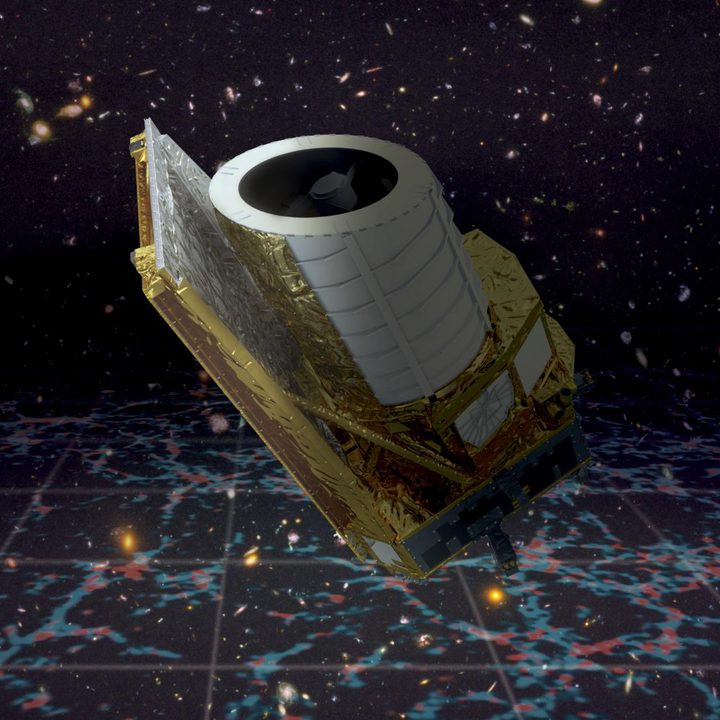
ESA's Euclid mission is designed to explore the composition and evolution of the dark Universe. The space telescope will create a great map of the large-scale structure of the Universe across space and time by observing billions of galaxies out to 10 billion light-years, across more than a third of the sky. Euclid will explore how the Universe has expanded and how structure has formed over cosmic history, revealing more about the role of gravity and the nature of dark energy and dark matter.
ESA’s Euclid mission is designed to explore the composition and evolution of the dark Universe. The space telescope will create a great map of the large-scale structure of the Universe across space and time by observing billions of galaxies out to 10 billion light-years, across more than a third of the sky. Euclid will explore how the Universe has expanded and how structure has formed over cosmic history, revealing more about the role of gravity and the nature of dark energy and dark matter. ESA/Euclid/Euclid Consortium/NASA. Background galaxies: NASA, ESA, and S. Beckwith (STScI) and the HUDF Team, CC BY-SA 3.0 IGO

“The issue of Euclid’s fine guidance is something we’ve all been concerned about. Teams at ESA’s technical heart (ESTEC), mission control (ESOC), Astronomy Centre (ESAC) and industry have been working day and night, tirelessly for months, and I can’t thank them enough for their determination to resolve the issue,” said Euclid Operations Director Andreas Rudolph in a statement. “I’m relieved to say that initial tests are looking good. We’re finding many more stars in all our tests, and while it’s too early to celebrate and more observations are needed, the signs are very encouraging.”

Recommended Videos

The teams have created updated software to address the issue, and the software fix has worked on a test version of the spacecraft which is kept at mission control. The update has now been sent to the telescope too, and the teams will be testing the telescope to see if it helps fix the issue.

“Obviously, this is where we will have the real test of truth, as only the science images can provide us with absolute certainty that Euclid’s pointing is performing well,” said Giuseppe Racca, Euclid Project Manager. “However, all evidence so far makes us very optimistic. We will continue to keep our fingers tightly crossed, but the restart of the performance verification phase gets nearer every day.”

Georgina Torbet
Georgina has been the space writer at Digital Trends space writer for six years, covering human space exploration, planetary…
Dimming the sun sounds unhinged, but this new study on El Niño makes a surprisingly good case for it
A natural test case, Australia's worst-ever wildfire season, suggests the idea deserves serious consideration.
Nature, Outdoors, Sky

When I first saw "scientists propose dimming the sun," I rolled my eyes. It sounds like a science fiction movie cooked up after watching many climate documentaries. But a new study, published on July 8, 2026, in the journal Science Advances, seems to have a genuinely compelling argument.

A Super El Niño is currently forming in the Pacific, feared to be the most intense in decades. It could escalate floods, wildfires, and extreme heat events worldwide. However, Researchers at UC San Diego's Scripps Institution of Oceanography, led by climate scientists Kate Ricke and Jessica Wan, are now proposing one of the most interesting solutions I’ve come across.

Read more
You can now walk through space and gaze into a black hole at this VR exhibit
Smithsonian Starstruck lets you drift past dying stars and see the origin point of the universe for as little as $18 a person.
Smithsonian Starstruck featured

Most planetarium shows ask you to sit still and look up. The Smithsonian's new VR exhibit takes a different approach, letting visitors walk through the vast expanse of the universe, drifting past stars, planets, and a black hole to get a physical sense of its true scale.

A $29 ticket to the edge of the galaxy

Read more
Scientists warn Elon Musk’s orbital data centers could blind Earth’s biggest telescopes
A new ESO study suggests millions of satellites could make parts of the night sky effectively unusable for astronomy.
One hour of satellites over the northern Atacama Desert in Chile (October 2025)

The race to blanket Earth with satellite internet has unlocked faster connectivity for millions. But according to the European Southern Observatory (ESO), it could also make one of humanity's oldest hobbies, and one of its most important sciences, a whole lot harder. The organization warns that the rapid growth of satellite mega-constellations could severely disrupt observations made by some of the world's most powerful telescopes.

Astronomers say the night sky is reaching its limit

Read more