  1. Home
  2. Space
  3. News

NASA photo shows off engines that will power next crewed lunar mission

Add as a preferred source on Google
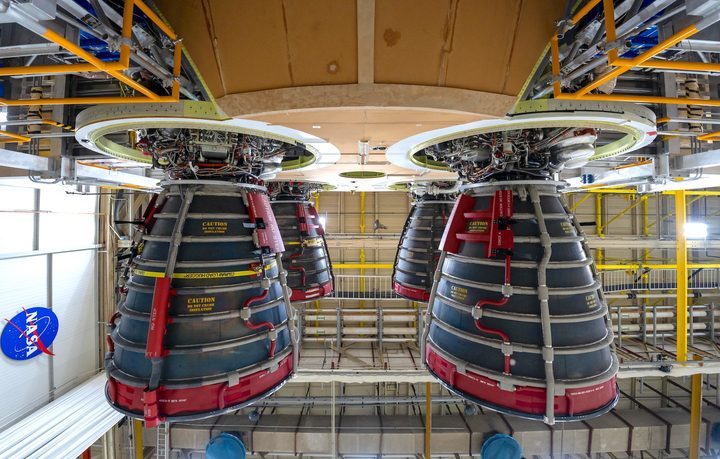
Four RS-25 engines attached to the core stage of NASA's SLS moon rocket.
NASA

NASA has shared an awesome shot (above) showing the four engines that will power the first crewed mission to the moon in five decades.

The four RS-25 engines were recently attached to the core booster of NASA’s Space Launch System (SLS) rocket that will propel the four astronauts toward the moon in the Artemis II mission, currently scheduled for November next year.

Recommended Videos

The engines were attached to the core stage at NASA’s Michoud Assembly Facility in New Orleans, Louisiana.

Together, the engines are capable of producing around 2.2 million pounds of thrust at launch. Working with the vehicle’s two side boosters, the SLS produced an impressive 8.8 million pounds of thrust when the rocket lifted off on its maiden flight in November last year, sending an uncrewed Orion capsule on a flyby of the moon in the Artemis I mission.

The first four Artemis missions are actually using refurbished engines that powered the Space Shuttle until the program was decommissioned in 2011.

The Artemis II mission will send NASA astronauts Christina Koch, Victor Glover, and Reid Wiseman, along with Canadian Space Agency astronaut Jeremy Hansen, on the same voyage as the Artemis I mission. There’ll be no moon landing, but instead, a flyby that will take the crew within just 80 miles of the lunar surface.

Seeing the core stage coming together is sure to give the four astronauts a boost as the date for their mission edges closer. In August, the crew were able to take their first close look at the actual Orion capsule that will carry them on their epic voyage next year.

The Artemis II mission will confirm the safe operation of Orion’s crew support systems and pave the way for a highly anticipated crewed landing, possibly in 2025. Astronauts for that mission have yet to be named.

Beyond that, NASA plans to build a permanent base on the moon for long-duration stays, similar to how astronauts spend extended periods on the near-Earth International Space Station today.

Trevor Mogg
Contributing Editor
Not so many moons ago, Trevor moved from one tea-loving island nation that drives on the left (Britain) to another (Japan)…
You can now walk through space and gaze into a black hole at this VR exhibit
Smithsonian Starstruck lets you drift past dying stars and see the origin point of the universe for as little as $18 a person.
Smithsonian Starstruck featured

Most planetarium shows ask you to sit still and look up. The Smithsonian's new VR exhibit takes a different approach, letting visitors walk through the vast expanse of the universe, drifting past stars, planets, and a black hole to get a physical sense of its true scale.

A $29 ticket to the edge of the galaxy

Read more
Scientists warn Elon Musk’s orbital data centers could blind Earth’s biggest telescopes
A new ESO study suggests millions of satellites could make parts of the night sky effectively unusable for astronomy.
One hour of satellites over the northern Atacama Desert in Chile (October 2025)

The race to blanket Earth with satellite internet has unlocked faster connectivity for millions. But according to the European Southern Observatory (ESO), it could also make one of humanity's oldest hobbies, and one of its most important sciences, a whole lot harder. The organization warns that the rapid growth of satellite mega-constellations could severely disrupt observations made by some of the world's most powerful telescopes.

Astronomers say the night sky is reaching its limit

Read more
Amazon’s Starlink rival just crossed a major milestone, but don’t expect perfect internet just yet
Amazon finally showed up to the space internet party
Amazon Leo satellite layout across all launch vehicles

Amazon has taken a significant step toward launching its long-awaited satellite internet service. Following its latest rocket launch, the company now has 396 Project Kuiper satellites in low-Earth orbit, enough to begin offering continuous service across select regions. The milestone keeps Amazon on track for its previously announced goal of launching commercial service by mid-2026.

https://twitter.com/Weber44Chris/status/2072575499461963938?ref_src=twsrc%5Etfw%7Ctwcamp%5Etweetembed%7Ctwterm%5E2072575499461963938%7Ctwgr%5Ed727a1b853cbf519585e7bf2655943afb2f91bb8%7Ctwcon%5Es1_&ref_url=https%3A%2F%2Fwww.theverge.com%2Fscience%2F960563%2Famazon-leo-service-tipping-point

Read more