1. Home
  2. Space
  3. News

James Webb observes merging stars creating heavy elements

Add as a preferred source on Google

In its earliest stages, the universe was composed mostly of hydrogen and helium. All of the other, heavier elements that make up the universe around us today were created over time, and it is thought that they were created primarily within stars. Stars create heavy elements within them in the process of fusion, and when these stars reach the ends of their lives they may explode in supernovas, spreading these elements in the environment around them.

That’s how heavier elements like those up to iron are created. But for the heaviest elements, the process is thought to be different. These are created not within stellar cores, but in extreme environments such as the merging of stars, when massive forces create exceedingly dense environments that forge new elements.

Recommended Videos

Now, the James Webb Space Telescope has detected some of these heavy elements being created in a star merger for the first time. Researchers used the telescope to observe the effects of a kilonova, a huge outpouring of energy that occurs when two neutron stars merge. The event created a particularly bright gamma-ray burst which allowed the researchers to zero in and identify the location of the merger.
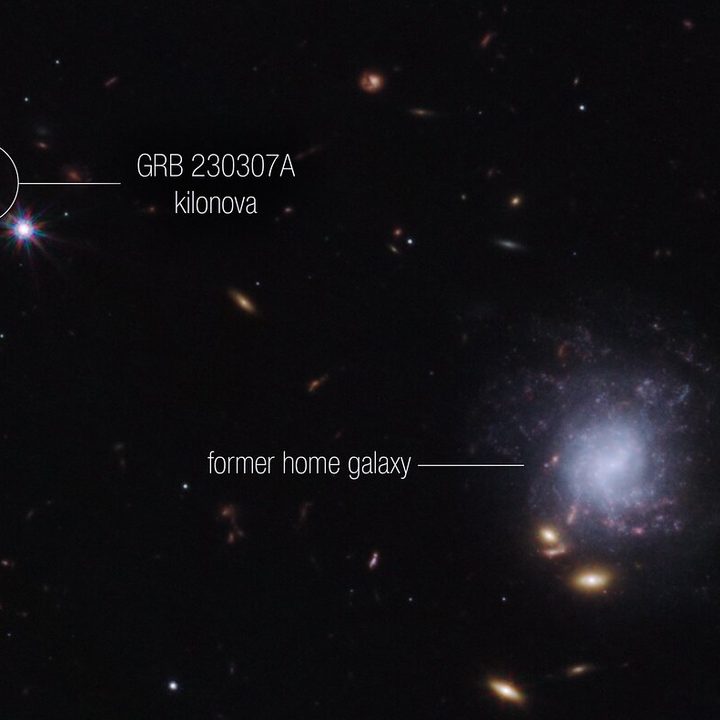
A team of scientists has used the NASA/ESA/CSA James Webb Space Telescope to observe an exceptionally bright gamma-ray burst, GRB 230307A, and its associated kilonova. Kilonovas—an explosion produced by a neutron star merging with either a black hole or with another neutron star—are extremely rare, making it difficult to observe these events. The highly sensitive infrared capabilities of Webb helped scientists identify the home address of the two neutron stars that created the kilonova. This image from Webb’s NIRCam (Near-Infrared Camera) instrument highlights GRB 230307A’s kilonova and its former home galaxy among their local environment of other galaxies and foreground stars. The neutron stars were kicked out of their home galaxy and travelled the distance of about 120,000 light-years, approximately the diameter of the Milky Way galaxy, before finally merging several hundred million years later.
A team of scientists has used the NASA/ESA/CSA James Webb Space Telescope to observe an exceptionally bright gamma-ray burst, GRB 230307A, and its associated kilonova. Kilonovas—an explosion produced by a neutron star merging with either a black hole or with another neutron star—are extremely rare, making it difficult to observe these events. The highly sensitive infrared capabilities of Webb helped scientists identify the home address of the two neutron stars that created the kilonova. This image from Webb’s NIRCam (Near-Infrared Camera) instrument highlights GRB 230307A’s kilonova and its former home galaxy among their local environment of other galaxies and foreground stars. The neutron stars were kicked out of their home galaxy and traveled a distance of about 120,000 light-years, approximately the diameter of the Milky Way galaxy, before finally merging several hundred million years later. NASA, ESA, CSA, STScI, A. Levan (IMAPP, Warw), A. Pagan (STScI)

Webb observed the element tellurium being ejected by the kilonova, which was likely created in the merger. Although scientists have long theorized that this is how heavy elements could be created, this is the first time such direct evidence has been observed as kilonovas are rare and brief events. The particular brightness of the gamma-ray burst GRB 230307A was key to helping to locate this event.

“Webb provides a phenomenal boost and may find even heavier elements,” said Ben Gompertz, a co-author of the study at the University of Birmingham in the United Kingdom. “As we get more frequent observations, the models will improve and the spectrum may evolve more in time. Webb has certainly opened the door to do a lot more, and its abilities will be completely transformative for our understanding of the Universe.”

The research is published in the journal Nature.

Georgina Torbet
Georgina has been the space writer at Digital Trends space writer for six years, covering human space exploration, planetary…
China’s answer to SpaceX’s reusable rockets literally catches boosters in a net
SpaceX catches boosters on legs. China just used a net.
Ammunition, Missile, Weapon

SpaceX's playbook for recovering a rocket booster generally involves legs, a precisely controlled vertical landing, and either a concrete pad or a drone ship. 

China just managed to pull off something similar, but in a slightly different way, and on July 10, it tested the method as well.

Read more
Dimming the sun sounds unhinged, but this new study on El Niño makes a surprisingly good case for it
A natural test case, Australia's worst-ever wildfire season, suggests the idea deserves serious consideration.
Nature, Outdoors, Sky

When I first saw "scientists propose dimming the sun," I rolled my eyes. It sounds like a science fiction movie cooked up after watching many climate documentaries. But a new study, published on July 8, 2026, in the journal Science Advances, seems to have a genuinely compelling argument.

A Super El Niño is currently forming in the Pacific, feared to be the most intense in decades. It could escalate floods, wildfires, and extreme heat events worldwide. However, Researchers at UC San Diego's Scripps Institution of Oceanography, led by climate scientists Kate Ricke and Jessica Wan, are now proposing one of the most interesting solutions I’ve come across.

Read more
You can now walk through space and gaze into a black hole at this VR exhibit
Smithsonian Starstruck lets you drift past dying stars and see the origin point of the universe for as little as $18 a person.
Smithsonian Starstruck featured

Most planetarium shows ask you to sit still and look up. The Smithsonian's new VR exhibit takes a different approach, letting visitors walk through the vast expanse of the universe, drifting past stars, planets, and a black hole to get a physical sense of its true scale.

A $29 ticket to the edge of the galaxy

Read more