1. Home
  2. Space
  3. News

See the dramatic, volcanic moon Io in new Juno images

Add as a preferred source on Google

NASA’s Juno spacecraft recently made a close flyby of the solar system’s most volcanic body, the Jovian moon of Io. During the flyby, the spacecraft came within 1,000 miles of Io, which is the closest any craft has come to the moon within the last 20 years.

During its flyby, the spacecraft snapped images using its JunoCam instrument, and some of those images are now publicly available.

Recommended Videos

The JunoCam instrument aboard our #JunoMission acquired six images of Jupiter's moon Io during its close encounter today. This black-and-white view was taken at an altitude of about 1,500 miles (2,500 kilometers). More images will be available soon at https://t.co/mGfITRe57Y pic.twitter.com/9GcamrhxPt

— NASA Solar System (@NASASolarSystem) December 31, 2023

Data from JunoCam is all shared on the Juno website, as part of a program encouraging the public to try their hand at image processing. One of the most prolific image processors is Kevin M. Gill, who works for NASA’s Jet Propulsion Laboratory and processed the image of Io below. This was taken on December 30 as Juno made its close approach:
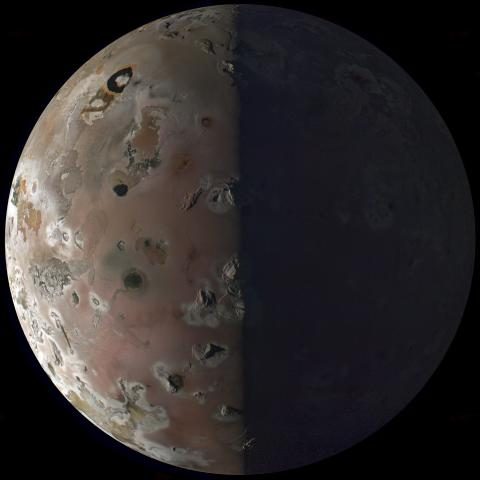
Io, imaged by the Juno spacecraft on December 30, 2023.
Io, imaged by the Juno spacecraft on December 30, 2023. NASA/JPL-Caltech/SwRI/MSSS/Kevin M. Gill

This is a follow-up of sorts to previous images of Io that Juno has taken during aerlier approaches to the moon. These previous images were taken from distances of down to 7,000 miles, such as this image from a flyby in October of last year:
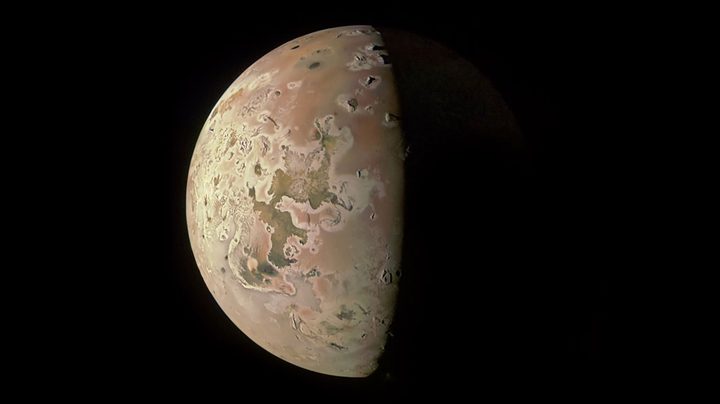
This image revealing the north polar region of the Jovian moon Io was taken on October 15 by NASA’s Juno. Three of the mountain peaks visible in the upper part of image, near the day-night dividing line, were observed here for the first time by the spacecraft’s JunoCam.
This image revealing the north polar region of the Jovian moon Io was taken on October 15 by NASA’s Juno. Three of the mountain peaks visible in the upper part of image, near the day-night dividing line, were observed here for the first time by the spacecraft’s JunoCam. Image data: NASA/JPL-Caltech/SwRI/MSSS, Image processing by Ted Stryk

Juno will be making another flyby to Io in February of this year, allowing researchers to get another close look at the moon. That’s exciting because scientists know that there are over 400 volcanoes on Io, and looking at it twice within a relatively short time period allows them to see whether surface changes are visible because of all this volcanic activity.

The Juno spacecraft was originally designed to primarily study Jupiter, but it is now on its extended mission and is making seven additional flybys of Io to gather more data about this relatively little-studied body. Once the spacecraft has made its Io flybys, it will be in a different orbit relative to Jupiter and will have to deal with short periods when the planet is blocking the sun, meaning it will not receive power from its solar panels. But NASA says that the five minute periods of darkness will be short enough that they won’t affect the spacecraft’s overall operation.

Georgina Torbet
Georgina has been the space writer at Digital Trends space writer for six years, covering human space exploration, planetary…
China’s answer to SpaceX’s reusable rockets literally catches boosters in a net
SpaceX catches boosters on legs. China just used a net.
Ammunition, Missile, Weapon

SpaceX's playbook for recovering a rocket booster generally involves legs, a precisely controlled vertical landing, and either a concrete pad or a drone ship. 

China just managed to pull off something similar, but in a slightly different way, and on July 10, it tested the method as well.

Read more
Dimming the sun sounds unhinged, but this new study on El Niño makes a surprisingly good case for it
A natural test case, Australia's worst-ever wildfire season, suggests the idea deserves serious consideration.
Nature, Outdoors, Sky

When I first saw "scientists propose dimming the sun," I rolled my eyes. It sounds like a science fiction movie cooked up after watching many climate documentaries. But a new study, published on July 8, 2026, in the journal Science Advances, seems to have a genuinely compelling argument.

A Super El Niño is currently forming in the Pacific, feared to be the most intense in decades. It could escalate floods, wildfires, and extreme heat events worldwide. However, Researchers at UC San Diego's Scripps Institution of Oceanography, led by climate scientists Kate Ricke and Jessica Wan, are now proposing one of the most interesting solutions I’ve come across.

Read more
You can now walk through space and gaze into a black hole at this VR exhibit
Smithsonian Starstruck lets you drift past dying stars and see the origin point of the universe for as little as $18 a person.
Smithsonian Starstruck featured

Most planetarium shows ask you to sit still and look up. The Smithsonian's new VR exhibit takes a different approach, letting visitors walk through the vast expanse of the universe, drifting past stars, planets, and a black hole to get a physical sense of its true scale.

A $29 ticket to the edge of the galaxy

Read more