1. Home
  2. Space
  3. News

Astrobotic reveals time and place of Peregrine spacecraft reentry

Add as a preferred source on Google

It’s been quite a ride for Astrobotic’s Peregrine lunar lander. When it launched from the Kennedy Space Center on Monday, January 8, there were high hopes that it would become the first U.S. mission to touch down on the moon since the final Apollo voyage in December 1972. Pittsburgh-based Astrobotic was also vying to become the first commercial endeavor to land on the moon.

But it wasn’t to be.

Recommended Videos

Just hours after liftoff, the company revealed that the Peregrine spacecraft had suffered a critical propellant leak that would prevent it from reaching the lunar surface in February as planned.

Despite the setback, the mission team remained upbeat and managed to keep Peregrine flying, helped in part by an easing in the rate of leakage. It also powered up and collected data from some of the 21 payloads that Peregrine is carrying for a range of organizations, NASA among them.

But with the spacecraft gradually losing power, the decision was recently taken to nudge the vehicle on a trajectory toward Earth, where a high-speed reentry will cause most, if not all, of the tool shed-sized machine to burn up. The alternative would’ve been to leave it in orbit, where it would’ve become yet another piece of hazardous space junk.

In its latest update on Wednesday, Astrobotic said it had managed to perform a series of short engine burns to place Peregrine on a route that will lead to its fiery end.

The engine burns also allowed the company to direct the spacecraft toward a remote area over the Pacific, about 850 miles north of New Zealand and 450 miles east of New Caledonia.

“The procedures the team executed were to minimize the risk of debris reaching land,” Astrobotic said in a release, adding that it expects reentry to occur at about 4 p.m. ET (1 p.m. PT) on Thursday, January 18.
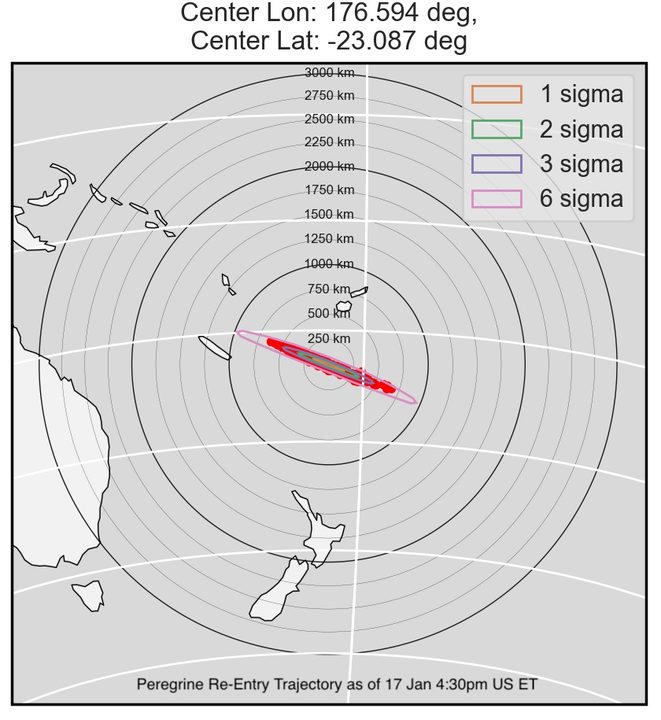
A map showing the approximate location of Peregrine's reentry.
A map showing the approximate location of Peregrine’s reentry. Astrobotic

The company plans to hold a teleconference the following day at 1 p.m. ET (10 a.m. PT) to share a detailed update on the mission.

Astrobotic’s Peregrine Mission 1 was part of NASA’s new CLPS (Commercial Lunar Payload Services) program, which contracts commercial firms to send science missions to the moon ahead of the first Artemis crewed landing, which could take place in 2026.

Astrobotic will take plenty of lessons from its failed Peregrine mission and apply them to its next attempt to reach the moon — with the Griffin lander — in November.

Trevor Mogg
Contributing Editor
Not so many moons ago, Trevor moved from one tea-loving island nation that drives on the left (Britain) to another (Japan)…
China’s answer to SpaceX’s reusable rockets literally catches boosters in a net
SpaceX catches boosters on legs. China just used a net.
Ammunition, Missile, Weapon

SpaceX's playbook for recovering a rocket booster generally involves legs, a precisely controlled vertical landing, and either a concrete pad or a drone ship. 

China just managed to pull off something similar, but in a slightly different way, and on July 10, it tested the method as well.

Read more
Dimming the sun sounds unhinged, but this new study on El Niño makes a surprisingly good case for it
A natural test case, Australia's worst-ever wildfire season, suggests the idea deserves serious consideration.
Nature, Outdoors, Sky

When I first saw "scientists propose dimming the sun," I rolled my eyes. It sounds like a science fiction movie cooked up after watching many climate documentaries. But a new study, published on July 8, 2026, in the journal Science Advances, seems to have a genuinely compelling argument.

A Super El Niño is currently forming in the Pacific, feared to be the most intense in decades. It could escalate floods, wildfires, and extreme heat events worldwide. However, Researchers at UC San Diego's Scripps Institution of Oceanography, led by climate scientists Kate Ricke and Jessica Wan, are now proposing one of the most interesting solutions I’ve come across.

Read more
You can now walk through space and gaze into a black hole at this VR exhibit
Smithsonian Starstruck lets you drift past dying stars and see the origin point of the universe for as little as $18 a person.
Smithsonian Starstruck featured

Most planetarium shows ask you to sit still and look up. The Smithsonian's new VR exhibit takes a different approach, letting visitors walk through the vast expanse of the universe, drifting past stars, planets, and a black hole to get a physical sense of its true scale.

A $29 ticket to the edge of the galaxy

Read more