  1. Home
  2. Space
  3. News

Watch this cool close-up footage of SpaceX’s rocket booster landing

Add as a preferred source on Google
A Falcon 9 booster landing in January 2024.
SpaceX

SpaceX successfully launched a Cygnus cargo ship to the International Space Station (ISS) on Tuesday.

It was the first time for SpaceX to launch the Cygnus, whose 19 previous missions had involved Antares or Atlas rockets.

Recommended Videos

The Elon Musk-led spaceflight company used its workhorse Falcon 9 rocket to launch the Cygnus cargo ship from the Kennedy Space Center in Florida. It carries science experiments, food, and other vital supplies for the ISS crew and will dock with the station early on Thursday.

Tuesday’s launch marked the 10th flight of this particular first-stage booster, which previously launched Crew-5, GPS III Space Vehicle 06, Inmarsat I6-F2, CRS-28, Intelsat G-37, and four Starlink missions.

The reuse of Falcon 9 boosters is made possible by SpaceX’s development of a clever landing procedure that brings the vehicle back to Earth for an upright landing around eight minutes after launch.

Following a number of failed attempts, SpaceX first achieved the feat in 2015 and has since refined the system to a point where it now rarely goes wrong.

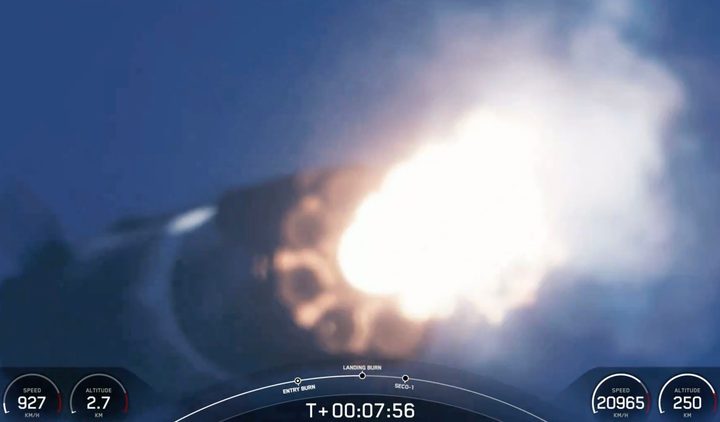
Tuesday’s booster return was captured in some dramatic close-up footage that tracked it all the way back to its landing position close to the launch site at Kennedy. You can watch it below:

Falcon 9's first stage returned to Earth and landed at Landing Zone 1, completing our 10th launch and landing of the year pic.twitter.com/MoqpgEt2hg

— SpaceX (@SpaceX) January 30, 2024

A SpaceX diagram shows the route that the 42.1-meter-tall booster takes for a touchdown on land (it’s slightly different when it heads to a droneship in the ocean).
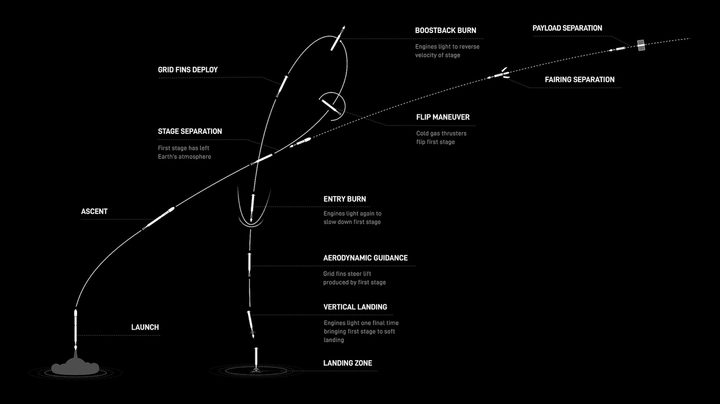
A diagram showing the landing process for a Falcon 9 booster.
SpaceX

After releasing the upper stage, the booster has to perform a crucial flip maneuver followed by a carefully timed boostback burn to set it on course for a safe and successful landing. In the final stages of its descent, the booster deploys grid fins to stabilize the vehicle, followed by an entry burn to slow it down and pave the way for a gentle touchdown.

Following checks and refurbishment, the booster can be used for another mission. The record number of missions flown by a single Falcon 9 booster is currently 19. Booster 1058 would almost certainly have flown again, but it suffered irreparable damage in December when it toppled over on a droneship as it headed to base following its 19th landing.

Trevor Mogg
Contributing Editor
Not so many moons ago, Trevor moved from one tea-loving island nation that drives on the left (Britain) to another (Japan)…
China’s answer to SpaceX’s reusable rockets literally catches boosters in a net
SpaceX catches boosters on legs. China just used a net.
Ammunition, Missile, Weapon

SpaceX's playbook for recovering a rocket booster generally involves legs, a precisely controlled vertical landing, and either a concrete pad or a drone ship. 

China just managed to pull off something similar, but in a slightly different way, and on July 10, it tested the method as well.

Read more
Dimming the sun sounds unhinged, but this new study on El Niño makes a surprisingly good case for it
A natural test case, Australia's worst-ever wildfire season, suggests the idea deserves serious consideration.
Nature, Outdoors, Sky

When I first saw "scientists propose dimming the sun," I rolled my eyes. It sounds like a science fiction movie cooked up after watching many climate documentaries. But a new study, published on July 8, 2026, in the journal Science Advances, seems to have a genuinely compelling argument.

A Super El Niño is currently forming in the Pacific, feared to be the most intense in decades. It could escalate floods, wildfires, and extreme heat events worldwide. However, Researchers at UC San Diego's Scripps Institution of Oceanography, led by climate scientists Kate Ricke and Jessica Wan, are now proposing one of the most interesting solutions I’ve come across.

Read more
You can now walk through space and gaze into a black hole at this VR exhibit
Smithsonian Starstruck lets you drift past dying stars and see the origin point of the universe for as little as $18 a person.
Smithsonian Starstruck featured

Most planetarium shows ask you to sit still and look up. The Smithsonian's new VR exhibit takes a different approach, letting visitors walk through the vast expanse of the universe, drifting past stars, planets, and a black hole to get a physical sense of its true scale.

A $29 ticket to the edge of the galaxy

Read more