  1. Home
  2. Space
  3. News

NASA’s damaged Ingenuity helicopter spotted in Mars rover photo

Add as a preferred source on Google

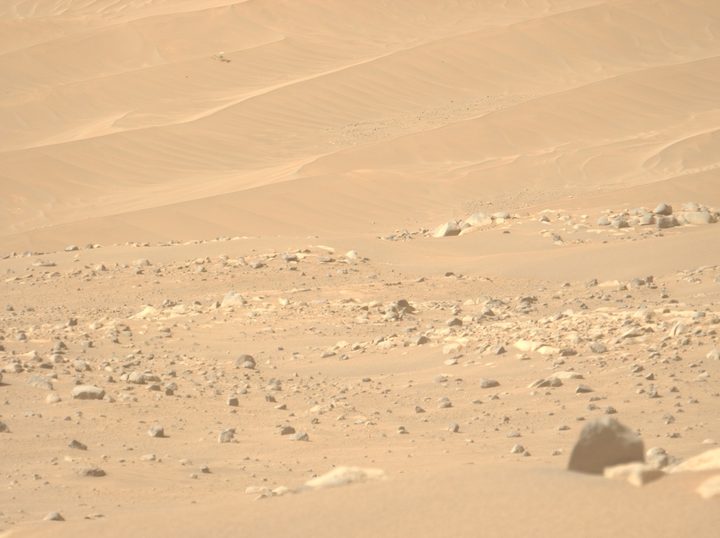
A Mars landscape with NASA's Ingenuity helicopter in the background.
A Mars landscape with NASA’s Ingenuity helicopter seen on the dune in the distance. NASA/JPL-Caltech/ASU

NASA’s Mars rover, Perseverance, has captured an image (above) showing the final resting place of the damaged Mars helicopter, Ingenuity.

Recommended Videos

Perseverance took the picture on February 4, nearly two weeks after NASA’s Jet Propulsion Laboratory (JPL) confirmed that Ingenuity had completed its 72nd and final flight on the red planet.

During that flight on January 18, Ingenuity suffered irreparable damage to a rotor blade, leaving the 4-pound- 19-inch-tall aircraft grounded for good.

In the image captured by Perseverance, we can see Ingenuity in the far distance, alone on a dune, while in the foreground, a variety of rocks dot the landscape. The image below shows the same shot cropped, with the helicopter in the center:
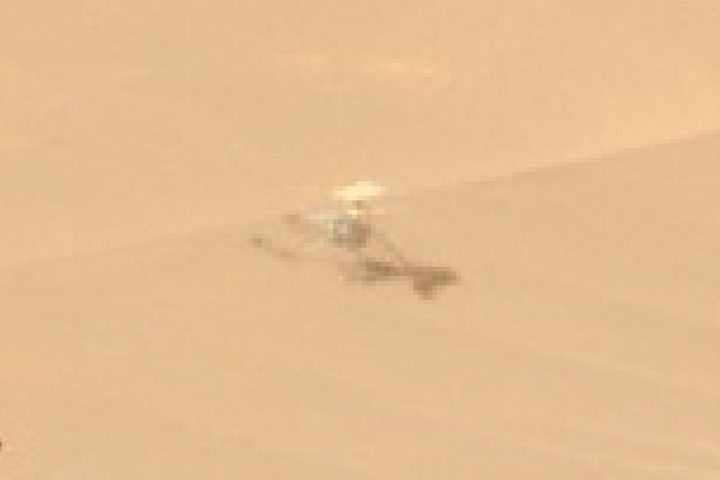
NASA's Ingenuity helicopter at its final resting place on Mars.
NASA’s Ingenuity helicopter at its final resting place on Mars. NASA/JPL-Caltech/ASU

It could be one of the last images we receive of the Ingenuity helicopter.

The remarkable drone-like machine performed well beyond expectations during its time nearly two years on the distant planet. After entering the record books in April 2021 for becoming the first aircraft to perform powered, controlled flight on another planet, Ingenuity’s mission transitioned from a technology demonstration to a test of its ability to assist the Perseverance rover in its quest to uncover evidence of ancient microbial life on Mars.

Ingenuity did this by using its downward-facing camera to explore the landscape inside Jezero Crater for areas of interest for the rover to investigate up close. Once a location of interest had been determined, aerial data from the helicopter could then be used to help the rover team plot the safest and most efficient route for wheel-based Perseverance to take to it.

Ingenuity’s mission was such a success that NASA engineers are set to build a larger, more advanced version of the machine for future missions to Mars and possibly beyond.

Shortly after news broke that Ingenuity had taken its last flight, JPL released a video highlighting the legacy of this extraordinary aircraft.

Trevor Mogg
Contributing Editor
Not so many moons ago, Trevor moved from one tea-loving island nation that drives on the left (Britain) to another (Japan)…
Getting to Mars may require a pit stop in orbit, and NASA just tested the nozzle to make that happen
A gas pump nozzle for spacecraft sounds simple. It is not, and that's what makes this test worth paying attention to.
Architecture, Building, Factory

Getting a spacecraft to Mars or beyond requires an enormous amount of fuel, most of which has to be hauled from Earth, adding to the overall cost and weight of the spacecraft. NASA has been working on a different approach, one that could be more efficient and effective.

It wants to refuel a spacecraft in orbit before heading out for the mission. What’s even more interesting is that the space agency just finished testing a component that could make that possible: a cryocoupler.

Read more
Elon Musk’ Starlink could soon offer mobile services as a US carrier
Showcase of T-Mobile Starlink service on an iPhone.

Elon Musk’s Starlink has already changed how millions of people access the internet, especially in places where traditional broadband struggles to reach. Now, the satellite internet service could be preparing for an even bigger leap — becoming your mobile carrier.

According to a Financial Times report, SpaceX has told investors it’s considering launching a retail Starlink mobile service in the US. Instead of simply partnering with wireless carriers, the company could begin selling mobile plans directly to consumers, putting it in direct competition with Verizon, AT&T, and T-Mobile.

Read more
Lightsails have hit another speed bump on the road to interstellar travel
The coolest interstellar travel idea may get betrayed by the light pushing it
LightSail in Earth orbit

Laser-powered lightsails are one of the coolest answers to spaceflight. It might not be as sci-fi-sounding as a warp drive, but now, its practicality has also come under question. Using lightsails, a spacecraft could unfurl an ultra-thin reflective sail and let a powerful laser push it toward another star, without relying on fuel.

The tech was simple and elegant--except it's also more complicated than it sounds. A new preprint from researchers Chao Shen and Jiaze Li of the Harbin Institute of Technology suggests that relativistic lightsails may run into a hidden propulsion problem once they start moving extremely fast.

Read more