  1. Home
  2. Space
  3. News

Dramatic images show a large satellite tumbling toward Earth

Add as a preferred source on Google

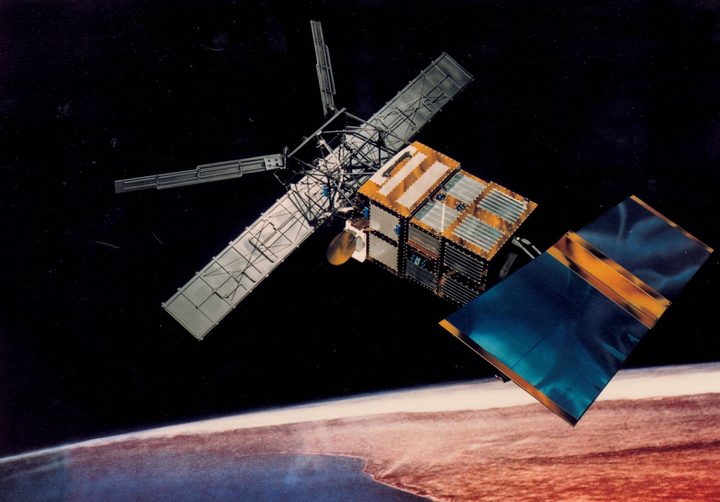
An illustration of ESA's ERS-2 satellite.
An illustration of the European Space Agency’s ERS-2 satellite. ESA

The European Space Agency (ESA) has shared remarkable images showing one of its satellites in what it describes as a “tumbling descent.”

Recommended Videos

ESA’s European Remote Sensing 2 satellite (ERS-2) is expected to burn up during reentry into Earth’s atmosphere on Wednesday.

The images (below) were captured around three weeks ago by Australian commercial imaging company HEO when the satellite was at an altitude of around 150 miles (300 kilometers).

ERS-2 spotted! 📸🛰️

The ESA satellite is on a tumbling descent that will lead to its atmospheric reentry and break up this week.

These images of ERS-2 were captured by @heospace for @spacegovuk using cameras on board other satellites.#ERS2reentry pic.twitter.com/GTuubP6apJ

— ESA Operations (@esaoperations) February 19, 2024

ERS-2 has since descended to an altitude of around 125 miles (200 km) and is falling by more than 6.2 miles (10 km) per day, with its speed rapidly increasing.

ESA said that when the 5,000-pound satellite descends to about 50 miles (80 km), it will start to break into pieces, most of which will burn up before they reach the ground. The space agency adds that the risk to people and property is extremely low, and that, “on average, an object of similar mass reenters Earth’s atmosphere every week or two.”

The satellite’s reentry is described by ESA as “natural” as the agency no longer has any control over it. “The only force causing ERS-2’s orbit to decay is atmospheric drag, which is influenced by unpredictable solar activity,” the agency said.

On Monday, ESA said it expects the satellite to meet a fiery end on Wednesday at 15:41 UTC (10:41 a.m. ET), though it could happen up to 11 hours on either side of that time. The reentry location is also hard to predict at the present time, though upcoming forecasts shared on ESA’s website will become increasingly accurate.
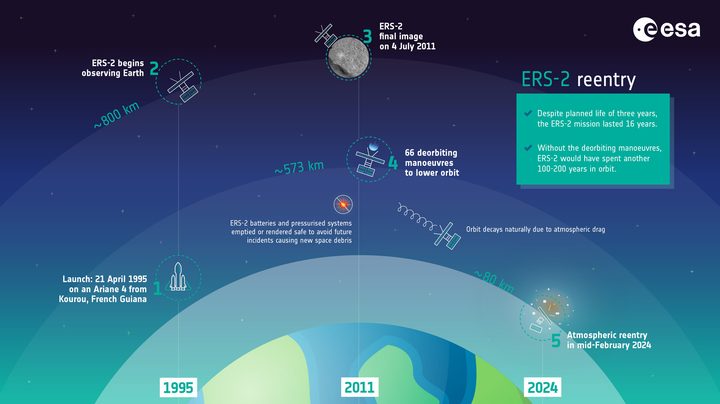
A diagram showing the history of ESA's ERS-2 satellite.
ESA

ERS-2 launched from Europe’s spaceport in Kourou, French Guiana, in 1995, and orbited Earth at an average altitude for 488 miles (785 km). The mission gathered valuable data on Earth’s land surfaces, oceans, and polar caps, while also capturing imagery of natural disasters such as flooding and earthquakes.

The mission ended in 2011 when ESA decided to deorbit the satellite to reduce the chances of it colliding with other satellites or space debris, thereby causing even more hazardous space junk.

Trevor Mogg
Contributing Editor
Not so many moons ago, Trevor moved from one tea-loving island nation that drives on the left (Britain) to another (Japan)…
China’s answer to SpaceX’s reusable rockets literally catches boosters in a net
SpaceX catches boosters on legs. China just used a net.
Ammunition, Missile, Weapon

SpaceX's playbook for recovering a rocket booster generally involves legs, a precisely controlled vertical landing, and either a concrete pad or a drone ship. 

China just managed to pull off something similar, but in a slightly different way, and on July 10, it tested the method as well.

Read more
Dimming the sun sounds unhinged, but this new study on El Niño makes a surprisingly good case for it
A natural test case, Australia's worst-ever wildfire season, suggests the idea deserves serious consideration.
Nature, Outdoors, Sky

When I first saw "scientists propose dimming the sun," I rolled my eyes. It sounds like a science fiction movie cooked up after watching many climate documentaries. But a new study, published on July 8, 2026, in the journal Science Advances, seems to have a genuinely compelling argument.

A Super El Niño is currently forming in the Pacific, feared to be the most intense in decades. It could escalate floods, wildfires, and extreme heat events worldwide. However, Researchers at UC San Diego's Scripps Institution of Oceanography, led by climate scientists Kate Ricke and Jessica Wan, are now proposing one of the most interesting solutions I’ve come across.

Read more
You can now walk through space and gaze into a black hole at this VR exhibit
Smithsonian Starstruck lets you drift past dying stars and see the origin point of the universe for as little as $18 a person.
Smithsonian Starstruck featured

Most planetarium shows ask you to sit still and look up. The Smithsonian's new VR exhibit takes a different approach, letting visitors walk through the vast expanse of the universe, drifting past stars, planets, and a black hole to get a physical sense of its true scale.

A $29 ticket to the edge of the galaxy

Read more