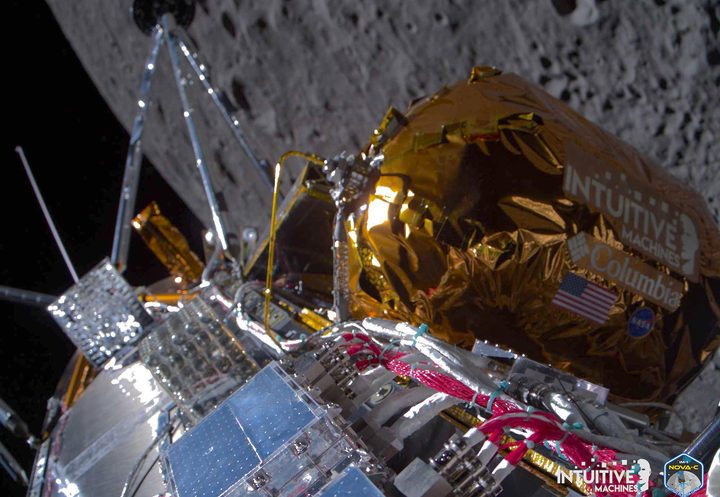
Texas-based Intuitive Machines is on course to perform the first successful soft lunar landing by a commercial company, as well as the first U.S. moon landing since the final Apollo mission more than five decades ago.
But, as the company said in a message on social media, “The landing opportunity will be Odysseus’ hardest challenge yet.”
The uncrewed Odysseus spacecraft successfully entered a lunar orbit on Wednesday, putting it on a path for a landing attempt on Thursday at 3:30 p.m. ET.
The company released a dramatic image (below) on Wednesday showing the spacecraft’s destination tantalizingly close, just 57 miles (92 kilometers) above the lunar surface.
Odysseus passes over the near side of the Moon following lunar orbit insertion on 21FEB2024. The lander continues to be in excellent health in lunar orbit.
(21FEB2024 1608 CST) pic.twitter.com/UX4kgkv5EW— Intuitive Machines (@Int_Machines) February 21, 2024
“Odysseus completed its scheduled 408-second main engine lunar orbit insertion burn,” Intuitive Machines said. “Initial data indicates the 800 m/s burn was completed within 2 m/s accuracy.”
It added that Odysseus continues to be in excellent health and that “over the next day, while the lander remains in lunar orbit, flight controllers will analyze the complete flight data and transmit imagery of the moon.”
That includes the picture below captured by Odysseus’ Terrain Relative Navigation camera showing the Bel’kovich K crater in the moon’s northern equatorial highlands. “It is an approximate 50-kilometer-in-diameter [31-mile-in-diameter] crater with mountains in the center, made when the crater was formed,” the company said.
Odysseus’ Terrain Relative Navigation camera captured this image of the Bel’kovich K crater in the Moon’s northern equatorial highlands.
It is an approximate 50 km diameter crater with mountains in the center, made when the crater was formed.
(21FEB2024 1750 CST) pic.twitter.com/0egu0NOrKP— Intuitive Machines (@Int_Machines) February 21, 2024
The IM-1 mission, which is part of NASA’s Commercial Lunar Payload Services (CLPS) program, launched from the Kennedy Space Center in Florida last week and is carrying with it 12 science and technology payloads for NASA and other organizations.
NASA will live stream Thursday’s highly anticipated landing attempt and Digital Trends has all the information you need to watch it.