1. Home
  2. Space
  3. News

The solar eclipse isn’t the only thing to enjoy in the skies in April

Add as a preferred source on Google
What's Up: April 2024 Skywatching Tips from NASA

NASA has just released its monthly update highlighting what to look out for in the skies over the next month.

Recommended Videos

While everyone is understandably fixed on the fast-approaching total solar eclipse (more on that later), there are also a number of other happenings to look out for.

First up, Jupiter. The fifth planet from the sun and the largest planet in our solar system can be viewed — with the naked eye — throughout this month, with its bright appearance making it easy to spot in the western sky following sunset.

If you’re up early between April 8 and April 12, take a moment to seek out Mars and Saturn as they rise together in the hour or so before sunrise. You’ll see them appear at their closest together on April 10 and 11, “about half a degree apart, or the width of the full moon,” NASA says on its website.

There’s also a sight to savor on April 10 when the slim lunar crescent (only 7% illuminated) will hang above the brightly lit Jupiter in the west after sunset.

The same evening also offers a great chance to see comet 12P/Pons-Brooks, which has been getting brighter and is observable with binoculars or a small telescope — especially if you can get to a spot away from bright city lights. “The comet will be just beneath the moon, and just right of Jupiter, but you’ll have to be quick, as it drops below 10 degrees elevation an hour after sunset and then sets an hour later,” NASA says, adding that you’ll want “a clear view toward the horizon, and be looking for it as twilight ends.”

But this month’s main event is the total solar eclipse, with the moon’s shadow set to sweep across the U.S. in a 115-mile-wide path from Maine to Texas on April 8.
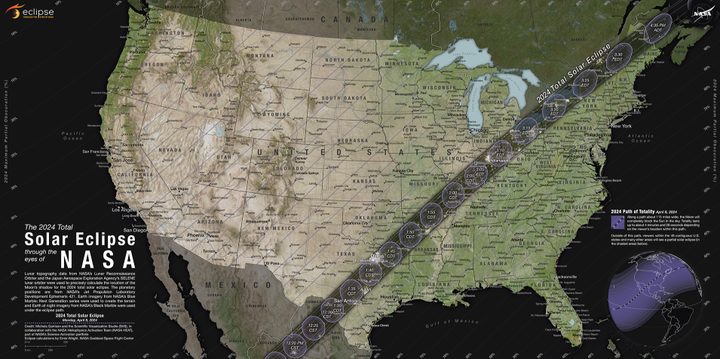
The path of totality of the solar eclipse on April 8, 2024.
The black band shows the eclipse’s path of totality, where the light will dim the most as the moon moves between the sun and Earth. NASA

“Outside the path of totality, the rest of the continental U.S. will experience a partial eclipse,” NASA says. “The amount of the sun covered by the moon at maximum eclipse depends on your distance from the path of totality.”

Digital Trends has more information on how to witness this breathtaking celestial event whether in person or online, and be sure to protect your eyes if your’e doing the former.

Trevor Mogg
Contributing Editor
Not so many moons ago, Trevor moved from one tea-loving island nation that drives on the left (Britain) to another (Japan)…
China’s answer to SpaceX’s reusable rockets literally catches boosters in a net
SpaceX catches boosters on legs. China just used a net.
Ammunition, Missile, Weapon

SpaceX's playbook for recovering a rocket booster generally involves legs, a precisely controlled vertical landing, and either a concrete pad or a drone ship. 

China just managed to pull off something similar, but in a slightly different way, and on July 10, it tested the method as well.

Read more
Dimming the sun sounds unhinged, but this new study on El Niño makes a surprisingly good case for it
A natural test case, Australia's worst-ever wildfire season, suggests the idea deserves serious consideration.
Nature, Outdoors, Sky

When I first saw "scientists propose dimming the sun," I rolled my eyes. It sounds like a science fiction movie cooked up after watching many climate documentaries. But a new study, published on July 8, 2026, in the journal Science Advances, seems to have a genuinely compelling argument.

A Super El Niño is currently forming in the Pacific, feared to be the most intense in decades. It could escalate floods, wildfires, and extreme heat events worldwide. However, Researchers at UC San Diego's Scripps Institution of Oceanography, led by climate scientists Kate Ricke and Jessica Wan, are now proposing one of the most interesting solutions I’ve come across.

Read more
You can now walk through space and gaze into a black hole at this VR exhibit
Smithsonian Starstruck lets you drift past dying stars and see the origin point of the universe for as little as $18 a person.
Smithsonian Starstruck featured

Most planetarium shows ask you to sit still and look up. The Smithsonian's new VR exhibit takes a different approach, letting visitors walk through the vast expanse of the universe, drifting past stars, planets, and a black hole to get a physical sense of its true scale.

A $29 ticket to the edge of the galaxy

Read more