NASA has big plans for the moon — not only sending people back to the moon for the first time in over 50 years but also having them investigate the exciting south pole region, where water is thought to be available. The plan is not just for astronauts to visit for a day or two, but to have them stay on the moon for weeks at a time, exploring the surrounding area. And to explore, they can’t just travel on foot — they’ll need a new moon buggy.
Today, Wednesday, April 3, NASA announced the three companies developing its new lunar vehicle: Intuitive Machines, Lunar Outpost, and Venturi Astrolab. They’ll each develop a lunar terrain vehicle (LTV) that can carry astronauts from their landing site across the moon’s surface, allowing them to range further and reach more areas of interest.
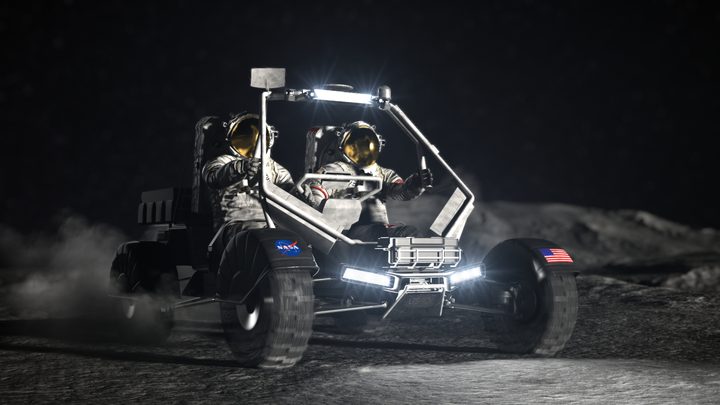
“We look forward to the development of the Artemis generation lunar exploration vehicle to help us advance what we learn at the Moon,” said Vanessa Wyche, director of NASA’s Johnson Space Center in Houston, in a statement. “This vehicle will greatly increase our astronauts’ ability to explore and conduct science on the lunar surface while also serving as a science platform between crewed missions.”
Intuitive Machines has already proven its lunar chops with the historic landing of its Odysseus craft on the moon earlier this year — challenges of that landing notwithstanding — and along with Astrolab and Lunar Outpost, it has submitted concepts to NASA for the LTV, which will now be studied over the next year.
The LTV will need to handle the extreme cold at the lunar south pole, as well as environmental challenges like the fine, dusty material called regolith, which the moon is covered in. The moon’s surface has many craters and rocks, so any vehicle hoping to traverse it will need to be able to handle slopes and slippery conditions. The hope is that a suitable vehicle can be developed for use in the Artemis V mission and beyond in the 2030s.
“We will use the LTV to travel to locations we might not otherwise be able to reach on foot, increasing our ability to explore and make new scientific discoveries,” said Jacob Bleacher, chief exploration scientist in the Exploration Systems Development Mission Directorate at NASA Headquarters in Washington. “With the Artemis crewed missions, and during remote operations when there is not a crew on the surface, we are enabling science and discovery on the Moon year-round.”