  1. Home
  2. Space
  3. News

Starliner spacecraft just took a major step toward first crewed flight

Add as a preferred source on Google

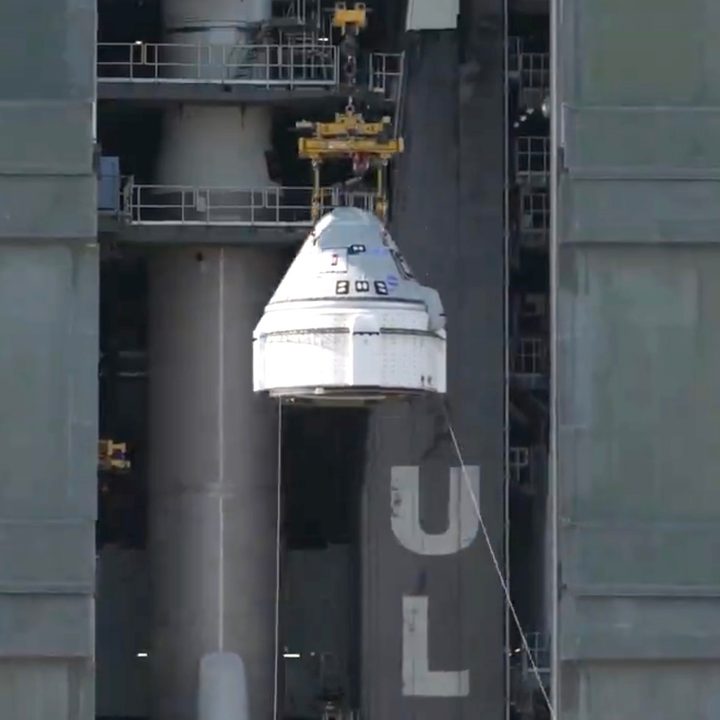
Boeing's Starliner spacecraft being stacked on the Atlas V rocket.
A crane lifts the Starliner spacecraft to the top of an Atlas V rocket. Boeing Space

Boeing’s CST-100 Starliner spacecraft has been stacked atop the United Launch Alliance (ULA) Atlas V rocket ahead of its first crewed flight next month.

Recommended Videos

After being fully fueled, engineers transported the Starliner spacecraft from Boeing’s Commercial Crew and Cargo Processing Facility (C3PF) to ULA’s Vertical Integration Facility (VIF) at the Kennedy Space Center in Florida, on Tuesday.

Boeing shared a video showing the Starliner’s six-mile journey to the Atlas V rocket.

See #Starliner roll out from our factory to @ulalaunch's Vertical Integration Facility for its Crew Flight Test. Starliner is now stacked on the #AtlasV rocket for a May 6 launch. pic.twitter.com/ovrdclFFEZ

— Boeing Space (@BoeingSpace) April 16, 2024

“Functionally, this rollout was similar in nature to previous rollouts, treating the spacecraft with the greatest care and detail,” Boeing’s Amanda Ireland said in a release.

Prepareation work will continue at the VIF to ensure the Atlas V and the spacecraft are properly communicating with each other.

NASA and Boeing are currently targeting May 6 for the first crewed flight, which will carry NASA astronauts Butch Wilmore and Suni Williams to the International Space Station (ISS).

Boeing has had a tough time getting the Starliner ready for its first crewed test. The spacecraft’s maiden flight in 2019 ended in failure when the vehicle was unable to make it to the ISS. The mission surfaced a slew of issues with the Starliner’s flight systems, which engineers spent years putting right. The spacecraft made it to the ISS for a short stay in another test mission in 2022, though more issues had to be resolved after that.

The first crewed flight has been delayed a number of times, but this time it really does appear that the Starliner will be flying astronauts to the space station in just a few weeks from now.

If the test flight goes according to plan, NASA will have a second commercial spacecraft for crewed trips to orbit alongside SpaceX’s Crew Dragon vehicle, which has been flying astronauts since 2020.

Trevor Mogg
Contributing Editor
Not so many moons ago, Trevor moved from one tea-loving island nation that drives on the left (Britain) to another (Japan)…
China’s answer to SpaceX’s reusable rockets literally catches boosters in a net
SpaceX catches boosters on legs. China just used a net.
Ammunition, Missile, Weapon

SpaceX's playbook for recovering a rocket booster generally involves legs, a precisely controlled vertical landing, and either a concrete pad or a drone ship. 

China just managed to pull off something similar, but in a slightly different way, and on July 10, it tested the method as well.

Read more
Dimming the sun sounds unhinged, but this new study on El Niño makes a surprisingly good case for it
A natural test case, Australia's worst-ever wildfire season, suggests the idea deserves serious consideration.
Nature, Outdoors, Sky

When I first saw "scientists propose dimming the sun," I rolled my eyes. It sounds like a science fiction movie cooked up after watching many climate documentaries. But a new study, published on July 8, 2026, in the journal Science Advances, seems to have a genuinely compelling argument.

A Super El Niño is currently forming in the Pacific, feared to be the most intense in decades. It could escalate floods, wildfires, and extreme heat events worldwide. However, Researchers at UC San Diego's Scripps Institution of Oceanography, led by climate scientists Kate Ricke and Jessica Wan, are now proposing one of the most interesting solutions I’ve come across.

Read more
You can now walk through space and gaze into a black hole at this VR exhibit
Smithsonian Starstruck lets you drift past dying stars and see the origin point of the universe for as little as $18 a person.
Smithsonian Starstruck featured

Most planetarium shows ask you to sit still and look up. The Smithsonian's new VR exhibit takes a different approach, letting visitors walk through the vast expanse of the universe, drifting past stars, planets, and a black hole to get a physical sense of its true scale.

A $29 ticket to the edge of the galaxy

Read more