NASA has shared an update on its beleaguered Mars Sample Return mission, admitting that its previous plan was too ambitious and announcing that it will now be looking for new ideas to make the mission happen. The idea is to send a mission to collect samples from the surface of Mars and return them to Earth for study. It’s been a long-term goal of planetary science researchers, but one that is proving costly and difficult to put into practice.
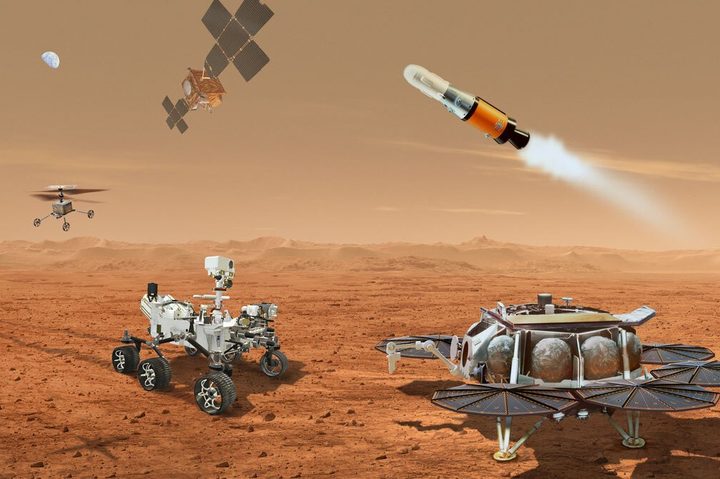
The Perseverance rover has already collected and sealed a number of samples of Mars rock as it journeys around the Jezero Crater, and has left these samples in a sample cache ready to be collected. However, getting them back to Earth in the previous plan required sending a vehicle to Mars, getting it to land on the surface, sending out another rover to collect the samples and bring them back, launching a rocket from the planet’s surface (something which has never been done before), and then having this rocket rendezvous with another spacecraft to carry them back to Earth. That level of complexity was just too much to be feasible within a reasonable budget, NASA Administrator Bill Nelson announced this week.
“Mars Sample Return will be one of the most complex missions NASA has ever undertaken. The bottom line is, an $11 billion budget is too expensive, and a 2040 return date is too far away,” said Nelson in a statement. “Safely landing and collecting the samples, launching a rocket with the samples off another planet — which has never been done before — and safely transporting the samples more than 33 million miles back to Earth is no small task. We need to look outside the box to find a way ahead that is both affordable and returns samples in a reasonable time frame.”
Now, NASA is aiming to come up with a less complicated and less expensive plan to get the samples back to Earth. For this, NASA is both tasking people within the agency to come up with a new plan and inviting contributions from private industry that could help make the mission a reality. As well as finding a simpler and cheaper way to do things, the agency is also hoping that the mission timeline can be brought into the 2030s rather than the 2040 date originally planned.
The issues with the plans for Mars Sample Return are a blow for NASA, which has seen great success with the sending of rovers to Mars, but has struggled to maintain congressional funding and public interest in the next phase of Mars exploration. However, NASA personnel acknowledge that challenge as part of the agency’s work.
“NASA does visionary science — and returning diverse, scientifically relevant samples from Mars is a key priority,” said Nicky Fox, associate administrator of NASA’s Science Mission Directorate. “To organize a mission at this level of complexity, we employ decades of lessons on how to run a large mission, including incorporating the input we get from conducting independent reviews. Our next steps will position us to bring this transformational mission forward and deliver revolutionary science from Mars — providing critical new insights into the origins and evolution of Mars, our solar system, and life on Earth.”