  1. Home
  2. Space
  3. News

James Webb telescope peers at the atmosphere of a rocky hell world

Add as a preferred source on Google

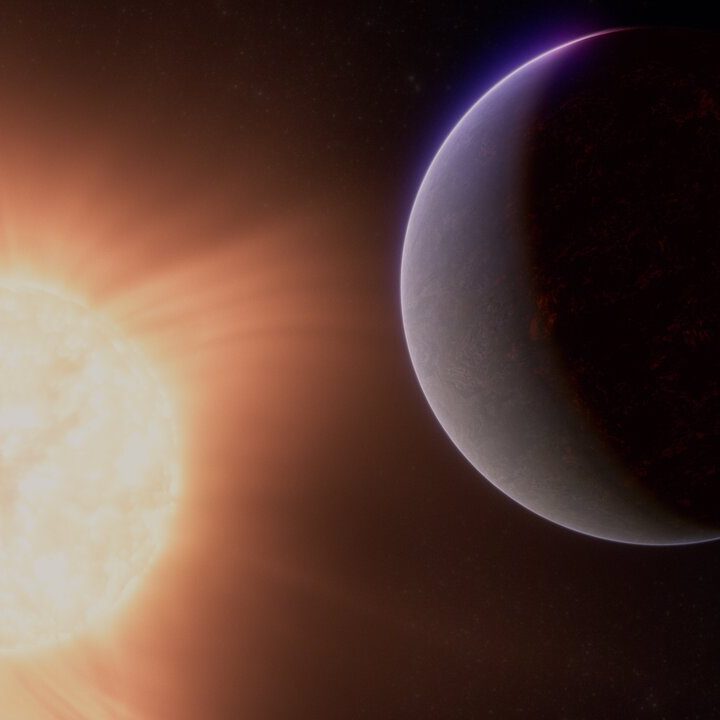
This artist’s concept shows what the exoplanet 55 Cancri e could look like. Also called Janssen, 55 Cancri e is a so-called super-Earth, a rocky planet significantly larger than Earth but smaller than Neptune, which orbits its star at a distance of only 2.25 million kilometres (0.015 astronomical units), completing one full orbit in less than 18 hours. In comparison, Mercury is 25 times farther from the Sun than 55 Cancri e is from its star. The system, which also includes four large gas-giant planets, is located about 41 light-years from Earth, in the constellation Cancer.
This artist’s concept shows what the exoplanet 55 Cancri e could look like. Also called Janssen, 55 Cancri e is a so-called super-Earth, a rocky planet significantly larger than Earth but smaller than Neptune, which orbits its star at a distance of only 2.25 million kilometers (0.015 astronomical units), completing one full orbit in less than 18 hours. NASA, ESA, CSA, R. Crawford (STScI)

When it comes to learning about exoplanets, or planets beyond our solar system, the James Webb Space Telescope is providing more information than ever before. Over the last decade or so, thousands of exoplanets have been discovered, with details available about these worlds, such as their orbits and their size or mass. But now we’re starting to learn about what these planets are actually like, including details of their atmospheres. Webb recently investigated the atmosphere around exoplanet 55 Cancri e, finding what could be the first atmosphere of a rocky planet discovered outside the solar system.

Recommended Videos

The planet in question, 55 Cancri e, isn’t a welcoming place. The star that hosts it is sun-like, but the planet orbit is so close to it, at just 1.4 million miles away, that its surface is likely to be a bubbling ocean of magma. It’s even known as the “hell planet.” But despite the extreme conditions there, astronomers have long wondered if the planet could host an atmosphere or if it is too hot and bombarded by too much radiation.

“I’ve worked on this planet for more than a decade,” said co-author of the new research, Diana Dragomir of the University of New Mexico, in a statement. “It’s been really frustrating that none of the observations we’ve been getting have robustly solved these mysteries. I am thrilled that we are finally getting some answers!”

It’s harder to spot atmospheres around rocky planets than around big, puffy gas giants because they are thinner, but researchers using Webb’s NIRCam (Near-Infrared Camera) and MIRI (Mid-Infrared Instrument) were able to see indications of a volatile-rich atmosphere, indicating there could be carbon monoxide or carbon dioxide.

The researchers also found that the side of the planet that faces its star, called the dayside, is cooler than expected. That suggests that heat is being transferred to the cooler nightside, possibly by an atmosphere. Now the question is how that atmosphere formed, as the extreme temperatures would likely have stripped away any gases present when the planet formed. The atmosphere could be forming from gases coming up from inside the planet, the researchers theorize.

“The primary atmosphere would be long gone because of the high temperature and intense radiation from the star,” said co-author Aaron Bello-Arufe of NASA’s Jet Propulsion Laboratory. “This would be a secondary atmosphere that is continuously replenished by the magma ocean. Magma is not only crystals and liquid rock, there’s a lot of dissolved gas in it, too.”

The research is published in the journal Nature.

Georgina Torbet
Georgina has been the space writer at Digital Trends space writer for six years, covering human space exploration, planetary…
You can now walk through space and gaze into a black hole at this VR exhibit
Smithsonian Starstruck lets you drift past dying stars and see the origin point of the universe for as little as $18 a person.
Smithsonian Starstruck featured

Most planetarium shows ask you to sit still and look up. The Smithsonian's new VR exhibit takes a different approach, letting visitors walk through the vast expanse of the universe, drifting past stars, planets, and a black hole to get a physical sense of its true scale.

A $29 ticket to the edge of the galaxy

Read more
Scientists warn Elon Musk’s orbital data centers could blind Earth’s biggest telescopes
A new ESO study suggests millions of satellites could make parts of the night sky effectively unusable for astronomy.
One hour of satellites over the northern Atacama Desert in Chile (October 2025)

The race to blanket Earth with satellite internet has unlocked faster connectivity for millions. But according to the European Southern Observatory (ESO), it could also make one of humanity's oldest hobbies, and one of its most important sciences, a whole lot harder. The organization warns that the rapid growth of satellite mega-constellations could severely disrupt observations made by some of the world's most powerful telescopes.

Astronomers say the night sky is reaching its limit

Read more
Amazon’s Starlink rival just crossed a major milestone, but don’t expect perfect internet just yet
Amazon finally showed up to the space internet party
Amazon Leo satellite layout across all launch vehicles

Amazon has taken a significant step toward launching its long-awaited satellite internet service. Following its latest rocket launch, the company now has 396 Project Kuiper satellites in low-Earth orbit, enough to begin offering continuous service across select regions. The milestone keeps Amazon on track for its previously announced goal of launching commercial service by mid-2026.

https://twitter.com/Weber44Chris/status/2072575499461963938?ref_src=twsrc%5Etfw%7Ctwcamp%5Etweetembed%7Ctwterm%5E2072575499461963938%7Ctwgr%5Ed727a1b853cbf519585e7bf2655943afb2f91bb8%7Ctwcon%5Es1_&ref_url=https%3A%2F%2Fwww.theverge.com%2Fscience%2F960563%2Famazon-leo-service-tipping-point

Read more