  1. Home
  2. Space
  3. News

Exoplanet catalog details over 100 worlds beyond our solar system

Add as a preferred source on Google

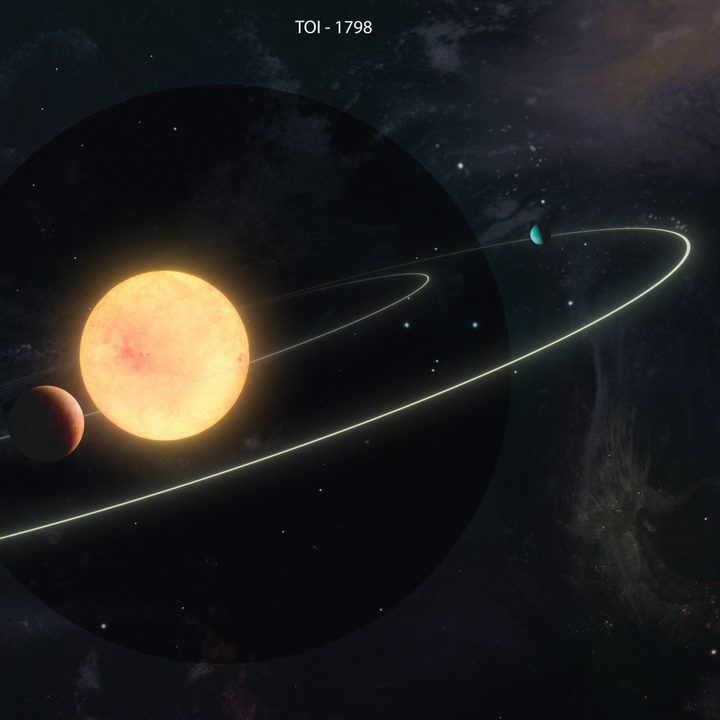
TOI-1798, a system that is home to two planets. The inner planet is a strange Super-Earth so close to its star, one year on this alien world lasts only half an Earth day.
TOI-1798 is a system that is home to two planets. The inner planet is a strange Super-Earth so close to its star that one year on this alien world lasts only half an Earth day. W. M. Keck Observatory/Adam Makarenko

A new catalog of exoplanets from two telescopes shows the incredible variety of planets that exist beyond our solar system. The catalog, using data from NASA’s TESS (Transiting Exoplanet Survey Satellite) space telescope and the ground-based W. M. Keck Observatory, shows 126 planets, along with the radius, mass, density and temperature of each.

Recommended Videos

“Relatively few of the previously known exoplanets have a measurement of both the mass and the radius. The combination of these measurements tell us what the planets could be made of and how they formed,” explained Stephen Kane, University of California, Riverside astrophysicist and principal investigator of the TESS-Keck Survey, in a statement. “With this information, we can begin to answer questions about where our solar system fits in to the grand tapestry of other planetary systems.”
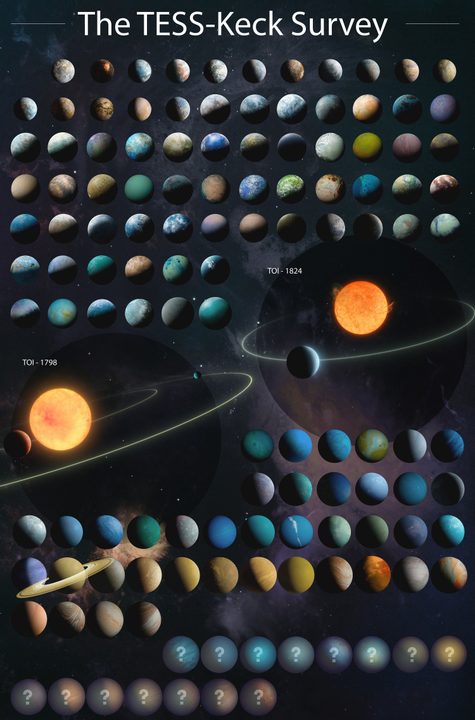
Artist conception of 126 planets in the latest TESS-Keck Survey catalog is based on data including planet radius, mass, density, and temperature. Question marks represent planets requiring more data for full characterization.
An artist’s concept of 126 planets in the latest TESS-Keck Survey catalog is based on data including planet radius, mass, density, and temperature. Question marks represent planets requiring more data for full characterization. W. M. Keck Observatory/Adam Makarenko

Among the exoplanets in the catalog are worlds like TOI-1798 c, shown at the top of this page, which orbits extremely close to its star and is bombarded by intense radiation as a result.

“TOI-1798 c orbits its star so quickly that one year on this planet lasts less than half a day on Earth. Because of their proximity to their host stars, planets like this one are also ultra hot — receiving more than 3,000 times the radiation that Earth receives from the sun,” said one of the catalog researchers, Alex Polanski of the University of Kansas.

Exoplanets like this one are unlikely to have any atmosphere as the intense radiation from their host stars would strip it away. But other worlds are more potentially hospitable, such as those orbiting small, cool stars called red dwarfs.

One big open question in exoplanet research is how typical our solar system is. The most commonly discovered exoplanets are gas giants, because their large size makes them easier to spot from extreme distances. But we don’t know how common Earth-sized worlds are because these are harder to identify in distant star systems due to their smaller size.

There is also a class of planet called sub-Neptunes which appear to be common elsewhere. “Planets smaller than Neptune, but larger than Earth are the most prevalent worlds in our galaxy, yet they are absent from our own solar system. Each time a new one is discovered, we are reminded of how diverse our universe is, and that our existence in the cosmos may be more unique than we can understand,” said Daria Pidhorodetska, also of UC Riverside.

Catalogs like this one help to show our place in the universe and the variety of planets out there. “Are we unusual? The jury is still out on that one, but our new mass catalog represents a major step toward answering that question,” Kane said.

The research is published in The Astrophysical Journal Letters.

Georgina Torbet
Georgina has been the space writer at Digital Trends space writer for six years, covering human space exploration, planetary…
Space is becoming Bezos and Musk’s next data center site, and we have every reason to worry
The AI boom is coming for the night sky
How Vast's space station will look in orbit.

AI data centers already consume vast amounts of electricity and water on Earth, so Silicon Valley has begun looking somewhere considerably more spacious... literally.

Elon Musk's SpaceX and Jeff Bezos' Blue Origin, along with several other companies, have proposed enormous constellations of satellites designed to operate as orbital data centers. However, environmental groups and former space officials are now warning that putting them into orbit at the proposed scale could have severe consequences for Earth's atmosphere and the night sky.

Read more
The first possible exomoon is here, and it makes our Moon look hilariously tiny
Scientists may have found the first exomoon, except this one is the size of Jupiter
This artist’s concept depicts a potential volcanic moon between the exoplanet WASP-49 b, left, and its parent star. New evidence indicating that a massive sodium cloud observed near WASP-49 b is produced by neither the planet nor the star has prompted researchers to ask if its origin could be an exomoon.

We have already discovered more than 6,000 planets outside of our immediate neighborhood. Yet, finding a moon orbiting one of those distant worlds has proved considerably harder. Astronomers may finally have something close to the real deal, but this particular object stretches the word “moon” almost beyond recognition.

Using the European Southern Observatory’s Very Large Telescope in Chile, researchers detected strong evidence for a moon-like object in the CD-35 2722 system. Further observations are still necessary to confirm the discovery, but it could become the first confidently detected natural satellite outside our solar system. There is still one tiny complication though. This moon is apparently massive.

Read more
China’s answer to SpaceX’s reusable rockets literally catches boosters in a net
SpaceX catches boosters on legs. China just used a net.
Ammunition, Missile, Weapon

SpaceX's playbook for recovering a rocket booster generally involves legs, a precisely controlled vertical landing, and either a concrete pad or a drone ship. 

China just managed to pull off something similar, but in a slightly different way, and on July 10, it tested the method as well.

Read more