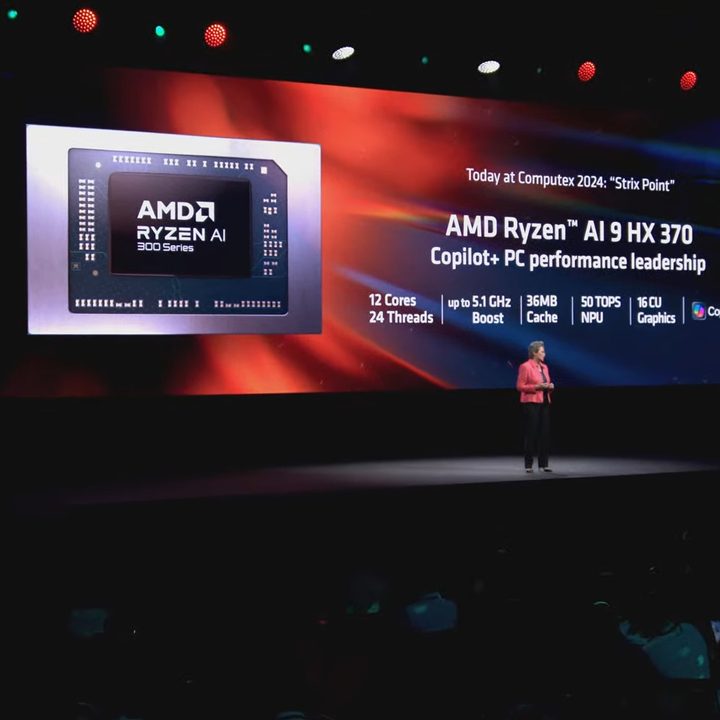
AMD’s upcoming Ryzen AI APUs stole the show at Computex 2024, but we haven’t seen them in action — until now. Three Geekbench tests have just leaked, showcasing the performance of AMD’s flagship APU, and it’s safe to say that it did an excellent job. It’s not just the highest number of TOPS in an NPU that AMD can now brag about — it’s also competitive, desktop-worthy CPU performance and a vastly improved GPU. Let’s dig in.
The Ryzen AI 9 HX 370 appeared in two Geekbench tests and one OpenCL test, meaning that we get some insight into both CPU and GPU performance. Before we get into comparing test scores, it’s worth noting that in these tests, the APU appears under the name of AMD Ryzen AI 9 HX 170 with a Radeon 880M GPU. In reality, as Wccftech points out, AMD appears to have changed its naming scheme at the last minute, and the HX 170 is now the HX 370. The GPU in that model should also be the 890M, so there are some discrepancies.
In the Geekbench 6.3 test, the Ryzen AI 9 HX 370 was able to score 2,544 and 14,158 points in single- and multi-core tests, respectively. For comparison’s sake, the Ryzen 5 7600 desktop CPU scored 2,739 points in single-core and 12,287 in multi-core, meaning that the APU won the multi-threaded test while falling slightly behind in single-core. However, it’s worth remembering that the Ryzen AI 9 HX 370 comes with 12 cores and 24 threads, double what the Ryzen 5 7600 can offer. Compared to its APU predecessor, the Ryzen 9 8945HS, the new chip still wins, leading by about 20% in multi-core tasks.
The OpenCL test went just as well, if not even better. The Radeon 890M GPU (which, as we assume, was wrongly labeled as the Radeon 880M) scored 41,995 points, putting it on par with the desktop version of Nvidia’s GTX 1650 Ti or the mobile version of the RTX 2050. It also beats the last-gen Radeon 780M by a whopping 40%.
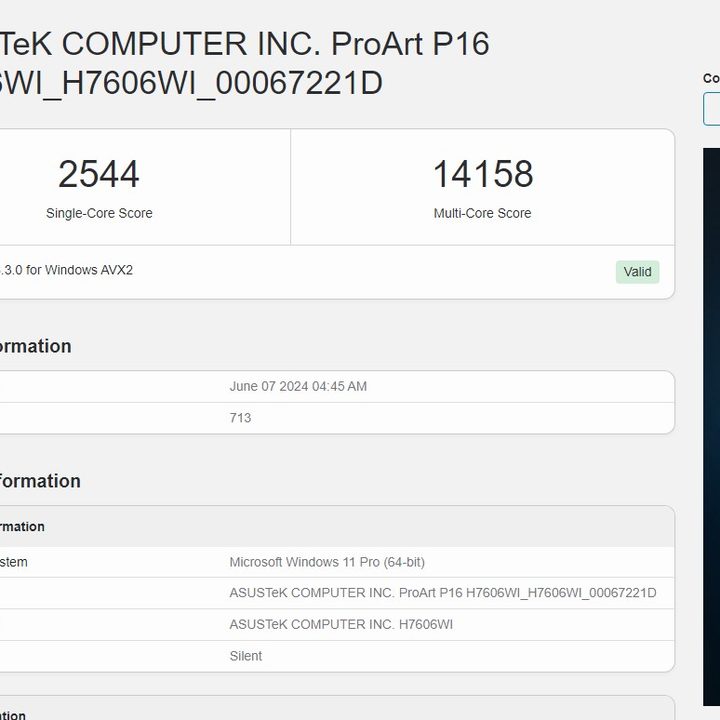
There’s one thing that’s important to consider when comparing these benchmark results: The new APUs don’t have a set TDP, and they can scale from 15 watts up to 54 watts. The TDP of the chip in question remains unclear here, but if we assume that it was on the lower end of the scale, then these test results are even more impressive.
Although it’s still early days, it appears that AMD was able to show off quite the generational uplift. We might see a bigger jump here in these AI mobile APUs than we will in the desktop versions of Zen 5 processors. It won’t be long until we can test these ourselves, as the APUs and the CPUs are both slated for a July 2024 launch.