The International Space Station (ISS) is nearing the end of its life after more than two decades in low-Earth orbit.
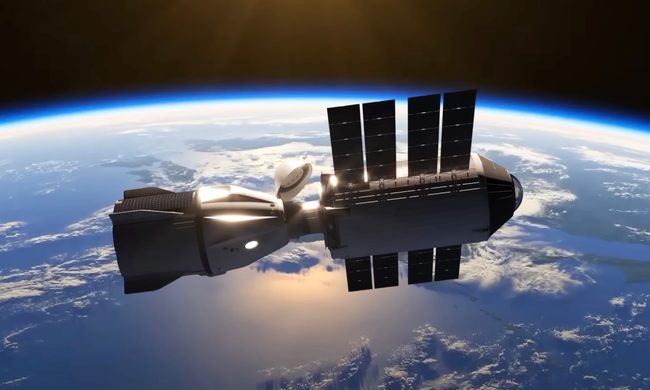
When the time comes about six years from now, NASA and its international partners will use a so-called “space tug” — officially known as the U.S. Deorbit Vehicle (USDV) — to guide the ISS to a safe location from where it will then descend at speed and mostly burn up in Earth’s atmosphere.
After putting out a call for proposals for the space tug last year, NASA announced on Wednesday that it has selected SpaceX to build it in a contract worth $843 million.
“As the agency transitions to commercially owned space destinations closer to home, it is crucial to prepare for the safe and responsible deorbit of the International Space Station in a controlled manner after the end of its operational life in 2030,” NASA said, adding that SpaceX has been chosen to develop and deliver the U.S. Deorbit Vehicle.
“Selecting a U.S. Deorbit Vehicle for the International Space Station will help NASA and its international partners ensure a safe and responsible transition in low-Earth orbit at the end of station operations,” said Ken Bowersox, NASA’s associate administrator for Space Operations Mission Directorate, adding that the the orbital laboratory “remains a blueprint for science, exploration, and partnerships in space for the benefit of all.”
After SpaceX has developed the deorbit spacecraft, NASA will take ownership of it and operate it throughout its crucial mission. Along with the space station, the space tug is expected to burn up upon reentry into Earth’s atmosphere.
It’s possible that some parts of the ISS will survive reentry, therefore NASA will attempt to send those parts plunging toward Point Nemo in the Pacific Ocean, a spot far from land known as “the space cemetery” as it is often targeted for controlled descents of space junk. The importance of getting the ISS reentry right was highlighted just recently when a piece of space junk released from the space station landed on a Florida home. A part of a SpaceX Crew Dragon spacecraft also came down in North Carolina. Neither part had been expected to survive reentry.
The U.S., Japan, Canada, and nations that contribute to the European Space Agency have committed to operating the station and sending astronauts there through 2030, while Russia has committed to continued operations until at least 2028.
Currently in its 24th year of continuously crewed operations, NASA describes the ISS as “a unique scientific platform where crew members conduct experiments across multiple disciplines of research, including Earth and space science, biology, human physiology, physical sciences, and technology demonstrations not possible on Earth.”
Commercially built space stations are expected to replace the ISS in low-Earth orbit, and in an additional plan to increase the presence of humans in space in long-duration missions, NASA is also aiming to build a permanent base on the moon where astronauts will live and work rather like they do on the ISS today.