1. Home
  2. Space
  3. News

See 25 gorgeous images of space to celebrate Chandra’s 25th birthday

Add as a preferred source on Google
nasa chandra 25 anniversary 25th lg jpg 92
NASA/CXC/SAO

Today, July 23, marks the 25th anniversary of one of NASA’s lesser known but highly prolific space telescopes. The Chandra X-ray Observatory was launched on July 23, 1999, and over its tenure has produced hundreds of stunning images of space — including 25 new images that have been released to celebrate the occasion.

Unlike Hubble, which looks primarily at the same wavelengths as the human eye (called the optical or visible light range), or James Webb, which looks in the infrared, Chandra operates in the X-ray portion of the spectrum. That allows it to see effects of high-energy events like kilonovas, and to investigate objects like supermassive black holes. It also gives different views of supernovas and the remnants they leave behind.

Recommended Videos

The ability to detect X-rays makes Chandra important for scientific discoveries as well. “For a quarter century, Chandra has made discovery after amazing discovery,” said Pat Slane, director of the Chandra X-ray Center. “Astronomers have used Chandra to investigate mysteries that we didn’t even know about when we were building the telescope — including exoplanets and dark energy.”
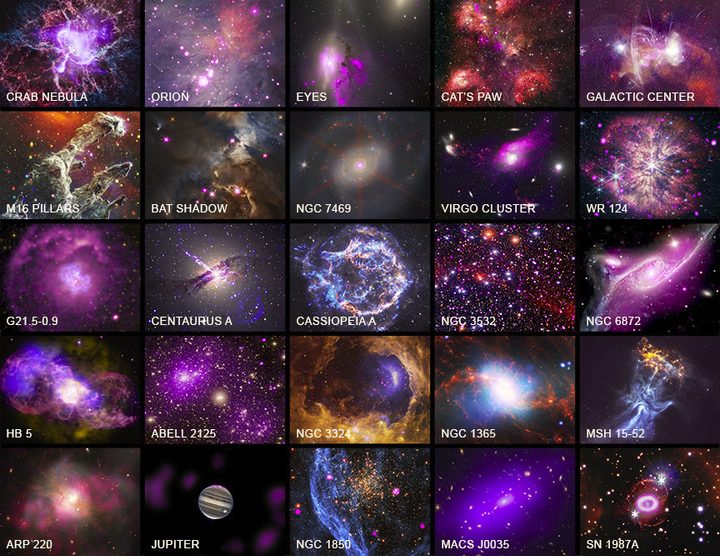
These images were released to commemorate the 25th anniversary of Chandra. They represent the wide range of objects that the telescope has observed over its quarter century of observations. X-rays are an especially penetrating type of light that reveals extremely hot objects and very energetic physical processes. The images range from supernova remnants, like Cassiopeia A, to star-formation regions like the Orion Nebula, to the region at the center of the Milky Way. This montage also contains objects beyond our own Galaxy including other galaxies and galaxy clusters.
These images were released to commemorate the 25th anniversary of Chandra. They represent the wide range of objects that the telescope has observed over its quarter century of observations. X-rays are an especially penetrating type of light that reveals extremely hot objects and very energetic physical processes. NASA/CXC/SAO

The gorgeous set of new images includes objects like nebulae, galaxies, and even a shot of Jupiter here in our own solar system. You can see a large version of the images here, and refer to the labelled version above to see what you are looking at. Many of these images combine data from Chandra with data from other telescopes, like Hubble, Webb, or Spitzer. These telescopes provide the background views of the stars, while Chandra shows the X-rays visible in these scenes, often in shades of purple and magenta.

There are some familiar sights in there for space fans, who will recognize objects like the famous Pillars of Creation or Cassiopeia A. Previous releases from Chandra have combined its data with famous images taken by Webb, adding an extra element that can only be seen in the X-ray wavelength.

“Chandra has been a great success story for humanity and its pursuit of knowledge,” said Andrew Schnell, acting project manager of NASA’s Chandra X-ray Observatory. “Chandra’s incredible accomplishments are made possible by the team’s hard work and dedication.”


Georgina Torbet
Georgina has been the space writer at Digital Trends space writer for six years, covering human space exploration, planetary…
Space is becoming Bezos and Musk’s next data center site, and we have every reason to worry
The AI boom is coming for the night sky
How Vast's space station will look in orbit.

AI data centers already consume vast amounts of electricity and water on Earth, so Silicon Valley has begun looking somewhere considerably more spacious... literally.

Elon Musk's SpaceX and Jeff Bezos' Blue Origin, along with several other companies, have proposed enormous constellations of satellites designed to operate as orbital data centers. However, environmental groups and former space officials are now warning that putting them into orbit at the proposed scale could have severe consequences for Earth's atmosphere and the night sky.

Read more
The first possible exomoon is here, and it makes our Moon look hilariously tiny
Scientists may have found the first exomoon, except this one is the size of Jupiter
This artist’s concept depicts a potential volcanic moon between the exoplanet WASP-49 b, left, and its parent star. New evidence indicating that a massive sodium cloud observed near WASP-49 b is produced by neither the planet nor the star has prompted researchers to ask if its origin could be an exomoon.

We have already discovered more than 6,000 planets outside of our immediate neighborhood. Yet, finding a moon orbiting one of those distant worlds has proved considerably harder. Astronomers may finally have something close to the real deal, but this particular object stretches the word “moon” almost beyond recognition.

Using the European Southern Observatory’s Very Large Telescope in Chile, researchers detected strong evidence for a moon-like object in the CD-35 2722 system. Further observations are still necessary to confirm the discovery, but it could become the first confidently detected natural satellite outside our solar system. There is still one tiny complication though. This moon is apparently massive.

Read more
China’s answer to SpaceX’s reusable rockets literally catches boosters in a net
SpaceX catches boosters on legs. China just used a net.
Ammunition, Missile, Weapon

SpaceX's playbook for recovering a rocket booster generally involves legs, a precisely controlled vertical landing, and either a concrete pad or a drone ship. 

China just managed to pull off something similar, but in a slightly different way, and on July 10, it tested the method as well.

Read more