NASA’s Perseverance rover was sent to Mars with one big, ambitious aim: to see if life could ever have thrived on our neighboring planet. Although there’s unlikely to be anything alive on Mars now, the planet was once similar to Earth, with a thicker atmosphere and plentiful water on its surface. And during this time, billions of years ago, microbial life could have survived there. Now, Perseverance has located some tantalizing indications of possible microbial life — although it’s too early for scientists to be sure.
The rover has been taking samples by drilling into the martian rock as it travels, and it’s a recent sample from an area called the Cheyava Falls that has ignited interest. The rock, collected on July 21, has indications of chemical signatures and physical structures that could potentially have been formed by life, such as the presence of organic compounds. These carbon-based molecules are the building blocks of life; however, they can also be formed by other processes.
Such compounds have been found on Mars before, so what makes this particular rock so exciting is the “leopard spots” that are present in it. These millimeter-sized splotches of lighter material have a black ring around them that contains iron and phosphate, and similar markings in rocks on Earth have been created by past life.
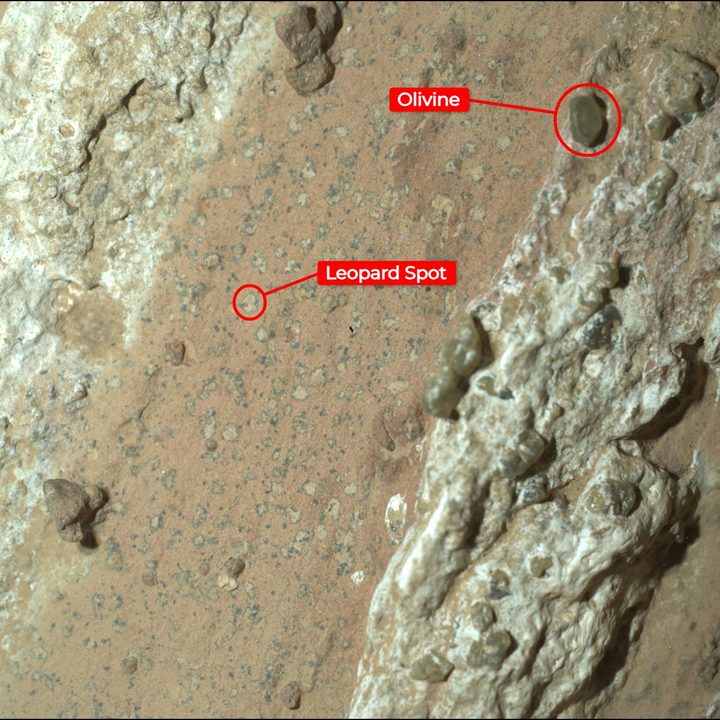
“These spots are a big surprise,” said David Flannery, an astrobiologist and member of the Perseverance science team from the Queensland University of Technology in Australia. “On Earth, these types of features in rocks are often associated with the fossilized record of microbes living in the subsurface.”
However, just because these marking could have been made by life doesn’t mean that they definitely were. They could also have been created by chemical reactions and the flow of water leaving behind mineral deposits.
Another unusual aspect of this rock is the presence of a different mineral called olivine, which forms from magma and was a surprising find for the science team. They are currently considering whether the mineral could have been added to the rock at very high temperatures, and whether this process could have contributed to the leopard spots.
When assessing evidence of such an important question as the presence of life, scientists work to rule out all other explanations before they make pronouncements. The steps for determining if life existed from a rock record are complex, and the unusual facets of this particular rock made determination harder.
“Cheyava Falls is the most puzzling, complex, and potentially important rock yet investigated by Perseverance,” said Ken Farley, Perseverance project scientist of Caltech. “On the one hand, we have our first compelling detection of organic material, distinctive colorful spots indicative of chemical reactions that microbial life could use as an energy source, and clear evidence that water — necessary for life — once passed through the rock. On the other hand, we have been unable to determine exactly how the rock formed and to what extent nearby rocks may have heated Cheyava Falls and contributed to these features.”
To be confident that these marks were produced by life, scientists would need to perform more complex analyses than are possible using the rover. NASA scientists are pointing to this as reason for the Mars Sample Return project, which aims to collect samples from Mars and bring them back to Earth for study.
“We have zapped that rock with lasers and X-rays and imaged it literally day and night from just about every angle imaginable,” Farley said. “Scientifically, Perseverance has nothing more to give. To fully understand what really happened in that Martian river valley at Jezero Crater billions of years ago, we’d want to bring the Cheyava Falls sample back to Earth, so it can be studied with the powerful instruments available in laboratories.”