1. Home
  2. Space
  3. News

SpaceX shares dramatic Starship engine test footage ahead of 5th flight

Add as a preferred source on Google
SpaceX testing the engines on its Starship rocket.
SpaceX

SpaceX has shared dramatic slow-motion footage (below) of a ground-based engine test involving the Starship spacecraft ahead of its fifth test flight.

“Slow-motion view of Flight 5 Starship’s six Raptor engines during static fire,” SpaceX said in a comment accompanying the video.

Recommended Videos

Slow motion view of Flight 5 Starship’s six Raptor engines during static fire pic.twitter.com/5395Vmq2j4

— SpaceX (@SpaceX) July 27, 2024

The Starship spacecraft forms the upper part of the Starship vehicle, which also comprises the first-stage Super Heavy booster.

The date for the fifth test flight has yet to be set, though recent reports have suggested that it could take place as early as next month, following its fourth test flight in June.

With 33 Raptor engines at the base of the Super Heavy pumping out a massive 17 million pounds of thrust at launch, the Starship vehicle is the most powerful rocket ever to fly.

The plan is to use the vehicle for crewed and cargo missions to the moon, Mars, and even beyond. But first it has to be fully developed and properly tested.

The Starship’s first test flight took place last year from SpaceX’s Starbase facility in Boca Chica, Texas, but ended just a few minutes into the mission when the first stage and upper stage failed to separate.

The second test achieved stage separation before both parts of the rocket exploded in midair, while the third and fourth tests marked a massive improvement in the rocket’s performance, with both flights lasting much longer and achieving most of the their mission goals.

The upcoming fifth flight is of particular interest as SpaceX is planning to try to “catch” the first-stage Super Heavy booster as it comes in to land after deploying the Starship spacecraft to orbit. The maneuver will use giant mechanical arms attached to the launch tower that will clamp and secure the booster when it returns home.

Catching the booster in this way will allow SpaceX to use the booster for multiple missions, similar to how it reuses its workhorse Falcon 9 booster. Such a system enables SpaceX to drastically reduce the cost of space flights.

Trevor Mogg
Contributing Editor
Not so many moons ago, Trevor moved from one tea-loving island nation that drives on the left (Britain) to another (Japan)…
Space is becoming Bezos and Musk’s next data center site, and we have every reason to worry
The AI boom is coming for the night sky
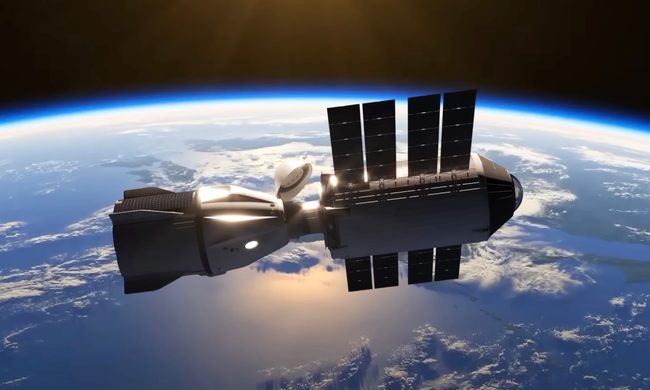
How Vast's space station will look in orbit.

AI data centers already consume vast amounts of electricity and water on Earth, so Silicon Valley has begun looking somewhere considerably more spacious... literally.

Elon Musk's SpaceX and Jeff Bezos' Blue Origin, along with several other companies, have proposed enormous constellations of satellites designed to operate as orbital data centers. However, environmental groups and former space officials are now warning that putting them into orbit at the proposed scale could have severe consequences for Earth's atmosphere and the night sky.

Read more
The first possible exomoon is here, and it makes our Moon look hilariously tiny
Scientists may have found the first exomoon, except this one is the size of Jupiter
This artist’s concept depicts a potential volcanic moon between the exoplanet WASP-49 b, left, and its parent star. New evidence indicating that a massive sodium cloud observed near WASP-49 b is produced by neither the planet nor the star has prompted researchers to ask if its origin could be an exomoon.

We have already discovered more than 6,000 planets outside of our immediate neighborhood. Yet, finding a moon orbiting one of those distant worlds has proved considerably harder. Astronomers may finally have something close to the real deal, but this particular object stretches the word “moon” almost beyond recognition.

Using the European Southern Observatory’s Very Large Telescope in Chile, researchers detected strong evidence for a moon-like object in the CD-35 2722 system. Further observations are still necessary to confirm the discovery, but it could become the first confidently detected natural satellite outside our solar system. There is still one tiny complication though. This moon is apparently massive.

Read more
China’s answer to SpaceX’s reusable rockets literally catches boosters in a net
SpaceX catches boosters on legs. China just used a net.
Ammunition, Missile, Weapon

SpaceX's playbook for recovering a rocket booster generally involves legs, a precisely controlled vertical landing, and either a concrete pad or a drone ship. 

China just managed to pull off something similar, but in a slightly different way, and on July 10, it tested the method as well.

Read more