  1. Home
  2. Space
  3. News

Gaia data shows hundreds of tiny moons orbiting around asteroids

Add as a preferred source on Google
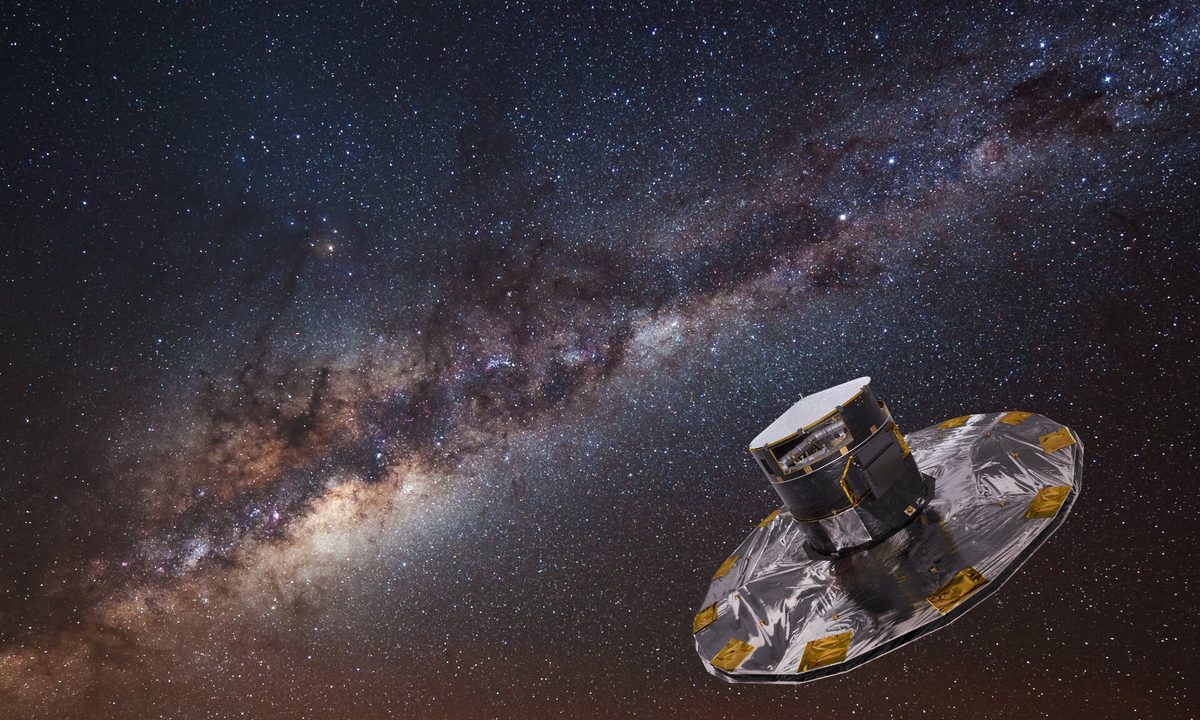
gaia asteroid binaries mapping the stars of milky way pillars 1
ESA/ATG medialab; background: ESO/S. Brunier

There are plenty of moons orbiting around the planets in our solar system — Saturn, for example, has well over 100 known moons — and astronomers believe that planets outside our solar system almost certainly have moons too, called exomoons. Those are particularly hard to spot, but now researchers have a new bevy of a different type of moon to explore: those that orbit around asteroids.

It seems funny to think of it, but it’s actually quite common for asteroids to have tiny moons of their own. These form what is called a binary asteroid, like the famous pair of Didymos and Dimorphos, which NASA crashed a spacecraft into in 2022. The new data about binary asteroids comes from the European Space Agency’s Gaia mission, a space-based telescope that has spotted new potential moons around 350 asteroids.

Recommended Videos

“Binary asteroids are difficult to find as they are mostly so small and far away from us,” said lead researcher Luana Liberato of Observatoire de la Côte d’Azur, France in a statement. “Despite us expecting just under one-sixth of asteroids to have a companion, so far we have only found 500 of the million known asteroids to be in binary systems. But this discovery shows that there are many asteroid moons out there just waiting to be found.”
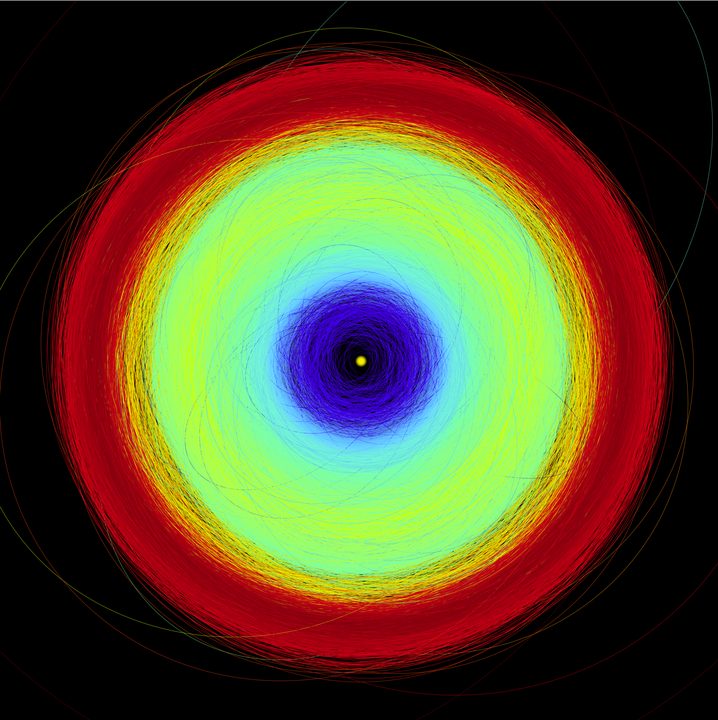
This image shows the orbits of the more than 150 000 asteroids in Gaia’s data release 3, from the inner parts of the Solar System to the Trojan asteroids at the distance of Jupiter, with different colour codes. The yellow circle at the centre represents the Sun. Blue represents the inner part of the Solar System, where the Near Earth Asteroids, Mars crossers, and terrestrial planets are. The Main Belt, between Mars and Jupter, is green. Jupiter trojans are red.
This image shows the orbits of the more than 150 000 asteroids in Gaia’s data release 3, from the inner parts of the Solar System to the Trojan asteroids at the distance of Jupiter, with different color codes. The yellow circle at the center represents the Sun. Blue represents the inner part of the Solar System, where the Near Earth Asteroids, Mars crossers, and terrestrial planets are. The Main Belt, between Mars and Jupiter, is green. Jupiter trojans are red. ESA/Gaia/DPAC; CC BY-SA 3.0 IGO; ACKNOWLEDGEMENTS P. Tanga (Observatoire de la Côte d'Azur)

Gaia is on a mission to map the entire Milky Way in 3D, but during its observations it also collects a large amount of data about objects within our solar system. It is this solar system data that has turned up the many new potential asteroid binaries. If these are confirmed, it would almost double the number of known asteroid binaries for astronomers to explore.

Gaia is able to detect hints of these binaries by looking for a distinctive “wobble” in the orbits of larger asteroids, which implies the existence of a smaller binary partner. Gaia is still collecting data, with another large-scale data release coming in 2026 that will uncover even more asteroid orbits.

“Gaia has proven to be an outstanding asteroid explorer, and is hard at work revealing the secrets of the cosmos both within and beyond the Solar System,” says Timo Prusti, project scientist for Gaia at ESA. “This finding highlights how each Gaia data release is a major step up in data quality, and demonstrates the amazing new science made possible by the mission.”

The research is published in the journal Astronomy & Astrophysics.

Georgina Torbet
Georgina has been the space writer at Digital Trends space writer for six years, covering human space exploration, planetary…
China’s answer to SpaceX’s reusable rockets literally catches boosters in a net
SpaceX catches boosters on legs. China just used a net.
Ammunition, Missile, Weapon

SpaceX's playbook for recovering a rocket booster generally involves legs, a precisely controlled vertical landing, and either a concrete pad or a drone ship. 

China just managed to pull off something similar, but in a slightly different way, and on July 10, it tested the method as well.

Read more
Dimming the sun sounds unhinged, but this new study on El Niño makes a surprisingly good case for it
A natural test case, Australia's worst-ever wildfire season, suggests the idea deserves serious consideration.
Nature, Outdoors, Sky

When I first saw "scientists propose dimming the sun," I rolled my eyes. It sounds like a science fiction movie cooked up after watching many climate documentaries. But a new study, published on July 8, 2026, in the journal Science Advances, seems to have a genuinely compelling argument.

A Super El Niño is currently forming in the Pacific, feared to be the most intense in decades. It could escalate floods, wildfires, and extreme heat events worldwide. However, Researchers at UC San Diego's Scripps Institution of Oceanography, led by climate scientists Kate Ricke and Jessica Wan, are now proposing one of the most interesting solutions I’ve come across.

Read more
You can now walk through space and gaze into a black hole at this VR exhibit
Smithsonian Starstruck lets you drift past dying stars and see the origin point of the universe for as little as $18 a person.
Smithsonian Starstruck featured

Most planetarium shows ask you to sit still and look up. The Smithsonian's new VR exhibit takes a different approach, letting visitors walk through the vast expanse of the universe, drifting past stars, planets, and a black hole to get a physical sense of its true scale.

A $29 ticket to the edge of the galaxy

Read more