1. Home
  2. Space
  3. News

How to see the stunning Perseid meteor shower this weekend

Add as a preferred source on Google
A bright Perseid meteor streaked down on August 7, 2010, over buildings at the Stellafane amateur astronomy convention in Springfield, Vermont.
A bright Perseid meteor streaked down on August 7, 2010, over buildings at the Stellafane amateur astronomy convention in Springfield, Vermont. Sky & Telescope / Dennis di Cicco

This weekend will see the peak of one of the most spectacular meteor showers of the year: the Perseids. The shower occurs around this time each year as Earth passes through a cloud of debris left in its orbit by a comet called Swift-Tuttle. The comet orbits the sun just once every 133 years, but over its time it has left a “river of rubble” across Earth’s orbit. When the planet passes through this river, the tiny pieces of debris burn up in the atmosphere and create a stunning lightshow in the sky.

The Perseids are generally one of the best meteor showers for sky-watchers, but this year the timing is particularly good due to the phase of the moon. As the moon is a source of bright light in the sky, when it is full it can create glare that makes meteors harder to see. This weekend the moon is only in its first quarter, and will affect viewing before midnight. “But as the Moon sets before midnight local time, the rest of the night is primed for perfect viewing circumstances,” said Diana Hannikainen, observing editor at Sky & Telescope.

Recommended Videos

The peak of the shower is on Monday, August 12, but you can look out for the shower from Sunday, August 11. A helpful illustration from Sky & Telescope shows where to look for the Perseids in the sky, with the center point that they appear to originate from — called the radiant — highlighted in yellow.
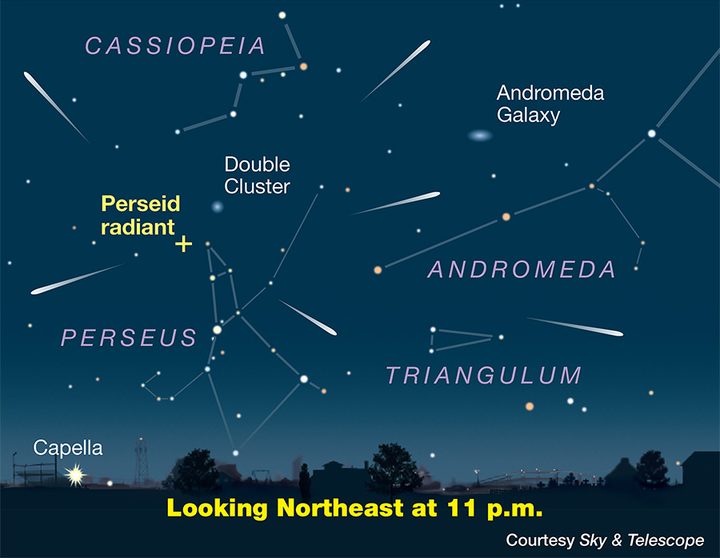
The Perseid meteors appear to stream away from the shower's "radiant" point near the border of Perseus and Cassiopeia
The Perseid meteors appear to stream away from the shower’s “radiant” point near the border of Perseus and Cassiopeia. Sky & Telescope Illustration

To enjoy the best views of the meteor shower, you’ll need to be somewhere with clear skies with no cloud cover. You also want to be as far as you can get from bright light sources like city lights. You’ll need to give your eyes some time to adjust to the darkness, so make yourself comfortable somewhere outside and expect to wait around 20 to 30 minutes for your eyes to adjust.

“And do resist looking at your phone during this time — or at any time during the night — because the harsh, bright light from the screen will wash away whatever dark adaptation you’ve built up,” Hannikainen said.

Also, if you’re heading out for a night of stargazing, then do be prepared for it to be cold, even during the summer. Sitting still for long periods outside can be chilly, so wrap up warm and don’t forget a spare blanket, and hopefully you can enjoy a gorgeous natural wonder of the sky.

Georgina Torbet
Georgina has been the space writer at Digital Trends space writer for six years, covering human space exploration, planetary…
China’s answer to SpaceX’s reusable rockets literally catches boosters in a net
SpaceX catches boosters on legs. China just used a net.
Ammunition, Missile, Weapon

SpaceX's playbook for recovering a rocket booster generally involves legs, a precisely controlled vertical landing, and either a concrete pad or a drone ship. 

China just managed to pull off something similar, but in a slightly different way, and on July 10, it tested the method as well.

Read more
Dimming the sun sounds unhinged, but this new study on El Niño makes a surprisingly good case for it
A natural test case, Australia's worst-ever wildfire season, suggests the idea deserves serious consideration.
Nature, Outdoors, Sky

When I first saw "scientists propose dimming the sun," I rolled my eyes. It sounds like a science fiction movie cooked up after watching many climate documentaries. But a new study, published on July 8, 2026, in the journal Science Advances, seems to have a genuinely compelling argument.

A Super El Niño is currently forming in the Pacific, feared to be the most intense in decades. It could escalate floods, wildfires, and extreme heat events worldwide. However, Researchers at UC San Diego's Scripps Institution of Oceanography, led by climate scientists Kate Ricke and Jessica Wan, are now proposing one of the most interesting solutions I’ve come across.

Read more
You can now walk through space and gaze into a black hole at this VR exhibit
Smithsonian Starstruck lets you drift past dying stars and see the origin point of the universe for as little as $18 a person.
Smithsonian Starstruck featured

Most planetarium shows ask you to sit still and look up. The Smithsonian's new VR exhibit takes a different approach, letting visitors walk through the vast expanse of the universe, drifting past stars, planets, and a black hole to get a physical sense of its true scale.

A $29 ticket to the edge of the galaxy

Read more