1. Home
  2. Space
  3. News

Event Horizon Telescope can now take images of black holes that are 50% sharper

Add as a preferred source on Google
Illustration of the highest-resolution detections ever made from the surface of Earth
Illustration of the highest-resolution detections ever made from the surface of Earth ESO/M. Kornmesser

The Event Horizon Telescope project, the group that took the first-ever image of a black hole, has made another historic breakthrough, making the highest-ever resolution observations of space taken from the Earth’s surface. The project uses facilities around the globe to turn the Earth itself into a giant observatory, which is capable of taking highly precise measurements of distant galaxies.

The latest observations made use of the Atacama Large Millimeter/submillimeter Array (ALMA), a large array of radio telescopes located in Chile, as well as other facilities in Spain, France, and Hawaii. To get higher-resolution images than previous observations, scientists weren’t able to make the telescope bigger — as it was already the size of the Earth — so they observed at a higher frequency instead.

Recommended Videos

The new setup allowed the researchers to detect light at a wavelength equivalent to 0.87 mm, which should make future images of black holes 50% more detailed — especially the area immediately around the boundary of a black hole.

“To understand why this is a breakthrough, consider the burst of extra detail you get when going from black and white photos to color,” said Sheperd Doeleman, founding director of the EHT. “This new ‘color vision’ allows us to tease apart the effects of Einstein’s gravity from the hot gas and magnetic fields that feed the black holes and launch powerful jets that stream over galactic distances.”
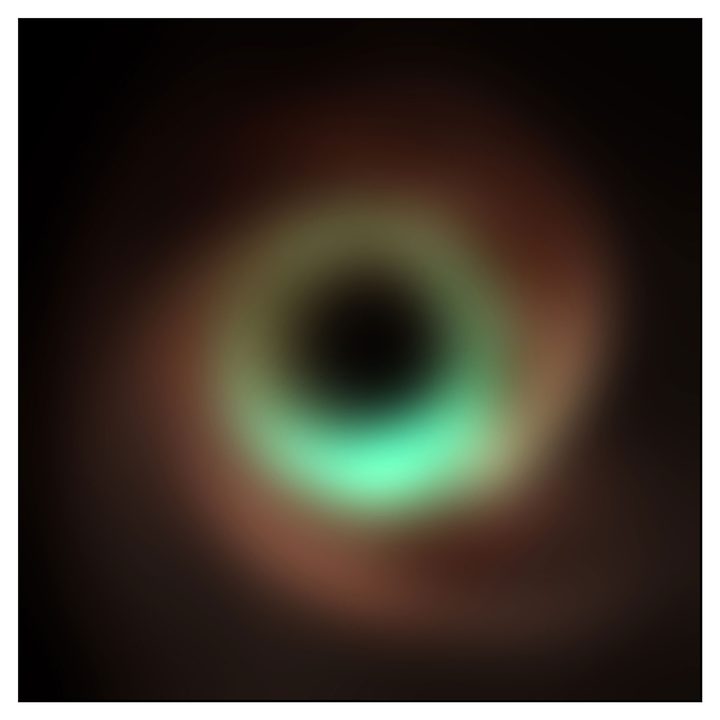
This simulated image shows how M87* is seen by the Event Horizon Telescope at 86 GHz (red), 230 GHz (green), and 345 GHz (blue). The higher the frequency, the sharper the image becomes, revealing structure, size, and shape that was previously less discernible.
This simulated image shows how M87* is seen by the Event Horizon Telescope at 86GHz (red), 230GHz (green), and 345GHz (blue). The higher the frequency, the sharper the image becomes, revealing structure, size, and shape that was previously less discernible. EHT, D. Pesce, A. Chael

This new ability should enable future images of black holes to be sharper, helping to see the cloud of dust and gas around the edges of a black hole that can help explain how black holes feed and grow, as well as learning about the jets of matter that they can send out at extreme speeds when feeding.

“With the EHT, we saw the first images of black holes using the 1.3-mm wavelength observations, but the bright ring we saw, formed by light bending in the black hole’s gravity, still looked blurry because we were at the absolute limits of how sharp we could make the images,” said fellow researcher Alexander Raymond. “At 0.87 mm, our images will be sharper and more detailed, which in turn will likely reveal new properties, both those that were previously predicted and maybe some that weren’t.”

The research is published in The Astronomical Journal.

Georgina Torbet
Georgina has been the space writer at Digital Trends space writer for six years, covering human space exploration, planetary…
China’s answer to SpaceX’s reusable rockets literally catches boosters in a net
SpaceX catches boosters on legs. China just used a net.
Ammunition, Missile, Weapon

SpaceX's playbook for recovering a rocket booster generally involves legs, a precisely controlled vertical landing, and either a concrete pad or a drone ship. 

China just managed to pull off something similar, but in a slightly different way, and on July 10, it tested the method as well.

Read more
Dimming the sun sounds unhinged, but this new study on El Niño makes a surprisingly good case for it
A natural test case, Australia's worst-ever wildfire season, suggests the idea deserves serious consideration.
Nature, Outdoors, Sky

When I first saw "scientists propose dimming the sun," I rolled my eyes. It sounds like a science fiction movie cooked up after watching many climate documentaries. But a new study, published on July 8, 2026, in the journal Science Advances, seems to have a genuinely compelling argument.

A Super El Niño is currently forming in the Pacific, feared to be the most intense in decades. It could escalate floods, wildfires, and extreme heat events worldwide. However, Researchers at UC San Diego's Scripps Institution of Oceanography, led by climate scientists Kate Ricke and Jessica Wan, are now proposing one of the most interesting solutions I’ve come across.

Read more
You can now walk through space and gaze into a black hole at this VR exhibit
Smithsonian Starstruck lets you drift past dying stars and see the origin point of the universe for as little as $18 a person.
Smithsonian Starstruck featured

Most planetarium shows ask you to sit still and look up. The Smithsonian's new VR exhibit takes a different approach, letting visitors walk through the vast expanse of the universe, drifting past stars, planets, and a black hole to get a physical sense of its true scale.

A $29 ticket to the edge of the galaxy

Read more