1. Home
  2. Space
  3. News

James Webb image shows two galaxies in the process of colliding

Add as a preferred source on Google
This composite image of Arp 107, created with data from the James Webb Space Telescope’s NIRCam (Near-InfraRed Camera) and MIRI (Mid-InfraRed Instrument), reveals a wealth of information about the star formation taking place in these two galaxies and how they collided hundreds of million years ago. The near-infrared data, shown in white, show older stars, which shine brightly in both galaxies, as well as the tenuous gas bridge that runs between them. The vibrant background galaxies are also brightly illuminated at these wavelengths.
This composite image of Arp 107, created with data from the James Webb Space Telescope’s NIRCam (Near-InfraRed Camera) and MIRI (Mid-InfraRed Instrument), reveals a wealth of information about the star formation taking place in these two galaxies and how they collided hundreds of million years ago. The near-infrared data, shown in white, show older stars, which shine brightly in both galaxies, as well as the tenuous gas bridge that runs between them. The vibrant background galaxies are also brightly illuminated at these wavelengths. NASA, ESA, CSA, STScI

A new image from the James Webb Space Telescope shows one of the universe’s most dramatic events: the colliding of two galaxies. The pair, known as Arp 107, are located located 465 million light-years away and have been pulled into strange shapes by the gravitational forces of the interaction, but this isn’t a purely destructive process. The collision is also creating new stars as young stars are born in swirling clouds of dust and gas.

The image above is a composite, bringing together data from Webb’s NIRCam (Near-InfraRed Camera) and MIRI (Mid-InfraRed Instrument). These two instruments operate in different parts of the infrared, so they can pick up on different processes. The data collected in the near-infrared range is seen in white, highlighting older stars and the band of gas running between the two galaxies. The mid-infrared data is shown in orange and red, highlighting busy regions of star formation, with bright young stars putting out large amounts of radiation.

Recommended Videos

If you look at just the MIRI data, below, you can see features like the glow of the supermassive black hole at the center of the galaxy to the right. Although the black hole itself can’t be seen directly, the swirling dust and gas around its event horizon heats up as it moves and glows brightly.
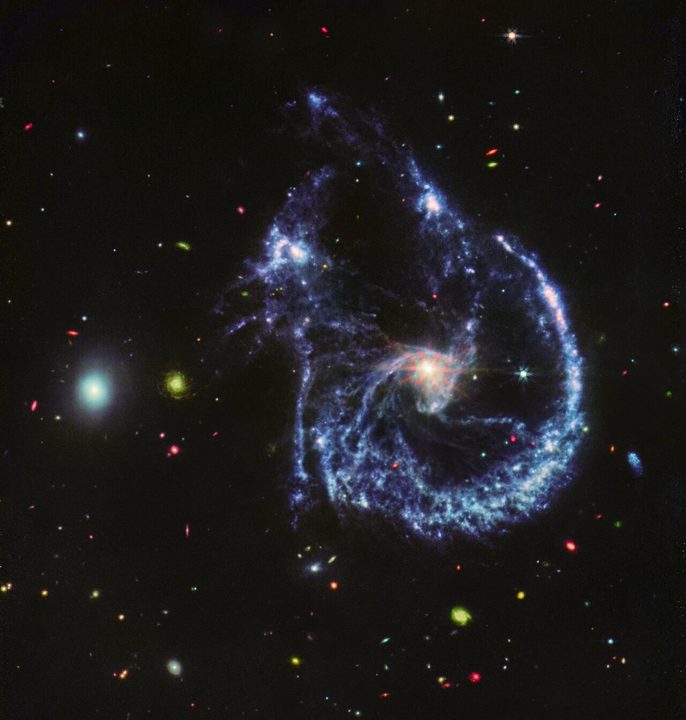
This image of Arp 107, obtained by Webb’s MIRI (Mid-InfraRed Instrument), reveals the supermassive black hole that lies in the centre of the large spiral galaxy to the right, as evidenced by the small, bright central ‘core’. This bright core, where the black hole is pulling much of the dust into lanes, also features Webb’s characteristic diffraction spikes, caused by the light that it emits interacting with the structure of the telescope itself.
This image of Arp 107, obtained by Webb’s MIRI (Mid-InfraRed Instrument), reveals the supermassive black hole that lies in the center of the large spiral galaxy to the right, as evidenced by the small, bright central core. This bright core, where the black hole is pulling much of the dust into lanes, also features Webb’s characteristic diffraction spikes, caused by the light that it emits interacting with the structure of the telescope itself. NASA, ESA, CSA, STScI

The swirls of star formation give this image a similar look to the Cartwheel Galaxy, which is also a galaxy undergoing an interaction. These interactions, or collisions, can reshape galaxies and have a complex relationship with the rate of star formation.

“The collision isn’t as bad as it sounds,” Webb scientists write. “Although there was much star formation occurring before, collisions between galaxies can compress gas, improving the conditions needed for more stars to form. On the other hand, as Webb reveals, collisions also disperse a lot of gas, potentially depriving new stars of the material they need to form.”

The Arp 107 pair will continue merging over hundreds of millions of years, eventually becoming one singular galaxy.

Georgina Torbet
Georgina has been the space writer at Digital Trends space writer for six years, covering human space exploration, planetary…
Getting to Mars may require a pit stop in orbit, and NASA just tested the nozzle to make that happen
A gas pump nozzle for spacecraft sounds simple. It is not, and that's what makes this test worth paying attention to.
Architecture, Building, Factory

Getting a spacecraft to Mars or beyond requires an enormous amount of fuel, most of which has to be hauled from Earth, adding to the overall cost and weight of the spacecraft. NASA has been working on a different approach, one that could be more efficient and effective.

It wants to refuel a spacecraft in orbit before heading out for the mission. What’s even more interesting is that the space agency just finished testing a component that could make that possible: a cryocoupler.

Read more
Elon Musk’ Starlink could soon offer mobile services as a US carrier
Showcase of T-Mobile Starlink service on an iPhone.

Elon Musk’s Starlink has already changed how millions of people access the internet, especially in places where traditional broadband struggles to reach. Now, the satellite internet service could be preparing for an even bigger leap — becoming your mobile carrier.

According to a Financial Times report, SpaceX has told investors it’s considering launching a retail Starlink mobile service in the US. Instead of simply partnering with wireless carriers, the company could begin selling mobile plans directly to consumers, putting it in direct competition with Verizon, AT&T, and T-Mobile.

Read more
Lightsails have hit another speed bump on the road to interstellar travel
The coolest interstellar travel idea may get betrayed by the light pushing it
LightSail in Earth orbit

Laser-powered lightsails are one of the coolest answers to spaceflight. It might not be as sci-fi-sounding as a warp drive, but now, its practicality has also come under question. Using lightsails, a spacecraft could unfurl an ultra-thin reflective sail and let a powerful laser push it toward another star, without relying on fuel.

The tech was simple and elegant--except it's also more complicated than it sounds. A new preprint from researchers Chao Shen and Jiaze Li of the Harbin Institute of Technology suggests that relativistic lightsails may run into a hidden propulsion problem once they start moving extremely fast.

Read more