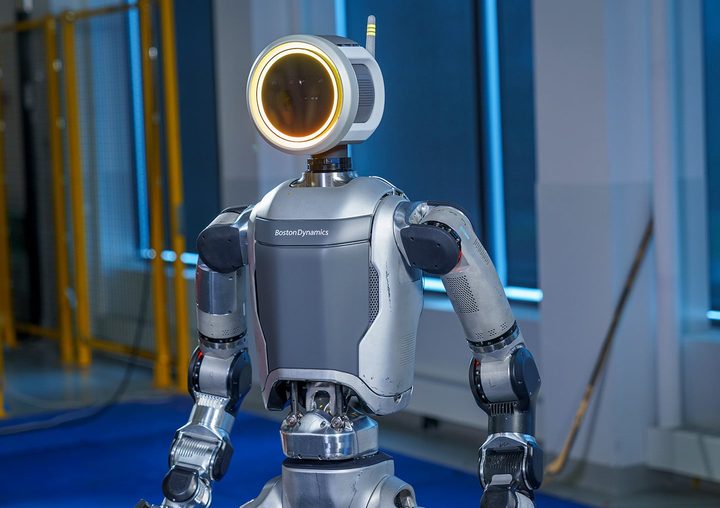
Boston Dynamics and Toyota Research Institute (TRI) announced on Tuesday that they are partnering to develop general-purpose humanoid robots. Boston Dynamics will contribute its new electric Atlas robot to the task, while TRI will utilize its industry-leading Large Behavior Models.
Boston Dynamics, which launched in 1992 as an offshoot from the Massachusetts Institute of Technology (MIT), has been at the forefront of robotics development for more than 30 years. It burst into the mainstream in 2009 with the BigDog and LittleDog quadrupedal systems and debuted the first iteration of its bipedal Atlas platform in 2013. Atlas’ capabilities have undergone a steady evolution in the past decade, enabling the robot to perform increasingly difficult acrobatics and dexterity tasks, from dancing and doing back flips to to conquering parkour courses and navigating simulated construction sites.
In April 2024, the company retired its long-standing, hydraulic Atlas platform in favor of a new generation driven by electric servos. The company describes the electric Atlas as “one of the most advanced humanoid robots ever built,” one that is “able to move in ways that exceed human capabilities.”
TRI, on the other hand, stands at the forefront of Large Behavior Model (LBM) development. LBMs are to robotics as LLMs are to chatbots. Just as LLM’s are trained on massive multimodal datasets to respond to a human like a human would, LBMs are trained on enormous corpora of human behaviors, enabling robots to move and act in a humanlike manner. They also help robots learn new behaviors and generalize across tasks. Per the announcement blog, “TRI’s work on LBMs aims to achieve multitask, vision-and-language-conditioned foundation models for dexterous manipulation.”
“Recent advances in AI and machine learning hold tremendous potential for advancing physical intelligence,” Gill Pratt, chief scientist for Toyota and CEO of TRI, said in a statement. “The opportunity to implement TRI’s state-of-the-art AI technology on Boston Dynamics’ hardware is game-changing for each of our organizations as we work to amplify people and improve quality of life.”
This news comes amid an increasingly crowded field of companies looking to incorporate robots into the future workforce. Agility Robotics’ Digit and Figure’s 01 and 02 models, for example, are already being tested in industrial settings such as BMW’s Spartanburg plant in South Carolina and a Spanx production facility in Flowery Branch, Georgia. Tesla’s Optimus is ostensibly also in the running, though even the most recent models still need to be remotely operated when performing more than the most basic tasks.