1. Home
  2. Phones
  3. Mobile
  4. News

The Google Messages app is getting a few important safety features

Add as a preferred source on Google
google messages scam identity fraud package delivery spam features detect
Google

Google’s software theme for 2024 has been safety. With the arrival of Android 15, the company added a host of anti-theft measures for phones, and later locked the Find My system behind biometric check. Next in line is the Messages app.

Earlier today, the company announced enhanced scam detection, putting special focus on package delivery scams and job frauds. Package delivery frauds have been on the rise lately, and they are being used for everything from brushing scams to those extorting money in the name of fake package delivery problems.

Recommended Videos

Even the U.S. Federal Communications Commission (FCC) issued a warning about the sharp rise in such scams. These deceptions usually originate with a misleading text message and often contain a fake tracking link.

Blocking a number sending spam SMS on a phone.
Andy Boxall / Digital Trends

Google says the Messages app will rely on on-device AI smarts to detect scammy texts. It will subsequently warn users about such messages and will automatically park them in the spam folder. This feature has already started rolling out to beta testers.

Next, Google is expanding a safety scan system that automatically looks for links or URLs that could be malicious. Such URLs can deal a lot of damage, ranging from installation of malware packages to redirecting users to a phishing portal. So far, this system has been tested in a few Asian countries, including India. Now, Google says it will expand intelligent URL warnings for Messages users worldwide before the end of this year.

But there is still a chance that users might fall into a web of carefully orchestrated online fraud starting with seemingly urgent messages. To avoid such a scenario, Google will offer an added layer of protection that blocks messages from unknown international senders.
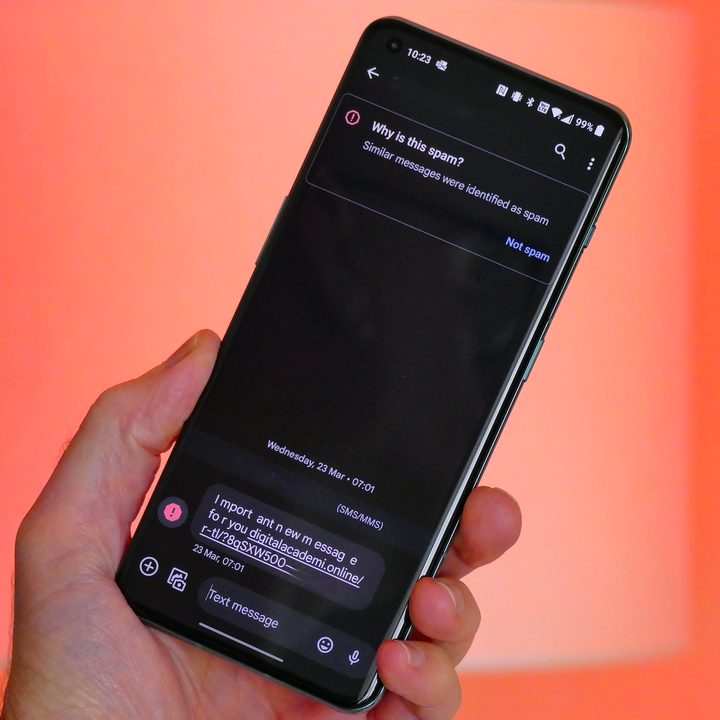
A spam SMS message on a phone.
Andy Boxall / Digital Trends

Cybercriminals often use virtual numbers of international origin to avoid tracking and detection by local law enforcement authorities. Google notes that the Messages app will let users automatically hide all such messages from international senders to minimize the risks.

All such communication will be pushed to the “Spam & blocked” folder in the Messages app. Rollout of this feature begins in Singapore, and based on the reception, it will be expanding to more markets.

But scammers don’t always use international numbers. They often try to spoof legitimate business entities like banking, automobile, and logistics brands using a business sender profile. In some cases, they simply try to pass off as an acquaintance. To tackle such sophisticated threats, the Messages app is prepping a contact verification system. This would rely on each contact’s public key for verification, a system that checks for the sender’s identity using a QR or registered phone number.

Google has already started working on a unified public key dashboard and will make the contact key verification system available for all phones running Android 9 or a later version.

Nadeem Sarwar
Nadeem is the Managing Editor at Digital Trends.
Samsung finally switched to silicon-carbon battery on Galaxy Z Fold 8. What’s so special about it?
One of Galaxy Z Fold 8’s biggest upgrade is hiding inside
Galaxy Z Fold 8 Ultra with Fold 8

Samsung has finally joined the silicon-carbon battery race with its latest batch of premium foldables packing the new battery tech. But details for this change were rather hard to spot on the spec sheets. The company has confirmed during media briefings that the Galaxy Z Fold 8 Ultra, Galaxy Z Fold 8, and Galaxy Z Flip 8 all use silicon-carbon batteries.

Even then, the resulting capacities are hardly record-breaking. The Fold 8 Ultra carries a 5,000mAh battery, the regular Fold 8 gets 4,800mAh, and the Flip 8 has 4,300mAh. Rivals from Honor and Motorola have already crossed the 6,000mAh mark. But the figures only tell part of the story.

Read more
I’ve used foldable phones for years. Here’s how to pick the right one between the Galaxy Z Fold 8 and Flip 8
Samsung’s three new foldables solve very different problems
Galaxy foldables with its screen visible

After years of reviewing foldable smartphones, I have learned that choosing one involves much more than what looks pretty or how large you want. Book-style foldables are usually sold as productivity machines, while flip phones cater to people who value portability. Samsung’s latest lineup complicates that choice by introducing two very different book-style models alongside its familiar clamshell.

Most of their shared specifications fade into the background once you start using them. Their shapes and screens have a much greater impact on daily life. So here's how I'd make a decision when choosing between the new Galaxy Z Fold 8 Ultra, Galaxy Z Fold 8, and Galaxy Z Flip 8.

Read more
How to set up selfie video sign-in for your Google account
Your face can now serve as a way to get back into your Google account. Here's how to set it up.
Google account selfie sign in tutorial featured

Losing access to a Google account is rarely a quick fix, but Google has been actively working to make things easier. Last year, the company introduced a feature called Recovery Contacts that lets you designate a trusted friend or family member to verify your identity if you ever get locked out. Now, Google has introduced a new option, one that uses your face to get you back in instead of a phone call to a friend.

Like Recovery Contacts, the new selfie video authentication feature requires some setup before you can use your face to sign into your Google account. This involves recording the reference video that Google will use to verify your identity whenever you attempt to log in this way. Here's how to set up selfie video sign-in for your Google account.

Read more