There’s been a lot of talk about AI PCs this year, but has it actually delivered on its promise? A new analysis from TrendForce says the significant boost in laptop sales in 2024 has more to do with Windows 11 updates than it does with fancy new AI features.
“The impact of AI-integrated notebooks on the overall market remains limited for now,” the report states. “However, AI features are expected to naturally integrate into notebook specifications as brands gradually incorporate them, resulting in a steady rise in the penetration rates of AI notebooks.”
The report doesn’t specify what is meant by “AI-integrated notebooks,” though it’s safe to assume it refers to Copilot+ PCs, which have a more powerful neural processing unit (NPU) onboard that can perform local AI processing.
There are a few reasons for this that can speculated on though. First, the TrendForce report states that the consumer market in North America has been dominated by “aggressive promotions” and “entry-level models.” Copilot+ PCs, meanwhile, are priced at $999 and up, catering to more premium segments. Those just aren’t the types of laptops driving the consumer Windows PC market right now.
In order to get people to pay extra for these AI PCs, they really need to be able to sell themselves on how AI capabilities will benefit them — and that doesn’t appear to have happened yet.
Most people rely on cloud-based AI tools like ChatGPT or find existing hardware sufficient for tasks like video calls or document editing. For professionals, AI PCs may offer benefits in efficiency for tasks like video editing, but the average user sees limited immediate utility, reducing the perceived need to upgrade now.
The privacy controversy and following delays of Recall certainly didn’t help the situation either. That was, after all, supposed to be the headlining AI feature of Copilot+ PCs — and it’s only now rolling out, nearly six months later.
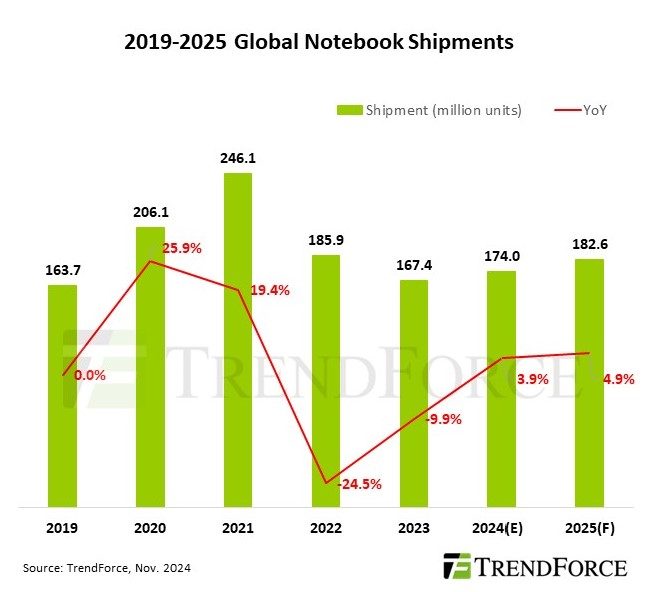
So, while AI might not have been the big marketing success Microsoft hoped it would be, the bump in PC sales is nice to see regardless. Global notebook shipments are predicted to grow by another 4.9% to 183 million units in 2025. As the the approaching end-of-support for Windows 10 gets even closer, more and more businesses and consumers are going to be compelled to upgrade.
The phasing out of Windows 10, however, has emerged as the key motivator for new laptop purchases. Many older systems lack the hardware requirements for Windows 11, such as TPM 2.0, forcing users to replace otherwise functional devices. This has driven significant demand for non-AI laptops compatible with the newer operating system. Businesses and consumers upgrading for compliance or functionality are prioritizing cost-effective models over experimental AI PCs.
As AI PCs evolve and the technology matures, their appeal might grow, especially if more software becomes optimized for NPUs and prices decrease. However, the AI push remains a secondary factor compared to the more immediate requirement to transition to Windows 11. This highlights a mismatch between industry innovation and consumer needs, with the latter focused on affordability and essential functionality rather than speculative advancements