During a 90-odd-minute keynote address at CES 2025 in Las Vegas on Monday, Nvidia CEO Jensen Huang showed off a powerful desktop computer for home AI enthusiasts. Currently going by Project Digits, this $3,000 device takes up about as much space as a Mac mini and offers 1 PFLOPS of FP4 floating point performance.
Nvidia reportedly used its DGX 100 server design as inspiration for the self-contained desktop AI, with Projects Digits being powered by a 20-core GB10 Grace Blackwell Superchip on 128GB of LPDDR5X memory with a 4TB NVMe solid-state drive (SSD).
“AI will be mainstream in every application for every industry,” Huang said during the keynote. “With Project Digits, the Grace Blackwell Superchip comes to millions of developers. Placing an AI supercomputer on the desks of every data scientist, AI researcher, and student empowers them to engage and shape the age of AI.”
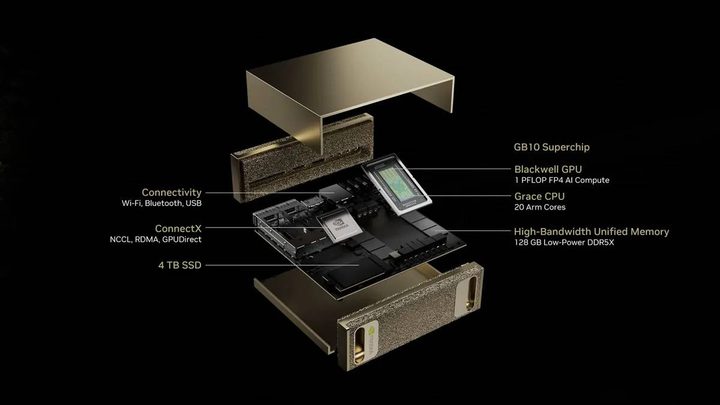
Nvidia collaborated extensively with Arm to create the Grace Blackwell chip. “Our collaboration with Arm on the GB10 Superchip will fuel the next generation of innovation in AI,” Ashish Karandikar, Nvidia’s vice president of SoC Products, said in the company’s press release.
That much compute power means a Project Digits device will be able to locally run a 200-billion-iteration AI large language model (LLM) when it is scheduled for release in May. ChatGPT using the GPT-4o model, for example, is only 12-billion iterations. Digits devices can also be tethered together, increasing their theoretical max model size up to 405 billion iterations.
The company is targeting users who need full-power LLMs running locally as their primary customers for Project Digits. As such, each device comes preloaded with Nvidia’s entire AI Enterprise software stack — everything an enterprise and research outfit would need to get their AI up and running — with the idea being that users “prototype, fine-tune, and test models on local Project Digits systems” before deploying them to the cloud.
Artificial intelligence has long been criticized as a top-down technology in that its development has largely been directed by a select number of companies and institutions (specifically, those wealthy enough to afford the massive training and operating costs AI requires). This is the precise opposite of how the first computer revolution came about in the 1970s to 1990s, where uncountable legions of individual hobbyists, tinkerers, and experimentalists drove the development of personal computer technology.
Project Digits could provide the same opportunity for the AI industry. Granted, $3,000 will surely limit its initial adoption to a degree, but to be fair, people didn’t blink at the $3,500 price tag on Apple’s failed Vision Pro headset, and that thing was just a fancy display strapped to their face. If you’re interested in trying Digits for yourself, Nvidia has a notification sign-up on its website.