1. Home
  2. Space
  3. News

Two NASA astronauts are currently outside the ISS, repairing an X-ray telescope

Add as a preferred source on Google
NASA astronauts Nick Hague and Suni Williams work on the exterior of the ISS on January 16, 2025.
NASA astronauts Nick Hague and Suni Williams work on the exterior of the ISS on January 16, 2025. NASA TV

Two NASA astronauts are currently performing a spacewalk, having headed outside of the International Space Station (ISS) at 8:01 a.m. ET this morning, Thursday, January 16. They are on a job expected to last for around six and a half hours, working to repair an X-ray telescope fitted to the exterior of the station called NICER (Neutron star Interior Composition Explorer).

The astronauts are Nick Hague and Suni Williams, and they are performing NASA’s first spacewalk in more than six months, following a suspension of spacewalk activities after a leak problem with a spacesuit in June 2024. With no problems with the suits thus far, Hague and Williams have been performing work to install special patches to the telescope. These patches will prevent too much light from entering the telescope and disrupting its readings, and they will cover over areas of the existing light filter which has been damaged.
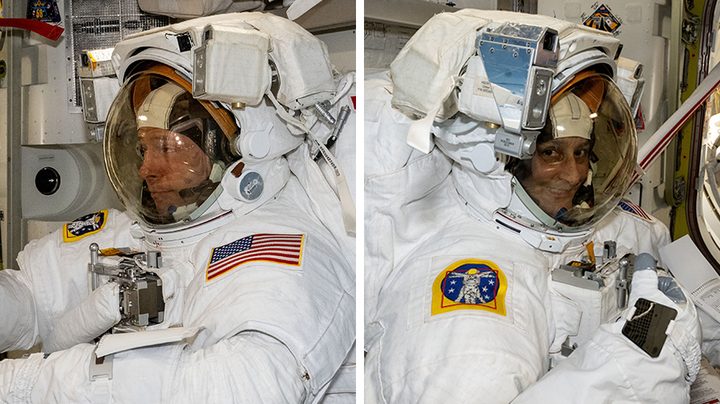
NASA astronauts Nick Hague and Suni Williams, both NASA astronauts, are pictured evaluating their spacesuits in a pressurized configuration in the Quest airlock.
NASA astronauts Nick Hague and Suni Williams, both NASA astronauts, are pictured evaluating their spacesuits in a pressurized configuration in the Quest airlock. NASA

On social media, representatives for NASA thanked the pair for their work in repairing the telescope, which is used to investigate very dense objects called neutron stars by observing X-rays, and which has previously produced a stunning map of the sky showing X-ray sources as seen from the ISS.

Recommended Videos

With some checking and calibration work to perform, NICER should be back to taking science observations soon.

The patches for our NICER telescope have been installed thanks to @NASA_Astronauts Nick Hague!

The next steps for the NICER team include unstowing the telescope and restarting daytime observations to examine the data with the patches installed. Stay tuned for updates. pic.twitter.com/JhFgskAmlj

— NASA Universe (@NASAUniverse) January 16, 2025

While on their spacewalk, Hague and Williams will be performing some other jobs too, including removing and then replacing a station part called a rate gyro assembly. These help to keep the station in the right orientation as it orbits the Earth at 250 miles above the planet’s surface. They will also be doing other maintenance, like replacing a reflector device on one of the station’s docking adapters. These reflectors are used for navigation, helping to indicate the position of the docking area. Finally, they will also check over an area that will have maintenance work performed on it in future.

This future spacewalk will tackle maintenance on the Alpha Magnetic Spectrometer, an “unfixable” dark matter instrument from 2011 which astronauts succeeded in fixing in 2023. The instrument was designed to last only for three year and was not intended to be maintained by astronauts, but given its scientific value, NASA was able to fabricate new tools to open it up and upgrade its cooling system, allowing it to continue operating.

You can watch along with the spacewalk here:

US Spacewalk 91 with Astronauts Nick Hague and Suni Williams (Official NASA Broadcast)
Georgina Torbet
Georgina has been the space writer at Digital Trends space writer for six years, covering human space exploration, planetary…
Space is becoming Bezos and Musk’s next data center site, and we have every reason to worry
The AI boom is coming for the night sky
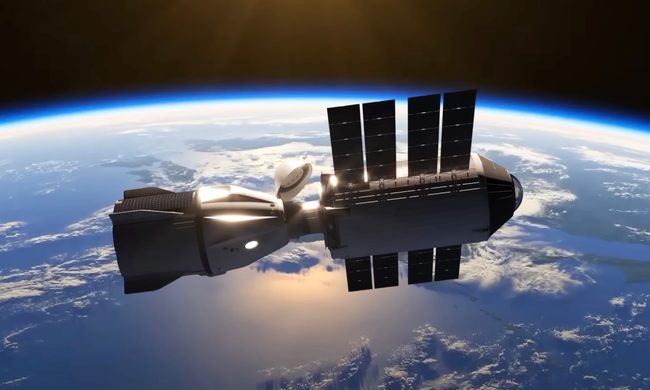
How Vast's space station will look in orbit.

AI data centers already consume vast amounts of electricity and water on Earth, so Silicon Valley has begun looking somewhere considerably more spacious... literally.

Elon Musk's SpaceX and Jeff Bezos' Blue Origin, along with several other companies, have proposed enormous constellations of satellites designed to operate as orbital data centers. However, environmental groups and former space officials are now warning that putting them into orbit at the proposed scale could have severe consequences for Earth's atmosphere and the night sky.

Read more
The first possible exomoon is here, and it makes our Moon look hilariously tiny
Scientists may have found the first exomoon, except this one is the size of Jupiter
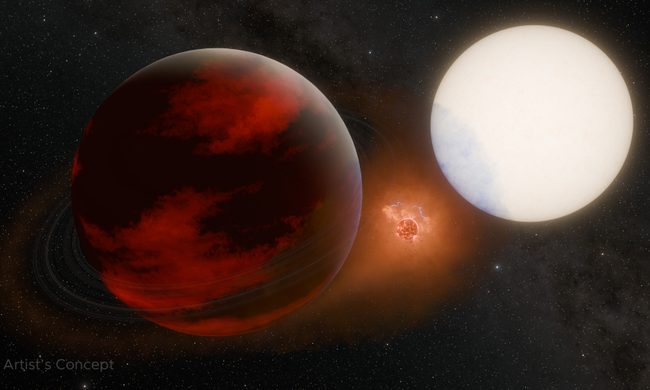
This artist’s concept depicts a potential volcanic moon between the exoplanet WASP-49 b, left, and its parent star. New evidence indicating that a massive sodium cloud observed near WASP-49 b is produced by neither the planet nor the star has prompted researchers to ask if its origin could be an exomoon.

We have already discovered more than 6,000 planets outside of our immediate neighborhood. Yet, finding a moon orbiting one of those distant worlds has proved considerably harder. Astronomers may finally have something close to the real deal, but this particular object stretches the word “moon” almost beyond recognition.

Using the European Southern Observatory’s Very Large Telescope in Chile, researchers detected strong evidence for a moon-like object in the CD-35 2722 system. Further observations are still necessary to confirm the discovery, but it could become the first confidently detected natural satellite outside our solar system. There is still one tiny complication though. This moon is apparently massive.

Read more
China’s answer to SpaceX’s reusable rockets literally catches boosters in a net
SpaceX catches boosters on legs. China just used a net.
Ammunition, Missile, Weapon

SpaceX's playbook for recovering a rocket booster generally involves legs, a precisely controlled vertical landing, and either a concrete pad or a drone ship. 

China just managed to pull off something similar, but in a slightly different way, and on July 10, it tested the method as well.

Read more