1. Home
  2. Space
  3. News

This distant exoplanet has an atmosphere ‘like something out of science fiction’

Add as a preferred source on Google
Tylos (or WASP-121b) is a gaseous, giant exoplanet located some 900 light-years away in the constellation Puppis. Using the ESPRESSO instrument on ESO’s Very Large Telescope (VLT), scientists have been able to prove into its atmosphere, revealing its 3D structure. This is the first time that this has been possible on a planet outside of the Solar System. The atmosphere of Tylos is divided into three layers, with iron winds at the bottom, followed by a very fast jet stream of sodium, and finally an upper layer of hydrogen winds. This kind of climate has never been seen before on any planet.
Tylos (or WASP-121b) is a gaseous, giant exoplanet located some 900 light-years away in the constellation Puppis. Using the ESPRESSO instrument on ESO’s Very Large Telescope (VLT), scientists have been able to prove into its atmosphere, revealing its 3D structure. This is the first time that this has been possible on a planet outside of the Solar System. The atmosphere of Tylos is divided into three layers, with iron winds at the bottom, followed by a very fast jet stream of sodium, and finally an upper layer of hydrogen winds. This kind of climate has never been seen before on any planet. ESO/M. Kornmesser

For decades, astronomers have been wondering about planets beyond our solar system — called exoplanets — and whether we could learn about these far-off worlds. With the introduction of tools like the James Webb Space Telescope, we’re now able to not only detect exoplanets, but also to learn about them in detail. Recently, astronomers created the first 3D view of an exoplanet atmosphere, letting them peer into the climate of another world.

The researchers used a ground-based telescope, the European Southern Observatory’s Very Large Telescope (ESO’s VLT), which consists of four telescopes that work together to take detailed readings of distant objects. They found that exoplanet WASP-121b, which has surface temperatures of over 3,000 Kelvins, or 5,000 degrees Fahrenheit, is so hot that metals like iron and titanium can be whipped up into the atmosphere, carried by powerful winds.

Recommended Videos

“This planet’s atmosphere behaves in ways that challenge our understanding of how weather works — not just on Earth, but on all planets. It feels like something out of science fiction,” said lead researcher Julia Victoria Seidel of the European Southern Observatory (ESO) in Chile.

By looking at the 3D structure of the atmosphere, the researchers found that the planets has winds which act in different layers. The iron, sodium, and hydrogen elements all move in separate layers which rotate differently relative to the orbit of the planet. It’s a complex, involved picture which underlines that other planets have systems which are just as complex — or even more so — than the climate of our own planet, and that there are many possible new configurations of climate for us to discover.
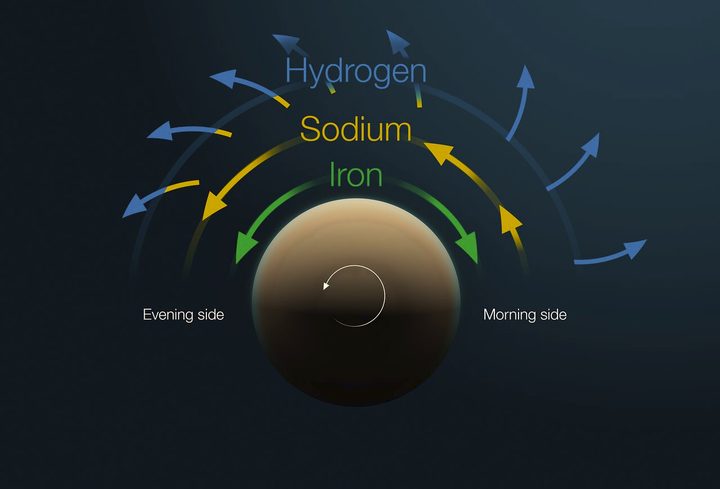
This diagram shows the structure and motion of the atmosphere of the exoplanet Tylos (WASP-121b). The exoplanet is shown from above in this figure, looking at one of its poles. The planet rotates counter-clockwise, in such a way that it always shows the same side to its parent star, so it's always day on one half of the planet and night on the other. The transition between night and day is the "morning side" while the "evening side" represents the transition between day and night; its morning side is to the right and its evening side to the left.
This diagram shows the structure and motion of the atmosphere of the exoplanet Tylos (WASP-121b). The exoplanet is shown from above in this figure, looking at one of its poles. ESO/M. Kornmesser

“What we found was surprising: a jet stream rotates material around the planet’s equator, while a separate flow at lower levels of the atmosphere moves gas from the hot side to the cooler side,” said Seidel. “This kind of climate has never been seen before on any planet.”

An animation shows the findings of different layers and how they move around the planet:

The different layers of the atmosphere on WASP-121b

The observations were made using the VLT’s ESPRESSO instrument, which brings together data from four large telescopes into one signal, allowing the researchers to track the movement of elements like iron, sodium, and hydrogen. By following these movements, they could track the path of the winds and build up a 3D model.

“It’s truly mind-blowing that we’re able to study details like the chemical makeup and weather patterns of a planet at such a vast distance,” said fellow researcher Bibiana Prinoth of Lund University, Sweden.

The research is published in two papers in the journals Nature and Astronomy & Astrophysics.

Georgina Torbet
Georgina has been the space writer at Digital Trends space writer for six years, covering human space exploration, planetary…
Space is becoming Bezos and Musk’s next data center site, and we have every reason to worry
The AI boom is coming for the night sky
How Vast's space station will look in orbit.

AI data centers already consume vast amounts of electricity and water on Earth, so Silicon Valley has begun looking somewhere considerably more spacious... literally.

Elon Musk's SpaceX and Jeff Bezos' Blue Origin, along with several other companies, have proposed enormous constellations of satellites designed to operate as orbital data centers. However, environmental groups and former space officials are now warning that putting them into orbit at the proposed scale could have severe consequences for Earth's atmosphere and the night sky.

Read more
The first possible exomoon is here, and it makes our Moon look hilariously tiny
Scientists may have found the first exomoon, except this one is the size of Jupiter
This artist’s concept depicts a potential volcanic moon between the exoplanet WASP-49 b, left, and its parent star. New evidence indicating that a massive sodium cloud observed near WASP-49 b is produced by neither the planet nor the star has prompted researchers to ask if its origin could be an exomoon.

We have already discovered more than 6,000 planets outside of our immediate neighborhood. Yet, finding a moon orbiting one of those distant worlds has proved considerably harder. Astronomers may finally have something close to the real deal, but this particular object stretches the word “moon” almost beyond recognition.

Using the European Southern Observatory’s Very Large Telescope in Chile, researchers detected strong evidence for a moon-like object in the CD-35 2722 system. Further observations are still necessary to confirm the discovery, but it could become the first confidently detected natural satellite outside our solar system. There is still one tiny complication though. This moon is apparently massive.

Read more
China’s answer to SpaceX’s reusable rockets literally catches boosters in a net
SpaceX catches boosters on legs. China just used a net.
Ammunition, Missile, Weapon

SpaceX's playbook for recovering a rocket booster generally involves legs, a precisely controlled vertical landing, and either a concrete pad or a drone ship. 

China just managed to pull off something similar, but in a slightly different way, and on July 10, it tested the method as well.

Read more