It’s hard to explain why I like Dark Deity so much. The easy answer would probably be, because it’s like Fire Emblem, but it’s not just that. It takes the skeleton of one of the world’s most successful strategy RPGs and fleshes it into its own world with charming characters and challenging gameplay, enough that conquering each map felt like an accomplishment. That feeling continues in its sequel, Dark Deity 2, which makes those strengths even stronger and adds stakes with decisions that affect the outcome of the story.
It pained me to learn that the developer itself was apparently harsh on the first game, because it’s actually the most fun Fire Emblem “clone” that I’ve played to date. Dark Deity 2 is equally — if not more — engrossing. Each map keeps me coming back for more, eager to find loot boxes or objectives I missed, or to discover the “what-if” of what I didn’t do before.
Same but different
The first Dark Deity game starred Irving, a teenage boy with a sword and his story fighting in a war with his schoolmates and unexpected allies. It’s more of a standard hero’s journey. Dark Deity 2 takes more of an effort to spin the trope with an established group of adult heroes, three of which are Irving’s children. The story takes a backseat to the satisfying combat, character customization, and maps, but even the multiple decision paths give Dark Deity 2 more replay potential than the original.
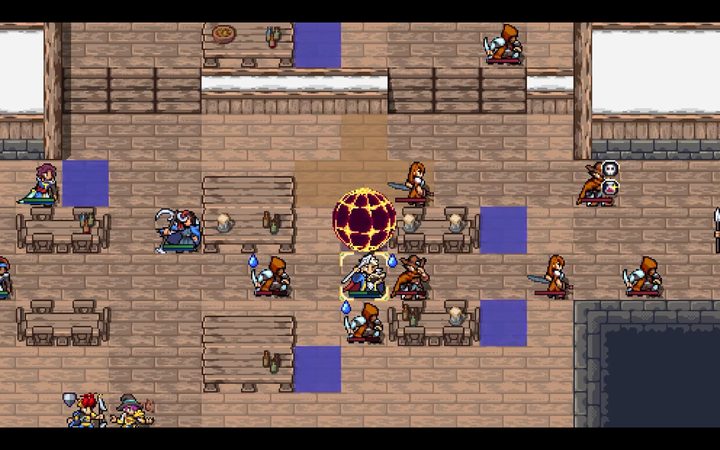
Like most strategy RPGs, characters move like pieces in a game of chess in Dark Deity games. Each has a class like warrior, mage, and rogue. Objectives vary, whether it’s defeating a certain number of enemies, reclaiming a territory, escaping from danger, or something else. Each map also features objectives that can net players extra gold or gems for crafting stat-boosting equipment. If that’s not challenging enough, players can also just increase the difficulty level whenever they want.
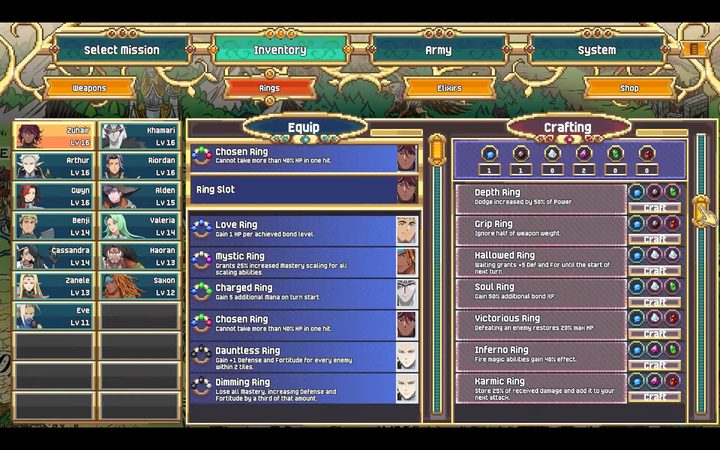
As a Fire Emblem fan, many of the systems felt familiar to me, but still deviated enough from the original that it felt intentional. Dark Deity 2 includes combat forecasts, where I can examine characters and enemies to predict potential damage before committing to a move, and different character classes and abilities that make them stand out. I may need a mage to take on enemies with low fortitude (this game’s version of magic weakness) or archers to attack enemies from afar. Some units might have higher defenses, perfect for baiting out enemies, and more. However, where the two series really differ is in class and stat customization.
Dark Deity 2 gives me room to experiment and learn without making it difficult. I can swap classes whenever I decide I don’t like them, so long as I have the Astral Coins to do so. I can choose between “rolled” and “linear” leveling modes, which give me randomized stat increases or set ones (Stat-boosting in-game items make it possible to even out unlucky rolls). On top of that, all the combat jargon has a definition nearby, in case I forget what certain stats do.
Penalty instead of permadeath
Permadeath, a term for when your character permanently leaves your party after their HP reaches 0 in battle, is a defining feature in Fire Emblem. Back in the day, you had to reset your save file from the beginning of the battle to revive fallen units or accept the loss and move on in the story. Modern Fire Emblem games now include easier game modes where the penalty isn’t as heavy handed, like Phoenix mode where the character revives at the end of the battle and is ready for the next one.
Instead of permadeath, Dark Deity introduced a stat penalty that permanently affected the fallen character. This was still enough of a punishment for me that I would reset a battle if any of my characters fell — like a sick form of self-punishment.
Dark Deity 2’s default option has a better track record of keeping me from resetting and just enjoying the game. Here, when my character is knocked out in battle, they receive a penalty for the next chapter like starting with zero mana or a status condition. It’s only temporary, so it isn’t anything to fret over if you do better next time. But, if a character repeatedly falls in battle, it could be difficult for them to assist allies in future battles. (I still reset if I killed more than one character, but it’s an improvement, I swear!)
I played the original Dark Deity at launch, which is why I started foaming at the mouth when I heard about Dark Deity 2. That said, you don’t need to play Dark Deity (or foam at the mouth) to enjoy its sequel. You can appreciate the context from the first when you play them in order or go back and learn the backstory if you play the sequel first. I’d start with the first one simply because it’s fun to recognize characters from the first game in the new one, like seeing an old friend out in public without meaning to. If you read all the bonding conversations between the main characters, that’s even more of a reason to see where they ended up.
On the other hand, you may want to start with Dark Deity 2 because it’s the most advanced version of the original, polished with new mechanics and more streamlined systems. It’s really up to you. All that matters is that you give the series a try. Heck, grab Dark Deity and buy its swimsuit DLC if you want to go all out.
Dark Deity 2 is available now on PC.