1. Home
  2. Space
  3. News

Check out the first stunning images from the world’s largest digital camera

Add as a preferred source on Google
Distant nebulas captured by the new Rubin Observatory.
This image combines 678 separate images taken by NSF–DOE Vera C. Rubin Observatory in just over seven hours of observing time. Combining many images in this way clearly reveals otherwise faint or invisible details, such as the clouds of gas and dust that comprise the Trifid nebula (top) and the Lagoon nebula, which are several thousand light-years away from Earth. NSF–DOE Vera C. Rubin Observatory

The NSF–DOE Vera C. Rubin Observatory in Chile has unveiled its first images, showcasing the astonishing capabilities of its groundbreaking 3,200-megapixel digital camera, the largest in the world. 

The new $800 million observatory took a decade to build and represents a significant step forward in astronomical research and exploration. Situated at 8,684 feet on Cerro Pachón, near the edge of the Atacama Desert, the facility benefits from a dry and remarkably stable atmosphere, conditions that make it well-suited for astronomical observation.

Recommended Videos

The stunning images, captured during a trial phase that began a couple of months ago, include breathtaking views of the Trifid Nebula and the Lagoon Nebula, both stellar nurseries located several thousand light-years away. The images were created from 678 separate exposures taken across seven hours, revealing intricate details and previously invisible features in vibrant colors.

“NSF–DOE Rubin Observatory will capture more information about our universe than all optical telescopes throughout history combined,” said Brian Stone, the acting NSF director. “Through this remarkable scientific facility, we will explore many cosmic mysteries, including the dark matter and dark energy that permeate the universe.”
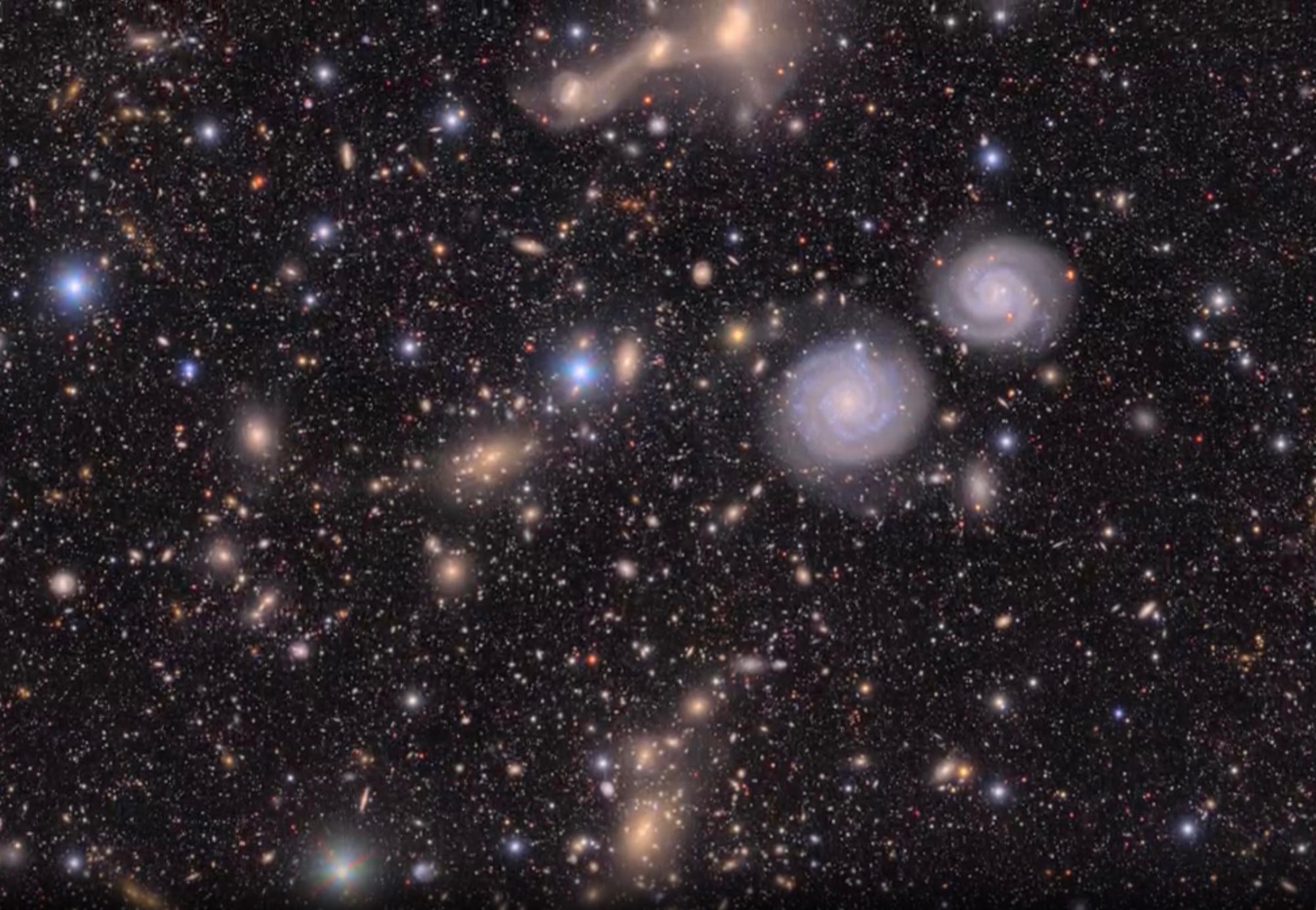
The Rubin Observatory is set to conduct the Legacy Survey of Space and Time (LSST), a 10-year endeavor that’s expected to get underway later this year. The ambitious project aims to map the entire southern sky every three to four nights. The tantalizing result will be an ultra-wide, ultra-high-definition time-lapse record of the universe that should yield a huge number of scientific discoveries. “The images will reveal asteroids and comets, pulsating stars, supernova explosions, far-off galaxies and perhaps cosmic phenomena that no one has seen before,” the Rubin Observatory said.

Across its first 10 hours of observation, the Rubin Observatory has already made notable discoveries, including more than 2,100 previously undetected asteroids, at the same time capturing millions of galaxies and Milky Way stars.

Sandrine Thomas, deputy director of Rubin Construction and associate director of Rubin Observatory for Rubin Summit Operation, said her team was “thrilled” to share the observatory’s first images with the world. “It’s a proud moment for our whole team,” she said. “While we still have a few important months of commissioning and testing ahead, everything we learn now brings us closer to full science operations later this year. Today is just the beginning.”


Trevor Mogg
Contributing Editor
Not so many moons ago, Trevor moved from one tea-loving island nation that drives on the left (Britain) to another (Japan)…
Space is becoming Bezos and Musk’s next data center site, and we have every reason to worry
The AI boom is coming for the night sky
How Vast's space station will look in orbit.

AI data centers already consume vast amounts of electricity and water on Earth, so Silicon Valley has begun looking somewhere considerably more spacious... literally.

Elon Musk's SpaceX and Jeff Bezos' Blue Origin, along with several other companies, have proposed enormous constellations of satellites designed to operate as orbital data centers. However, environmental groups and former space officials are now warning that putting them into orbit at the proposed scale could have severe consequences for Earth's atmosphere and the night sky.

Read more
The first possible exomoon is here, and it makes our Moon look hilariously tiny
Scientists may have found the first exomoon, except this one is the size of Jupiter
This artist’s concept depicts a potential volcanic moon between the exoplanet WASP-49 b, left, and its parent star. New evidence indicating that a massive sodium cloud observed near WASP-49 b is produced by neither the planet nor the star has prompted researchers to ask if its origin could be an exomoon.

We have already discovered more than 6,000 planets outside of our immediate neighborhood. Yet, finding a moon orbiting one of those distant worlds has proved considerably harder. Astronomers may finally have something close to the real deal, but this particular object stretches the word “moon” almost beyond recognition.

Using the European Southern Observatory’s Very Large Telescope in Chile, researchers detected strong evidence for a moon-like object in the CD-35 2722 system. Further observations are still necessary to confirm the discovery, but it could become the first confidently detected natural satellite outside our solar system. There is still one tiny complication though. This moon is apparently massive.

Read more
China’s answer to SpaceX’s reusable rockets literally catches boosters in a net
SpaceX catches boosters on legs. China just used a net.
Ammunition, Missile, Weapon

SpaceX's playbook for recovering a rocket booster generally involves legs, a precisely controlled vertical landing, and either a concrete pad or a drone ship. 

China just managed to pull off something similar, but in a slightly different way, and on July 10, it tested the method as well.

Read more